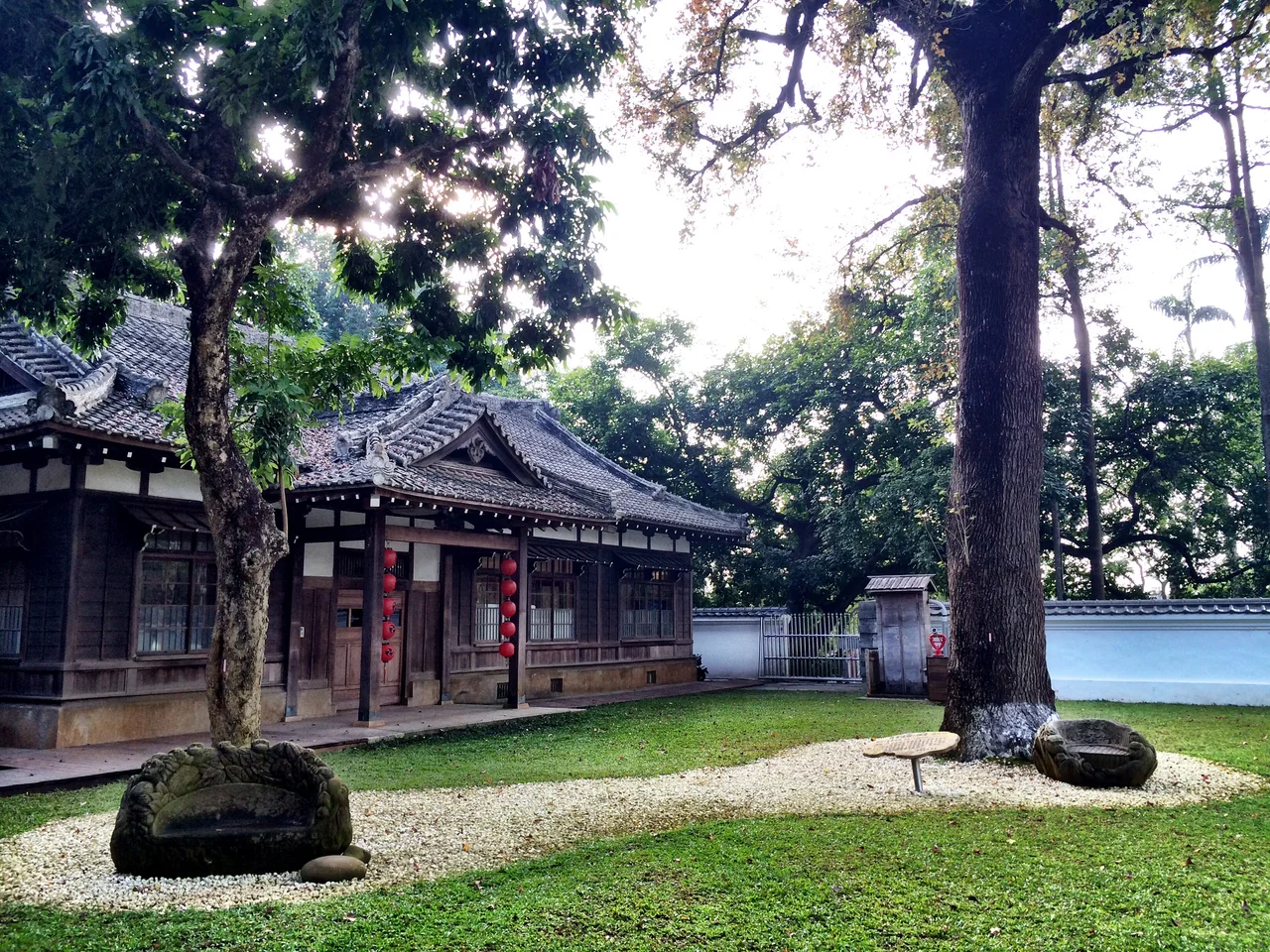

Kagi Shrine
What survives of the Kagi Shrine is not the shrine itself. The main hall burned in a fire on 24 April 1994, fifty years after it had been redesignated by the Republic of China government as a martyrs' shrine honoring soldiers who died fighting for a different political cause than the one it was originally built to serve. What remains in Chiayi Park is a collection of stone objects and wooden buildings that have outlasted multiple regimes, multiple purposes, and multiple attempts to make the site mean something new: a temizuya purification pavilion, a sandō approach pathway, stone tōrō lanterns, komainu guardian statues, and two wooden structures built in the classical Japanese shoin-zukuri style. Together they form one of the most historically layered sites in a city that has accumulated more colonial sediment than most.
Built for the Gods of Empire
The Kagi Shrine was built on 28 October 1915 — in the Japanese imperial calendar, the fourth year of the Taishō era — on a hill in what was then called Soa-a-teng in Kagi City, Tainan Prefecture. The shrine faced south initially, which is unusual; most Shinto shrines face south or east toward the sun, but the original orientation here was later altered to face west in 1942. Designated as a prefectural shrine in 1917, the Kagi Shrine was elevated in rank in 1944 — near the end of the Pacific War, when the colonial government was consolidating sacred sites to shore up imperial morale. The deities enshrined were Prince Yoshihisa, who died during the Japanese campaign in Korea in 1895; Ōnamuchi no Mikoto, a Shinto deity of nation-building; and Amaterasu, the sun goddess and imperial ancestor. The shrine was simultaneously a place of worship and a mechanism of colonial authority, its sacred geography inscribed onto land that had belonged, before Japanese administration, to a different set of inhabitants with a different set of beliefs.
The Layers Accumulate
When Japan surrendered in 1945 and the Republic of China government took control of Taiwan, the Kagi Shrine faced the fate that met most Shinto shrines across the island: repurposing. The main hall — the honden — was converted into a martyrs' shrine dedicated to soldiers who had died fighting for the ROC, particularly in the resistance against the Japanese. This was not mere pragmatism. Turning a Japanese imperial shrine into a Chinese nationalist memorial was an act of symbolic displacement, writing one state's dead over another's sacred space. For nearly five decades the site served this function. Then, in 1994, fire destroyed the main hall entirely. The martyrs' shrine was gone. The question of what to do with what remained — the subsidiary wooden buildings, the stone elements, the grounds — was answered in 1998 when the Chiayi Tower was built in the main hall's place.
The Sun-Shooting Tower
The Chiayi Tower, completed in 1998, stands where the shrine's main hall once stood. Its design draws not from Japanese or Chinese nationalist symbolism but from the mythology of Taiwan's indigenous peoples — specifically an aboriginal legend about a hero who shoots an extra sun out of the sky to save the world from heat and drought. The tower is called the Sun-Shooting Tower in Chinese, and it houses an observation deck from which visitors can look out over Chiayi City and the surrounding plain toward the mountains. The choice of an indigenous mythological theme for a structure on a site that had been successively Japanese and Chinese Nationalist feels pointed — or perhaps simply pragmatic in a different way, reaching for a layer of Taiwanese identity that predated both colonial powers. Whatever the intent, the result is a site where three distinct historical moments exist in physical proximity: the stone remnants of the Shinto shrine, the open ground where the martyrs' shrine burned, and the tower whose myth belongs to neither of the two regimes that preceded it.
What the Stone Remembers
The wooden structures that survived — the shamusho (administrative office) and haiden (worship hall) complex, built in the shoin-zukuri style — underwent restoration and opened as the Chiayi City Historical Relics Museum on 5 January 2001. The building now houses artifacts and documents from Chiayi's history, performing a curatorial function that is itself a kind of layering: colonial-era architecture repurposed for the preservation of historical memory. In the surrounding park, the stone elements of the shrine's original ritual architecture endure: the temizuya where worshippers purified their hands before approaching the gods, the sandō pathway that once oriented the approach to the sacred, the stone tōrō lanterns that lined the approach, and the komainu lion-dog statues that guard shrine gates across Japan. These objects were built to last. They have outlasted the shrine, the martyrs' memorial, and the political certainties of every regime that tried to make this ground mean something definitive.
A Park That Doesn't Let You Forget
Chiayi Park today is a functioning city park — shaded paths, the zoo nearby, families and school groups and people walking dogs. The Kagi Shrine remnants are integrated into the park rather than cordoned off, which means you can encounter a stone lantern from a Japanese imperial shrine while sitting on a bench, or walk the old sandō toward the Chiayi Tower without necessarily registering that you are tracing the path that once led to a honden enshrining imperial Japanese deities. This casualness is part of what makes the site unusual. Taiwan has not resolved what to do with its Japanese colonial heritage — it has, in many ways, simply kept it, absorbed it into daily life, allowed it to coexist with later histories in the same physical space. The komainu still face each other across the pathway. The lanterns still stand. The fire took the main hall but left the grammar of the place intact, and you can still read it if you look.
From the Air
The Kagi Shrine site (now Chiayi Park) is located at approximately 23.481°N, 120.469°E in central Chiayi City, Taiwan. From the air at 1,500 to 2,500 feet, Chiayi Park appears as a green zone in the urban grid, with the Chiayi Tower visible as the tallest landmark within the park. The nearest airport is Chiayi Airport (RCKU), approximately 3 km to the west-southwest. The Alishan mountain range is visible to the east on clear days. The park is positioned between the older city center to the west and the East District heritage cluster — Hinoki Village, the Old Prison — slightly to the northwest.
Nearby Stories
- Paiyun Lodge 1.2 km away
- Wushantou Reservoir 4.3 km away
- 1999 Jiji Earthquake 6.5 km away
- Xiluo 7.4 km away
- Bunun Cultural Museum 27 km away
- TransAsia Airways Flight 222 28 km away
- Mudouyu Lighthouse 29 km away
- Daya Bay 551 km away