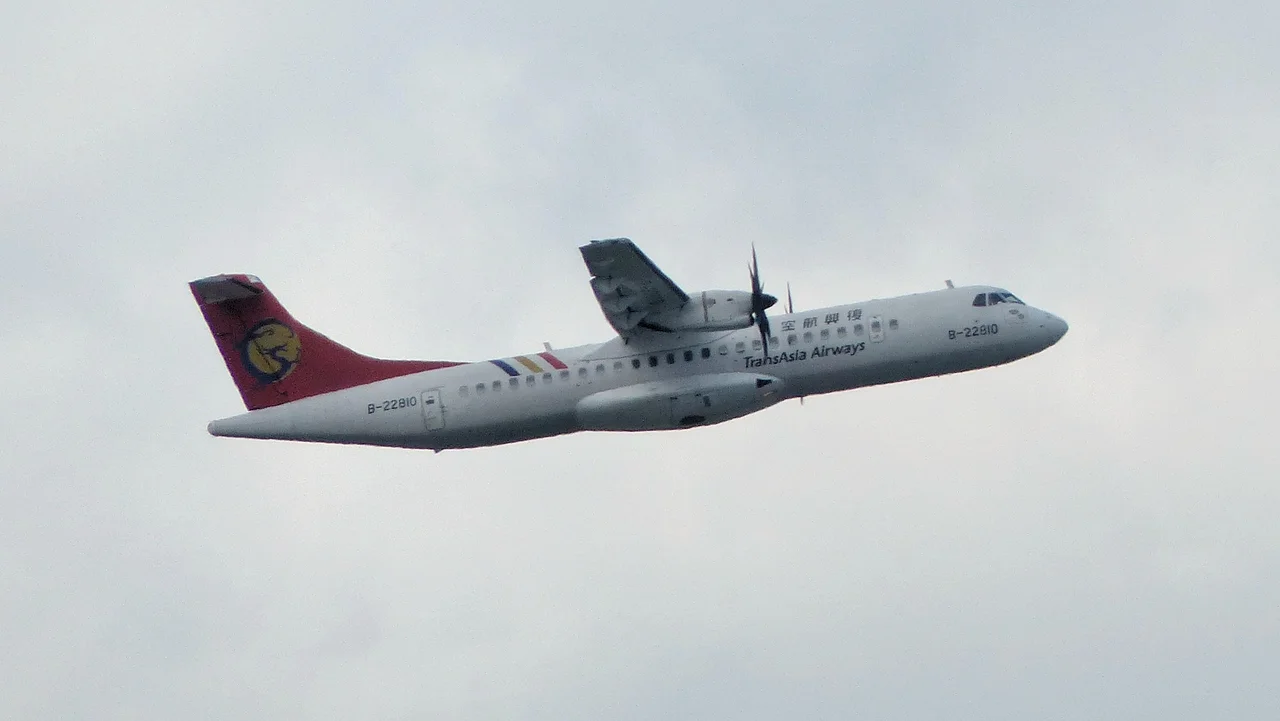

TransAsia Airways Flight 222
The flight from Kaohsiung to Magong takes about forty minutes on a clear day. On the evening of 23 July 2014, there were no clear days in Penghu. Typhoon Matmo had crossed Taiwan earlier, and although Taipei Center had reopened the airspace, warnings remained in effect specifically for the islands — warnings that the weather around Penghu would stay severe. Flight GE222, a TransAsia ATR 72-500 carrying 54 passengers and a crew of four, began its approach to Magong Airport as those conditions closed in. It did not land safely. Forty-eight of the 58 people aboard died. Ten survived.
The People on Board
Among those aboard Flight 222 were families, children — four of the 54 passengers were reported to be children — and people traveling the short domestic route between Kaohsiung and Penghu that TransAsia operated regularly. Two French citizens were on the flight. Forty-six of those who died were Taiwanese, including all four crew members.
One of the passengers was Yeh Ken-chuang, a recognized Taiwanese master carpenter whose craft had earned him distinction in his field. He did not survive. The lives cut short that evening represented the full range of what a routine domestic flight carries: people going home, people visiting family, people on business, children.
Ten people survived the crash. Their accounts of the final approach — turbulence, thunder and lightning, the aircraft shaking as it descended into the storm — form part of the factual record of what the 58 aboard experienced in those last minutes.
The Evening the Flight Came Down
Flight 222 was scheduled to depart Kaohsiung at 4:00 p.m. local time. Bad weather pushed the departure back; the aircraft finally lifted off at 5:43 p.m. The flight proceeded normally until the approach to Magong Airport (RCQC), where visibility had deteriorated sharply.
Kaohsiung Approach Control held Flight 222 in a holding pattern with three other aircraft while conditions were assessed. A report of improved visibility reached the crew, and they requested landing clearance. At 6:55 p.m. the aircraft was cleared to land. The approach continued. The crew descended through assigned altitudes — 2,000 feet, then 400 feet — and then set an altitude below the minimum descent altitude of 330 feet. The investigation would later establish that the crew continued the approach at 300 feet, then 200 feet, without visual contact with the runway environment.
At 7:00 p.m., Captain Lee Yi-liang told the passengers to prepare for landing. Moments later, Flight 222 struck terrain and exploded. It had crashed into buildings in a residential area near the airport.
Storm and Investigation
Typhoon Matmo had passed most of Taiwan by the time Flight 222 approached Magong, but the center of the storm was only 23 nautical miles from Penghu Island. Satellite imagery showed the area coded severe at 6:57 p.m. Survivors reported turbulence with thunder and lightning on the approach. Tower personnel confirmed that visibility at Magong had been drastically reduced, though it briefly improved — the information that had prompted the crew to request their landing clearance.
Taiwan's Aviation Safety Council conducted the official investigation. The flight data and cockpit voice recorders were recovered. The findings, published in the final report, were clear: this was a controlled flight into terrain. The crew had continued the approach below the minimum descent altitude without being able to see the runway. The investigation found the captain had a disregard for procedures and regulations — a pattern the report characterized as an 'Anti-Authority' attitude — and that his overconfidence contributed directly to the accident.
TransAsia Airways tightened its operating procedures afterward, requiring visibility at arrival airports to be 50 percent above published minimums before an approach is attempted, and limiting holding time to thirty minutes before diverting.
Aftermath and Memory
TransAsia Airways acknowledged the disaster immediately. General manager Chooi Yee-choong offered a public apology on the day of the crash. On 25 August 2014, the airline announced compensation of NT$14.9 million for each of the 48 victims — the highest compensation rate a Taiwanese airline had paid to crash victims since the 2002 China Airlines Flight 611 disaster.
Flight 222 did not end TransAsia's accidents. Seven months later, in February 2015, another TransAsia ATR 72 — Flight 235 — crashed shortly after takeoff from Taipei, killing 43 people. The airline ceased operations entirely in November 2016.
The 48 people who died on 23 July 2014 came to Penghu as passengers on a short domestic hop. The airspace near Magong Airport, familiar to crews who flew the route regularly, was that evening something the minimum altitudes were designed precisely to protect against. Those protections were not followed. The ten who survived carried their experience of that evening home from Penghu. The forty-eight did not.
From the Air
The crash site is located near Magong Airport (RCQC) at approximately 23.58°N, 119.64°E, in the eastern approach corridor to Runway 20. RCQC sits on Penghu's main island; approaches from Kaohsiung arrive from the southeast. The airport's minimum descent altitudes for instrument approaches exist specifically because of the terrain and obstacle environment in the approach path. Typhoon season — roughly June through October — brings rapidly changing visibility conditions at RCQC; Penghu's open-ocean exposure means fronts and storm remnants can tighten without warning. When Taipei Center issues warnings of post-typhoon inclement weather around Penghu, those warnings reflect conditions that are operationally significant.
Nearby Stories
- 1904 Douliu Earthquake 7.1 km away
- Yanshuei District 8.2 km away
- China Airlines Flight 611 9.7 km away
- Fangyuan Lighthouse 12 km away
- Dongji Island 15 km away
- Nanxiong Formation 436 km away
- Daya Bay 483 km away
- Battle of Xiapi 1166 km away