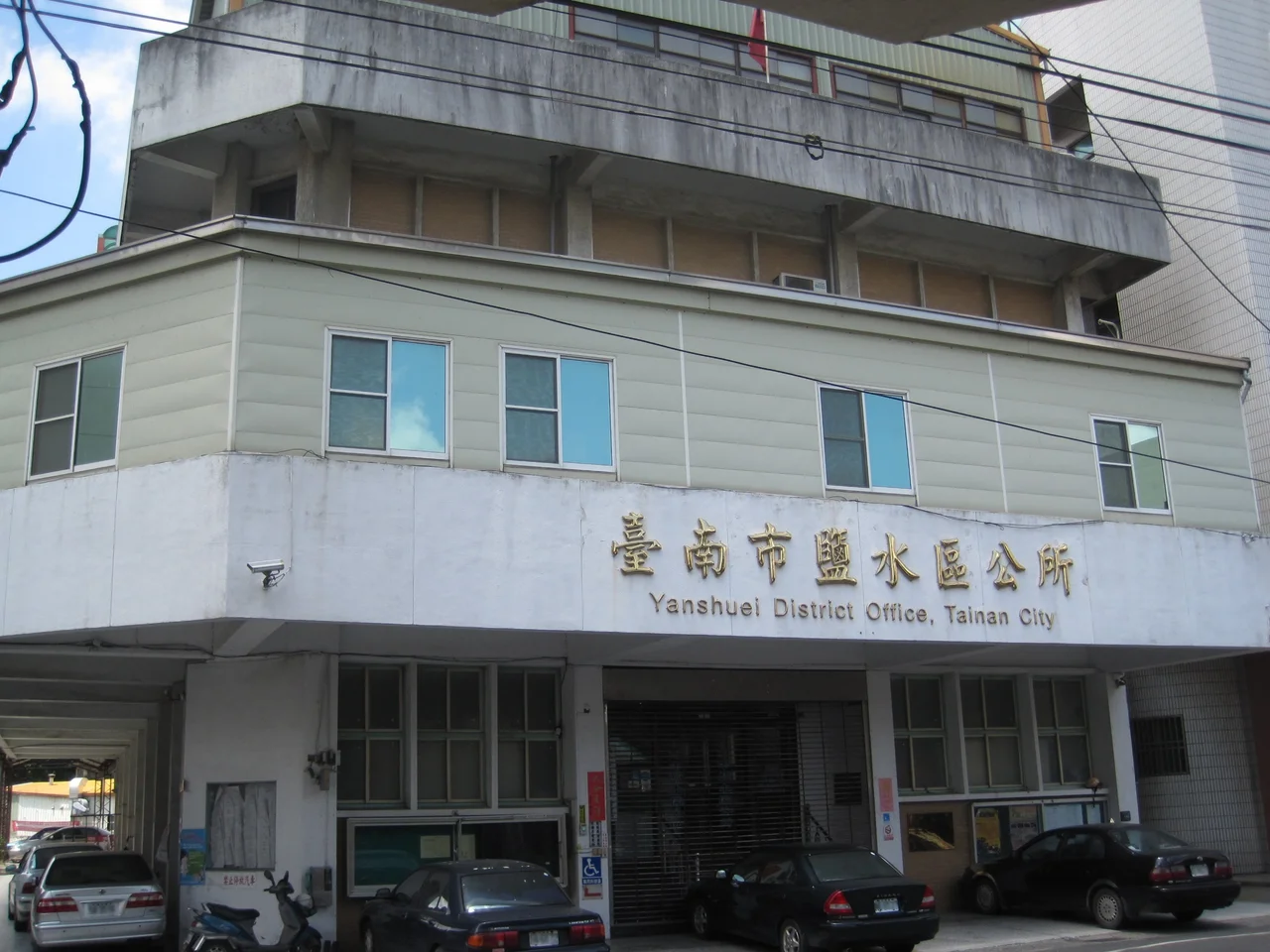

Yanshuei District
Every year, fifteen days after the Lunar New Year, the people of Yanshuei put on helmets, layer themselves in fireproof clothing, and walk toward the rockets. This is not recklessness. It is devotion. The Beehive Fireworks Festival — called Fengpao — sends thousands of bottle rockets arcing outward from iron-and-wood launcher frames into the night sky and, frequently, into the crowd itself. Being struck is considered good fortune. The more hits, the better the year ahead. Spectators who understand this lean in. Those who do not are turned away.
A Port Town That Lost Its Harbor
Yanshuei's original identity was maritime. Known in earlier centuries by its Hokkien name — roughly transliterated as Goat-tin-kang — it was one of the five most important port towns in Taiwan, a status it carried through the Qing period and into the Japanese colonial era. That standing ended in 1900 when the harbor closed, likely a consequence of silting and the shift of trade routes to deeper, more accessible ports. The town restructured itself around what remained. Rail service once connected Yanshuei to the wider network; the Taiwan Sugar Corporation operated passenger trains to Yanshuei station, which has been preserved. Today, there are no rail links. The preserved station stands as evidence of a connection that was once taken for granted.
The Epidemic Behind the Festival
The Beehive Festival did not begin as entertainment. Around 1875, near the end of Qing-era rule in Taiwan, a cholera epidemic broke out in Yanshuei and lasted for more than twenty years. Disease of that duration and that lethality left communities desperate for any remedy. The survivors turned to ritual. They invited the spirit of Guan Yu — the Chinese god of war, also venerated as the patron saint of businessmen — to pass through the town, his statue carried in palanquins through the streets while firecrackers were detonated to drive out the evil forces believed to carry disease. According to local tradition, the epidemic receded. The ritual was repeated the following year, and the year after that, and has continued ever since. What began as an act of collective desperation became an annual observance.
The Mechanics of the Beehive
The launchers that give the festival its name are extraordinary objects. Thousands of bottle rockets are arranged row upon row in iron-and-wooden frameworks — the setup resembling, in the dim light before ignition, a giant beehive packed with coiled energy. When the frame is lit, rockets shoot outward in all directions simultaneously, whizzing and spiraling across the sky. The crowd, prepared for this, presses in rather than retreating. Local adherents believe that being struck by a rocket brings good luck proportional to the number of hits received. The devout dress accordingly: multiple layers of clothing, modified motorcycle helmets reinforced with fire-retardant material, an extended drape protecting the back of the neck, a flexible gorget at the front. A towel around the neck is strongly advised for anyone not wearing full protection, as hearing loss from a rocket entering a helmet is a documented risk.
Contested and Continuing
Spectators have been injured. Moves to restrict or ban the festival have been made. It continues anyway. The persistence of Fengpao reflects something about Yanshuei's relationship with its own history — a community that remembers what the epidemic took and what the ritual gave back. The festival draws visitors from across Taiwan and increasingly from abroad, people who come specifically for the experience of standing in a crowd where rockets are considered blessings rather than hazards. Safety equipment is available locally. First-timers are advised to wear it. The festival takes place on the fifteenth day of the Lunar New Year, also known as the Shang Yuan Festival or Lantern Festival — the same evening that sky lanterns rise over towns across Taiwan.
A District Finding New Purposes
Yanshuei covers 52.25 square kilometers and is home to roughly 24,000 people. The district became part of Tainan City in December 2010, when Tainan County was merged with Tainan City — an administrative consolidation that connected this former port town to the resources of one of Taiwan's largest urban centers. The historic Ciaonan Street preserves some of the architectural character of Yanshuei's trading past. The old station building remains. The harbor it once served is gone. What endures is the festival — the one night each year when a quiet district of 24,000 people becomes a destination, and the sky above the town fills with light and the sound of ten thousand small explosions, and the crowd leans forward to receive them.
From the Air
Yanshuei District lies at 23.3052°N, 120.243°E in the western lowlands of Tainan, on the flat agricultural plain between the coast and the foothills. The district is approximately 25 km north of central Tainan and 40 km south of Chiayi. Nearest airport is RCNN (Tainan Airport), approximately 30 km to the south. From the air, the district appears as a grid of agricultural fields and low-rise development. The old town center, with Ciaonan Street and the preserved rail station, is not visually prominent but sits near the district's geographic center.
Nearby Stories
- Yakou Mountain Pass 3.6 km away
- Xingang, Chiayi 6.2 km away
- Siraya Language 13 km away
- Dongji Island 22 km away
- Kunci Temple 23 km away
- 1999 Jiji Earthquake 25 km away
- TransAsia Airways Flight 222 25 km away
- Daya Bay 549 km away