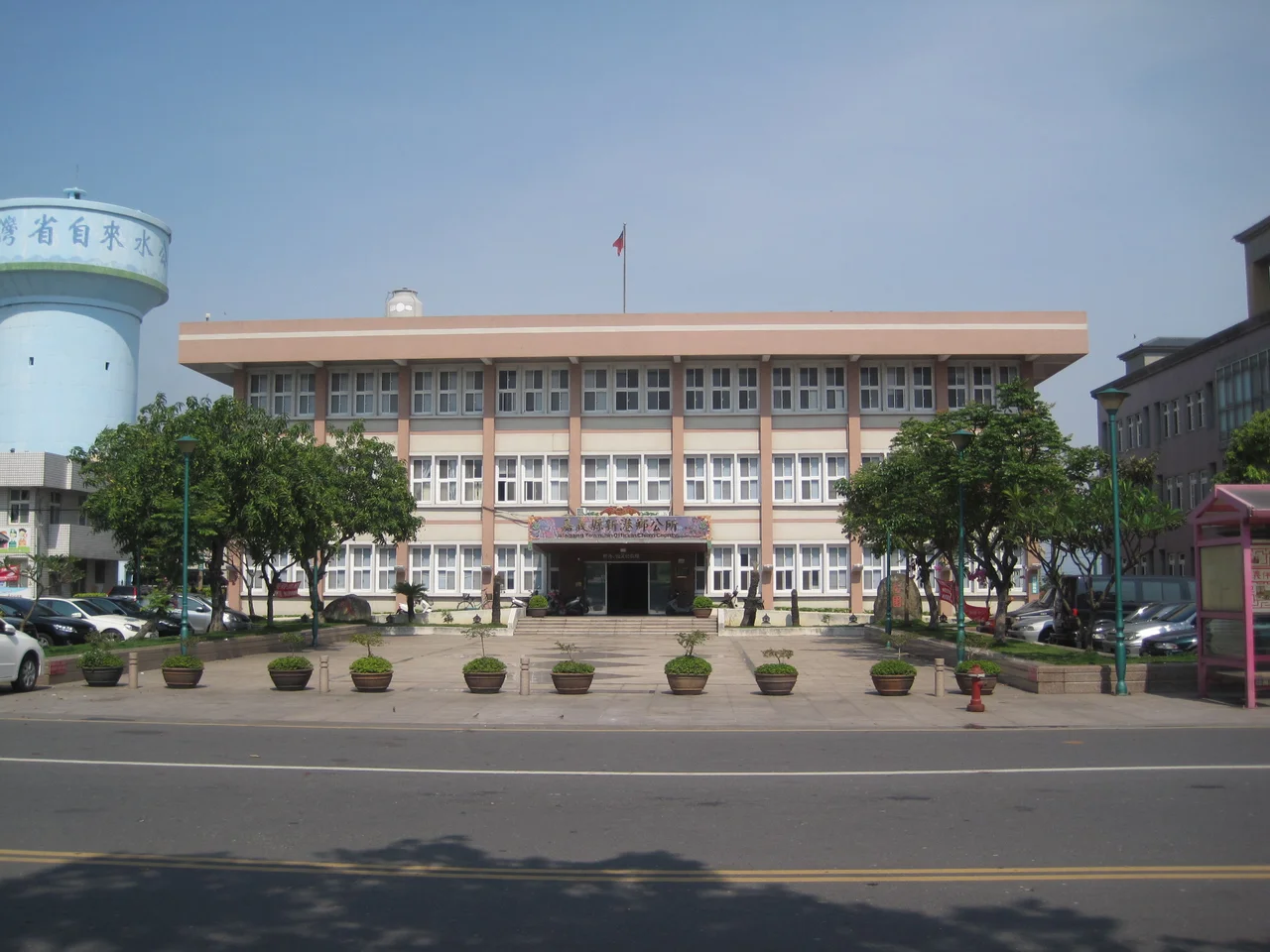

Xingang, Chiayi
Cloud Gate Dance Theatre — the company that put Taiwanese contemporary dance on the world stage — was founded by a man from Xingang. Lin Hwai-min grew up in this small Chiayi County township surrounded by the folk religion, agricultural rhythms, and temple processions that would eventually find their way into some of the most acclaimed dance works in Asia. Xingang itself is quiet, dense, and intensely religious, anchored by the Fengtian Temple that draws pilgrims from across Taiwan every year. The town shaped the artist; the artist made the town's name recognizable far beyond the island.
A Township Held Together by Temples
Xingang Township covers 66.05 square kilometers and holds about 30,000 people across 22 villages — figures that make it modest by any measure. But its density of religious sites is remarkable even by the standards of Taiwan, where folk temples are woven into the urban fabric as naturally as convenience stores.
The Fengtian Temple is the anchor: a Mazu temple of national significance, designated as a county-level monument in 1985, and the endpoint of the famous Dajia Mazu Pilgrimage that draws hundreds of thousands of participants each spring. But Fengtian Temple is not alone. Xingang is also home to the Bengang Shuixian Temple, the Bengang Tianhou Temple, Dasing Temple, Dengyun College, Liousing Temple, and the Southern Altar Shueiyue Nunnery, among others. For a town of 30,000, that's an extraordinary accumulation of religious architecture. Temple festivals here aren't occasional events; they're the texture of local life, recurring through the year in overlapping cycles of devotion.
The Goddess at the Center
Mazu is the sea goddess of Chinese folk religion — originally venerated by fishing communities along the Fujian coast, and carried across the Taiwan Strait by the migrants who settled Taiwan over centuries. In Xingang, the Fengtian Temple's Mazu is no ordinary local deity. The temple's claim that its Mazu statue originated with the Dajia Mazu pilgrimage tradition has made it a destination of extraordinary significance. Pilgrims who walk for days to arrive here are not only fulfilling a religious obligation; they're completing a geographical and spiritual circuit that connects the Taiwan Strait coast to the agricultural interior.
The Xingang Mazu Temple referenced in the source article — distinct from the Fengtian Temple but equally devoted to Mazu — organizes annual inspection-tour processions through southern Taiwan and pilgrimages to Mazu temples in mainland China, where a branch temple has been established in Yongchun. This cross-strait religious connection is one of the more striking aspects of Xingang's religious life: the temple maintains active relationships with sites in Fujian Province, the ancestral homeland of most Taiwanese Hoklo communities.
Lin Hwai-min's Xingang
Lin Hwai-min was born in Xingang in 1947, the son of a township magistrate. He left to study in the United States, trained with Martha Graham in New York, and returned to Taiwan in 1973 to found Cloud Gate Dance Theatre — the first professional contemporary dance company in any Chinese-speaking society. The name came from an ancient Chinese text, a ritual dance described in records dating to the Zhou dynasty.
What Lin brought back from Xingang was harder to name than technique. The folk religion, the temple processions, the physical vocabulary of devotion that he had watched as a child — these found their way into Cloud Gate's most celebrated works, which drew on Taiwanese and broader Asian traditions to create something entirely new. Lin has spoken in interviews about the influence of his hometown's religious culture on his artistic sensibility. Xingang, in turn, can reasonably claim some credit for one of the defining artistic achievements of twentieth-century Taiwan.
The Singang Railway Park and a Town's Memory
At the edge of town, the Singang Railway Park preserves the memory of the narrow-gauge rail lines that once connected Xingang to the sugar industry infrastructure of the broader region. Sugar production shaped the economy of western Taiwan's lowlands for most of the Japanese colonial period and well into the post-war decades, and the light rail networks that served the mills became part of the landscape. The park repurposes that heritage for recreational use — a common approach in Taiwan, where industrial-era rail infrastructure has been thoughtfully converted in several locations.
Xingang also has a school of the arts — the National Singang Senior High School of Arts — that gives the town an institutional connection to creative practice unusual for a rural township. Whether through its temples, its most famous native son, or its school, Xingang has managed to tie its identity to something more than its agricultural surroundings. The flat fields of Chiayi County press in on all sides. Inside the town limits, there's a lot going on.
The Plain and Its Communities
The Chiayi Plain is wide and productive, given over to rice, sugarcane, and vegetables that feed the broader population of southern Taiwan. Xingang sits in the middle of this agricultural landscape, its town center compact and dense the way Taiwanese township cores tend to be — a maze of narrow streets, scooters, morning markets, and temple gates opening unexpectedly off alleys.
Linguist Ang Ui-jin, who worked on the study of Taiwanese languages and was born in Xingang, represents another dimension of the town's outsized contribution to Taiwanese intellectual life. The Legislative Yuan member Hsu Chih-chieh and former Examination Yuan Vice President Lin Chin-sheng round out a roster of notable natives that's impressive for a community this size. Xingang doesn't have the population or the infrastructure of Taiwan's cities. What it has is a deep root system — in religion, in art, in the people it has sent out into the world.
From the Air
Xingang Township is centered at approximately 23.56°N, 120.35°E in the flat Chiayi Plain of southwestern Taiwan. From the air, the town appears as a compact grid of streets surrounded by agricultural fields, with the Fengtian Temple complex distinguishable as a larger-footprint structure in the town center. The coastline of the Taiwan Strait lies roughly 20 kilometers to the west. Chiayi Airport (RCKU) is approximately 12 kilometers to the southeast and serves as the nearest commercial airport. The Central Mountain Range is visible to the east on clear days. Recommended viewing altitude is 2,000–4,000 feet to see both the town's layout and the surrounding agricultural landscape of the Chiayi Plain.
Nearby Stories
- Puli 7.3 km away
- Guanzihling 11 km away
- Fangyuan Lighthouse 11 km away
- Yakou Mountain Pass 13 km away
- 1999 Jiji Earthquake 15 km away
- China Airlines Flight 611 23 km away
- TransAsia Airways Flight 222 26 km away
- Dongji Island 26 km away