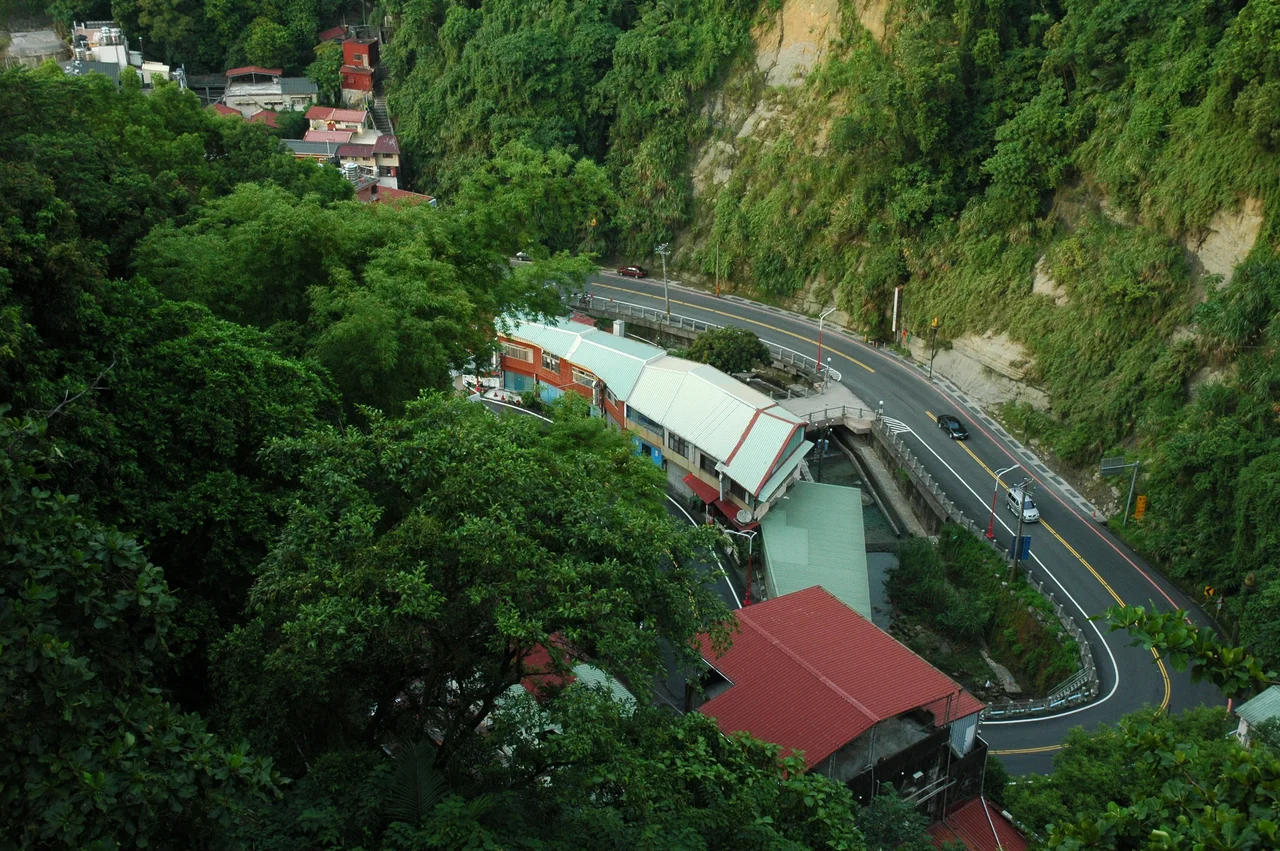

Guanzihling
Most hot springs run clear. At Guanzihling, the water is grey. It comes out of the earth carrying fine volcanic silt — a mineral suspension that coats the skin and, according to the spring's devoted regulars, does things to it that clear water cannot. The mud hot springs of Guanzihling (關子嶺) are, by most accounts, one of only three of their kind in the world, the others being in Kagoshima, Japan and on the Italian island of Vulcano. In the foothills above the plains of Tainan, tucked between old resort hotels and newer hilltop villas, this unusual water has been drawing people for well over a century.
Two Villages, One Valley
Guanzihling divides naturally into two zones separated by a hill. At the bottom of the valley, closer to the hot spring source, the older part of town clusters around the original resorts — buildings that have seen better decades but retain a worn, unhurried charm. Up the hill at the summit, newer establishments have been built to serve travelers who want mountain views alongside their thermal soak. The two areas are connected by a winding main road of about two kilometers, a wooden stairway that passes the spring source itself, and a pedestrian staircase — called 好漢坡, or 'Hero's Slope' — of approximately 300 steps. The name suggests the climb is not for the uncommitted.
The Mud Itself
The treatment at Guanzihling is simple and slightly absurd in the best possible way. You submerge in a pool of warm, grey, silty water. You emerge coated. You wait a few minutes while the mineral-laden mud dries on your skin, then rinse off in a cleaner pool and repeat. The water's reputation for treating skin conditions, particularly allergies, draws visitors who have exhausted other options. Whether the science fully supports the claims is debated; the experience itself is less debatable. Resorts in the old quarter offer the full progression — fish pedicures where small carp graze on dead skin, foot baths, pools at 43.5°C, moderate pools at 39°C, and cold plunge pools at 17°C. Dry hot spring mud, packaged for home use, fills every souvenir shelf in town.
Getting There and Getting Around
Guanzihling is not unreachable, but it requires intention. From Tainan, the most straightforward approach is the Taiwan Railways Authority (TRA) local train to Houbi station — about 30 minutes — followed by a taxi of around 25 minutes to the springs. From Chiayi, buses depart hourly from the Zhongshan Road station, passing through Baihe before terminating near the Toong Mao resort at the summit, with the journey taking about an hour. Taxi drivers from both cities know Guanzihling well; the phrase 'King's Garden Villa' is apparently recognizable without Mandarin. One consistent piece of advice for first-timers: take your taxi driver's phone number before they leave. In the hot spring district, return transport does not wait around.
Old Springs, New Interest
Guanzihling's popularity has grown steadily as Taiwan's domestic travel scene has expanded. The springs are close enough to Tainan and Chiayi to attract day-trippers but far enough into the hills to feel like a destination. The hilltop resorts, newer and more polished, cater to visitors who want a full overnight stay in the mountains with thermal bathing as the centerpiece. The older valley establishments serve those who want the original experience without the premium pricing. Neither version requires much planning: show up, soak, repeat. The mud does not care how far you came or what time you arrived.
A Rarity in the Foothills
What makes Guanzihling genuinely unusual is not the resort culture around it — Taiwan has many hot spring towns — but the specific character of the water. Mud hot springs of this type require a precise combination of geological conditions: volcanic activity, particular mineral compositions in the rock, and a water source that carries the fine silt up through the earth without clarifying it on the way. That this combination exists in southern Taiwan's foothills, rather than in more obviously volcanic terrain, makes Guanzihling something of a geological surprise. The alternative name spellings — Guanziling, Kuantzuling, Kuantzeling — reflect decades of romanization inconsistency, but the place itself is unambiguous. There is nothing else quite like it.
From the Air
Guanzihling sits at 23.3333°N, 120.50°E in the foothills east of Tainan's coastal plain, where the terrain rises toward the Central Mountain Range. The valley is visible from the air as a green fold in the hills, with the resort buildings clustered along the valley floor and the summit area visible atop the ridge. Nearest airports are RCNN (Tainan Airport), approximately 35 km to the southwest, and RCKU (Chiayi Airport), approximately 30 km to the northwest. Flying east from Tainan, the transition from flat agricultural plain to forested foothills is abrupt and visually striking.
Nearby Stories
- Yakou Mountain Pass 3.6 km away
- Xingang, Chiayi 6.2 km away
- Siraya Language 13 km away
- Dongji Island 22 km away
- Kunci Temple 23 km away
- 1999 Jiji Earthquake 25 km away
- TransAsia Airways Flight 222 25 km away
- Daya Bay 549 km away