
Nanxiong Formation
Sixty-six point seven million years ago, the world was about to end for the dinosaurs — and in a basin tucked into the mountains of northern Guangdong, some of the last of them left behind extraordinary evidence of their final chapter. The Nanxiong Formation is that evidence: a thick band of deep red rock, compressed from ancient river sediments, that preserves a remarkable snapshot of life at the very close of the Cretaceous period. Farmers have been pulling strange bones and eggs from these ruddy soils for generations. Scientists have been following ever since.
Red Rock, Deep Time
Drive north from Guangzhou toward the border with Jiangxi and the landscape shifts. The subtropical lowlands give way to folded hills, and the soil turns a vivid, almost rusty red. That color tells the geological story: the Nanxiong Basin formed when Mesozoic rifting split the underlying Jurassic granite apart, creating a graben — a sunken block of crust bounded by faults — that trapped sediment from ancient rivers for millions of years. The result is a thick accumulation of siliciclastic red beds, the kind geologists call continental deposits because they formed not beneath an ancient sea but on land, along floodplains and river channels where dinosaurs lived and died. The formation has been dated to approximately 66.7 million years ago, placing it right at the boundary between the Cretaceous and the Paleogene — the moment the asteroid struck, the skies darkened, and the non-avian dinosaurs disappeared.
A Cast of Extraordinary Creatures
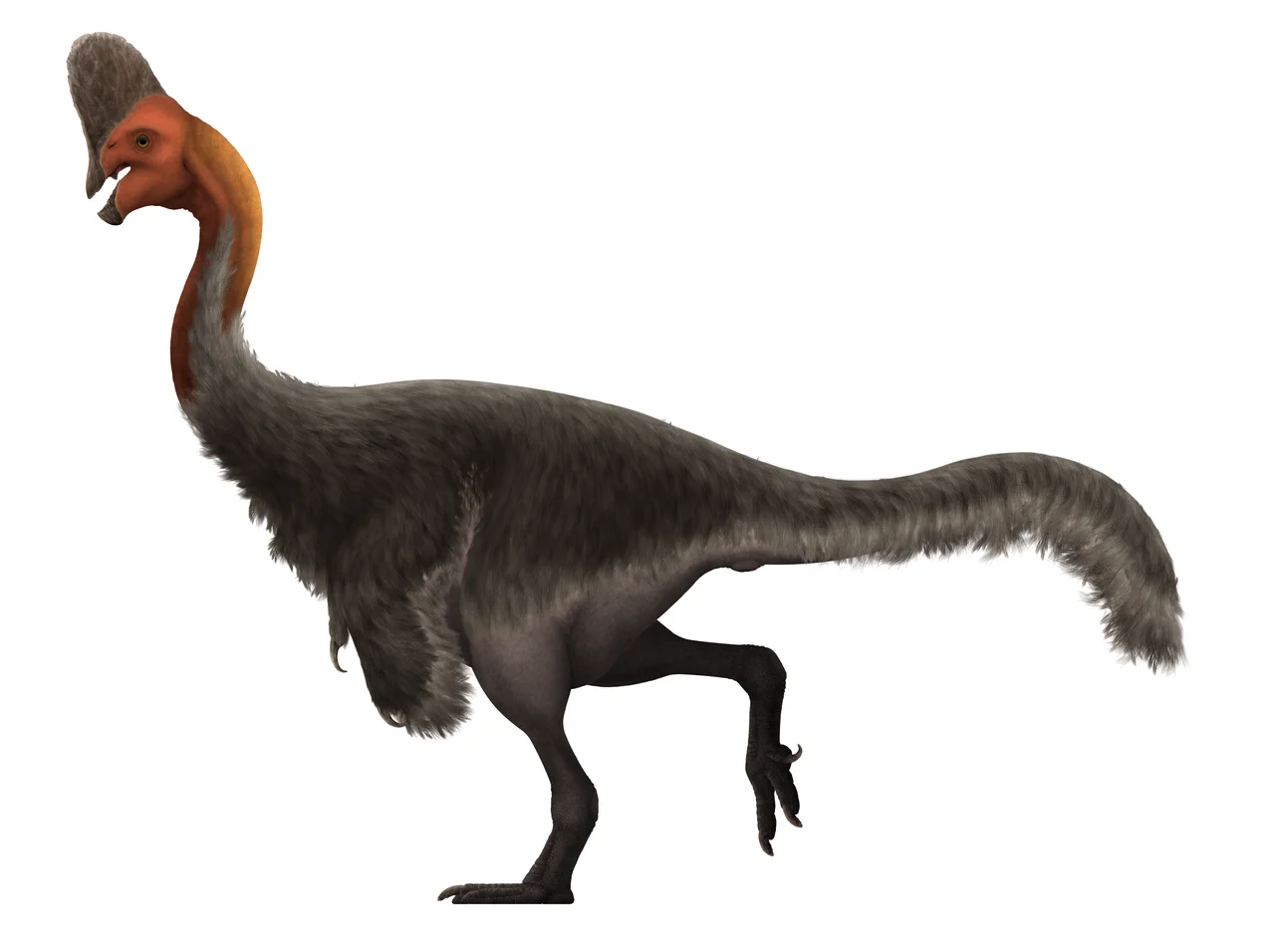
The Nanxiong Formation has produced a fauna strikingly rich in variety. Sauropods lumbered through — titanosaurian giants whose fossilized remains include several newly described species, among them Gandititan cavocaudatus, formally named in 2024, which extended the known diversity of long-necked dinosaurs right to the end of the Cretaceous. Theropods prowled alongside them: oviraptorosaurs with elaborate crests, therizinosaurs with scythe-like claws, and tyrannosaurs — including a deep-snouted species described as recently as 2024 — that represent a distinct Asian lineage quite different from their North American cousins. Ornithopods left tracks pressed into ancient mud, now lithified and studied alongside pterosaur footprints from the same beds. Large predatory lizards — some reaching impressive size — rounded out an ecosystem that in broad outline resembled the Nemegt Formation of Mongolia, suggesting similar ecological conditions across a wide band of Late Cretaceous Asia.
The Egg Hunters
If one discovery has made the Nanxiong Formation famous beyond specialist circles, it is the eggs. Thousands of dinosaur eggs have emerged from these red beds, many of them elongatoolithid eggs produced by oviraptorids — crested, beaked theropods that sat on their nests like birds. The eggs are often found in clutches, sometimes with the brooding adult preserved directly atop the nest. More remarkable still, some eggs contain embryonic skeletons inside, giving paleontologists a rare window into how these animals developed before hatching. Research published in 2019 even suggested that oviraptorids hatched asynchronously — meaning eggs in the same clutch hatched at different times, a reproductive strategy previously unknown in non-avian dinosaurs. A 2005 study added another layer: a female oviraptorid preserved with two shelled eggs still inside her body, caught in the act of laying. Each season of fieldwork seems to produce another chapter in the oviraptorid life story.
Beyond the Dinosaurs
The formation's richness extends well beyond the famous headline animals. Crocodyloids of the genus Jiangxisuchus — known from a nearly complete skull and mandible — inhabited the ancient waterways. Turtles of the family Nanhsiungchelyidae left their shells behind, along with trionychid soft-shelled turtles. Large lizards of the platynota group, relatives of today's monitor lizards, hunted through the undergrowth. Taken together, this community of animals resembles in some ways the world being documented today from the roughly contemporaneous deposits of Central Asia — a world that, within a geological instant of these sediments being deposited, would vanish entirely. The red beds of the Nanxiong Basin record not just individual species but the texture of a world at its terminus.
Fieldwork and Ongoing Discovery
Research on the Nanxiong Formation accelerated sharply after the 1980s, as Chinese and international paleontologists gained greater access to the region around Ganzhou city in Jiangxi Province — where many of the formation's most productive exposures lie — and the Nanxiong Basin in Guangdong itself. New species continue to be described at a pace that reflects both the richness of the deposits and the growing capacity of Chinese paleontology. Two new titanosaur species were named in 2023 and 2024 respectively. A new deep-snouted tyrannosaur was published in 2024. The oviraptorid diversity from Ganzhou now numbers among the highest concentrations of that group anywhere in the world. For anyone who looks at the terracotta-colored hillsides of northern Guangdong and sees only eroded rock, a closer look at what lies within them reframes the view entirely.
From the Air
The Nanxiong Formation outcrops are centered around 25.13°N, 114.31°E in the Nanxiong Basin of northern Guangdong, near the city of Nanxiong, with additional exposures around Ganzhou in Jiangxi Province near 25.85°N, 114.93°E. Flying southbound from the interior, the ruddy red hills of the basin become visible at lower altitudes, distinct from the surrounding greener terrain. The nearest major airport is ZGGG (Guangzhou Baiyun International Airport), approximately 200 km to the south. Nanxiong itself lies about 50 km south of the Jiangxi border. Optimal viewing altitude for the basin's geography is 8,000–12,000 feet, where the sedimentary red-bed character of the landscape contrasts clearly with surrounding granite uplands. Weather in this part of Guangdong is often hazy with morning cloud cover; afternoon hours typically offer cleaner visibility.
Nearby Stories
- Heyuan 9.7 km away
- Mount Luofu 32 km away
- Mount Guanyin (Dongguan) 36 km away
- Huizhou (Guangdong) 40 km away
- Penghu Air Raids 429 km away
- Mudouyu Lighthouse 436 km away
- Taijiang National Park 485 km away
- Pingdingshan Museum 1121 km away
Sources
- Nanxiong Formation - Wikipedia
- Elongatoolithid eggs containing oviraptorid embryos from the Upper Cretaceous of Southern China — BMC Ecology and Evolution
- An oviraptorid preserved atop an embryo-bearing egg clutch — ScienceDirect
- A New Oviraptorid Dinosaur from the Late Cretaceous of Southern China — Scientific Reports