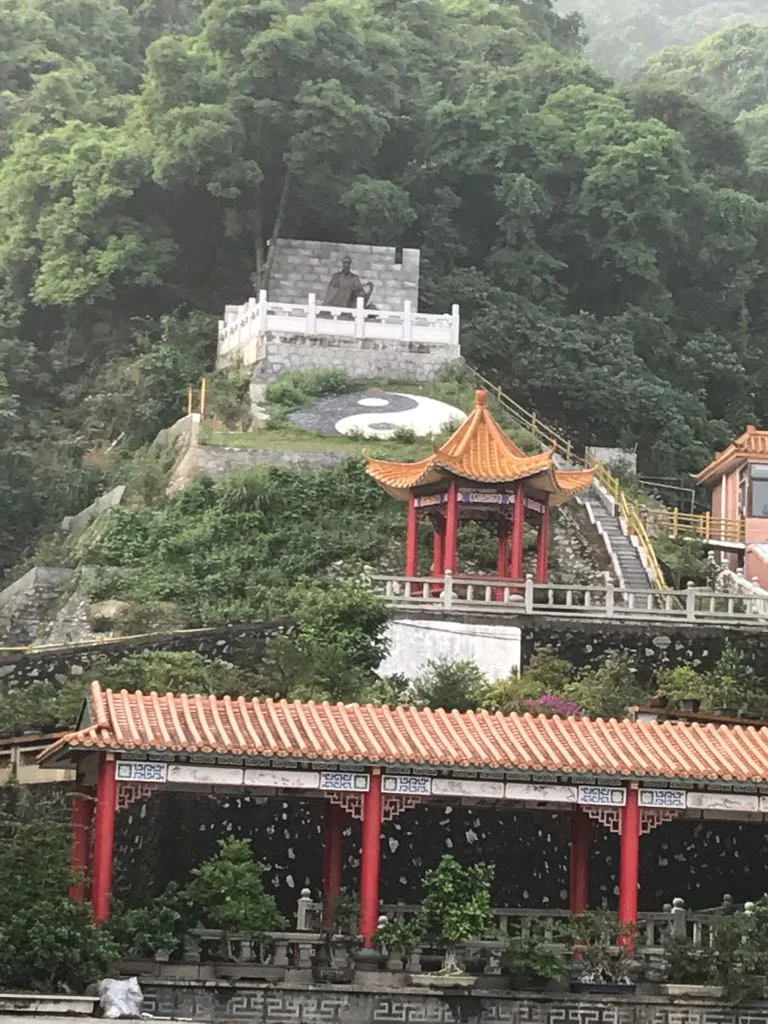

Mount Luofu
Ge Hong came to Mount Luofu to become immortal. That is not a metaphor. The fourth-century Taoist practitioner and alchemist arrived at this forested mountain north of the Dongjiang River during the Eastern Jin dynasty with a specific purpose: to refine elixirs capable of extending or transcending life. He built four huts. The huts became temples. The temples became one of the most sacred sites in Chinese Taoism — one of the ten greater dongtian, or 'grotto-heavens,' in the Taoist cosmological map of China's sacred landscape. Ge Hong, by most accounts, never achieved physical immortality. But the mountain that absorbed his life's work has now been accumulating the weight of that pursuit for seventeen centuries.
The Alchemist's Mountain
Ge Hong is one of the foundational figures of Chinese alchemy and Taoist religious practice. His most important work, the Baopuzi, blends Taoist cosmology with practical instruction on elixir-making and ritual. At Mount Luofu, he had a laboratory. The 'alchemical kitchen' where he refined his compounds, the 'Well of Longevity' from which he drew water, and the pond where he washed his elixirs are still marked on the mountain. The Grotto of Vermillion Brightness — a natural formation in a deep forest valley, reached by descending into a stillness broken only by running water — is said to be the spot where Ge Hong attained the closest thing to what he was looking for. Whether that means he died there, transcended there, or simply found peace there depends on which tradition you consult.
Temples Layered Deep
At the height of the mountain's religious life, there were said to be nine Taoist temples (guan), eighteen Buddhist monasteries (si), and twenty-two nunneries (an) on Mount Luofu. Dynasties rose and fell, and the buildings mostly didn't outlast them. What remains today is five Taoist temples and five Buddhist monasteries. The five surviving Taoist temples are the Temple of Emptiness, the Temple of Junkets, the Temple of the Nine Heavens, the Temple of the White Crane, and the Temple of the Yellow Dragon — the same four original temples Ge Hong established, plus one addition. The Temple of Emptiness is recognized by China's State Council as one of the national key Taoist temples, a designation that comes with both prestige and preservation resources. In the Qing dynasty, a branch of the Dragon Gate Sect established itself at the Temple of Junkets, and during the Guangxu Emperor's reign, the abbot Chen Jiaoyou wrote a significant text on the transmission history of the sect.
Where Legend Settles Into Stone
The mountain holds its stories in specific, physical places. The 'Boots-Losing House' is one of them. According to tradition, Ge Hong and his teacher Bo Jing once sat here talking through the night, so absorbed in scripture that neither noticed the hours passing. At dawn, two swallows flew toward them — but on closer inspection the swallows turned out to be a pair of boots entangled in flight. A stone tablet marks the spot. It is five chi long, half a chi wide, one chi high, leaning against a larger rock like a bed in permanent shadow. Whether the story is history or parable matters less than the fact that the mountain has held on to it, that the house still has a name, and that someone thought it worth marking with stone.
Martial Arts and the Mountain's Living Traditions
Mount Luofu did not become a closed preserve of antiquity. Several living traditions remained connected to it through the Qing dynasty and into the modern era. Mok Gar martial arts masters studied meditation and traditional Chinese medicine at the Temple of Emptiness. The Wa Sau Toi temple on the mountain is linked to both the Dragon and Bak Mei styles of kung fu. Choy Fook, one of the teachers of Chan Heung — the founder of Choy Lee Fut, one of Southern China's major kung fu systems — is said to have been a monk here. These are not simply historical footnotes; they connect the mountain to living lineages of physical and contemplative practice that are still transmitted today. Mount Luofu is a place that has been continuously inhabited by people trying to understand something large, using whatever forms were available to them.
From the Air
Mount Luofu is located at approximately 23.3°N, 114.0°E in Boluo County, northwest of the Huizhou urban area, on the north bank of the Dongjiang River. The mountain rises as a prominent forested massif above the surrounding river plain. The nearest major airport is Shenzhen Bao'an International Airport (ZGSZ), approximately 80 km to the south. Huizhou Pingtan Airport (ZGHZ) lies roughly 35 km to the southeast. Flying over the region, the mountain is identifiable as a higher forested ridge rising distinctly from the river valley. Mountain weather can produce rapid cloud cover; pilots should be aware of orographic effects on visibility.
Nearby Stories
- Lotus Hill 7.4 km away
- Mount Guanyin (Dongguan) 13 km away
- Heyuan 23 km away
- Battle of First Bar 25 km away
- Nanxiong Formation 38 km away
- Qingyuan 53 km away
- Penghu Great Bridge 557 km away
- Anping Small Fort 568 km away