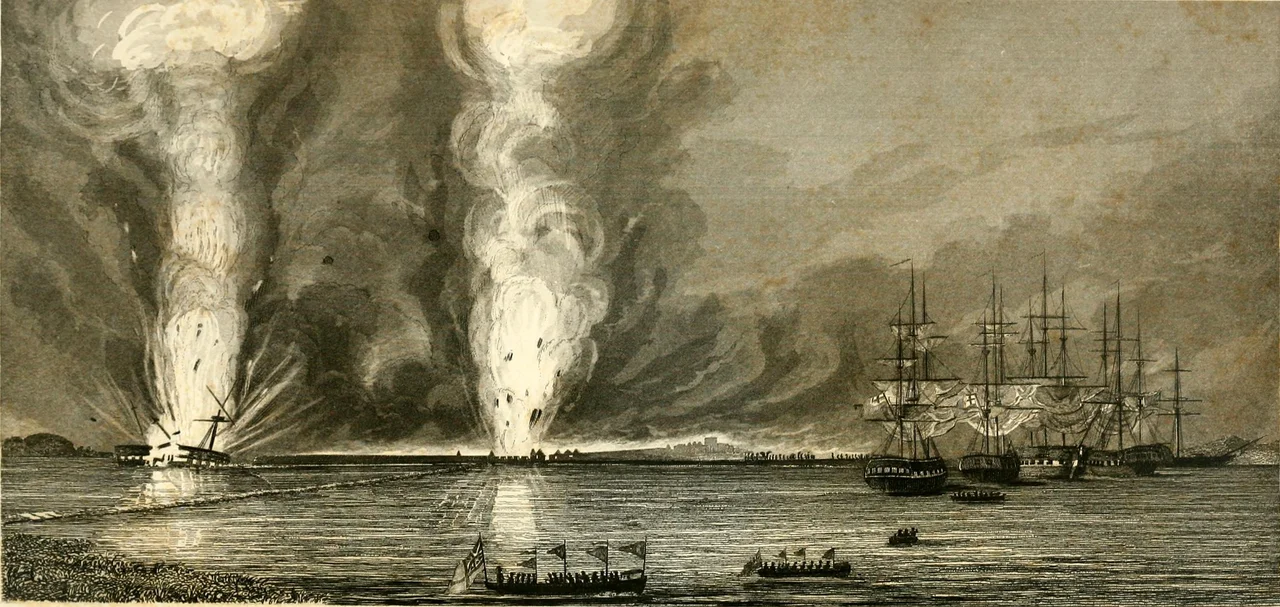

Battle of First Bar
On the morning of 27 February 1841, the shore of the Pearl River was lined with thousands of onlookers watching British warships sail past. Lieutenant John Elliot Bingham, aboard HMS Modeste, wrote that many of them were "secretly wishing them success" — though whose success he meant is impossible to know. What is certain is that by afternoon, hundreds of men were dead, a camp was burning, and the river that connects Guangzhou to the sea had become a battlefield. The Battle of First Bar was a single episode in the First Opium War, a conflict driven by Britain's insistence on trading opium into China against the Chinese government's determined efforts to stop it. The consequences of that day reached far beyond the smoke rising from the paddy fields.
The War Behind the Battle
The First Opium War did not begin as a war over territory or religion. It began over trade — and over a drug. British merchants had found in opium a commodity that could reverse their trade deficit with China, flooding Chinese markets with the drug despite imperial edicts banning its import. When Commissioner Lin Zexu confiscated and destroyed roughly 1,200 tonnes of British-owned opium at Canton in 1839, Britain responded with military force. By early 1841, British warships had already seized the Bocca Tigris forts at the mouth of the Pearl River, and the fleet was pressing upriver toward Canton itself.
In the days before First Bar, Lin Zexu noted in his writings that thousands of troops from Hunan and Yunnan had arrived to reinforce the Canton defenses. He personally inspected the river fortifications with Imperial Commissioner Qishan. The Qing military prepared as best it could — but it was preparing with smoothbore cannon and war junks against steam-powered iron warships firing explosive shells and rockets.
The Morning of 27 February
Seven ships sailed from the direction of the Bocca Tigris that morning: HMS Calliope, Herald, Alligator, Sulphur, and Modeste, along with the steamers Madagascar and Nemesis. Commodore Gordon Bremer placed Captain Thomas Herbert of Calliope in overall command. By noon, the fleet had passed Tiger Island and Second Bar and reached the stretch of river near First Bar Island.
There the British found what they were looking for. A former East Indiaman called Cambridge had been repurposed by the Qing forces, now flying a Chinese admiral's red flag. Along the riverbank, field fortifications mounting 47 guns stretched in a long line. White tents in the paddies behind indicated a large encampment of Manchu Bannermen — the elite imperial troops. More than 40 war junks waited further upstream. It was a formidable defensive position, assembled in the days that Lin Zexu and Qishan had spent inspecting the river.
An Hour of Fire
When the British steamers advanced, the Chinese batteries opened fire. The British returned fire with shells and rockets. HMS Modeste pushed to within 300 yards of the shore and fired broadsides; the other ships joined the cannonade. The rockets and explosive shells from Madagascar and Nemesis set the camp ablaze. The Cambridge opened fire in return but was overwhelmed and her crew jumped overboard.
Captain Herbert later reported that after about an hour the Chinese batteries were "nearly silenced" and British forces landed. He wrote that they drove "upwards of two thousand of their best troops" from the works. Bingham recorded that soldiers who fled attempted to cross a deep branch of the river and that numbers of them perished there. Herbert reported close to three hundred Qing soldiers killed. One British seaman died: aboard Modeste, the hammer of his musket caught on a ship's thwart and when the piece discharged, the ball struck him in the head.
The toll was devastatingly asymmetric. The Qing forces had fought with real determination against a technological gap they could not close.
What the River Remembered
In the aftermath, the diplomats resumed their meetings — Qishan, Deng Tingzhen, and Yiliang gathered that same afternoon, according to Lin Zexu's account. The military academy that would later be founded nearby on Changzhou Island was still decades away. The Opium War would continue for another year before ending with the Treaty of Nanking, which ceded Hong Kong to Britain and opened five Chinese ports to foreign trade.
First Bar itself is a quiet stretch of the Pearl River today, southeast of modern Guangzhou. The river still runs between the same banks, braided around the same low islands. The name "First Bar" comes from the sandbars that once made navigation treacherous for large ships — the same bars that made it a natural place to build defenses. What those defenses could not stop, in 1841, says as much about the pressures of empire as it does about the soldiers who stood and fired until the order came to withdraw.
From the Air
First Bar Island lies at approximately 23.07°N, 113.48°E on the Pearl River, roughly 20 km southeast of central Guangzhou. From the air at 3,000–5,000 feet, the river's braided channels and low-lying delta islands are clearly visible — the flat paddy landscape that the Qing encampment once occupied stretches south toward the delta. The nearest major airport is ZGGG (Guangzhou Baiyun International), approximately 40 km to the north-northwest. In clear weather, the Pearl River corridor is a distinctive visual reference threading through the urban sprawl of the Guangdong delta.
Nearby Stories
- Shunde 12 km away
- 2015 Shenzhen Landslide 15 km away
- Mount Luofu 23 km away
- Qingyuan Maglev Tourist Line 32 km away
- Kaiping 56 km away
- Heyuan 90 km away
- Chikan, Kaiping 92 km away
- Erlitou Site Museum of the Xia Capital 1257 km away