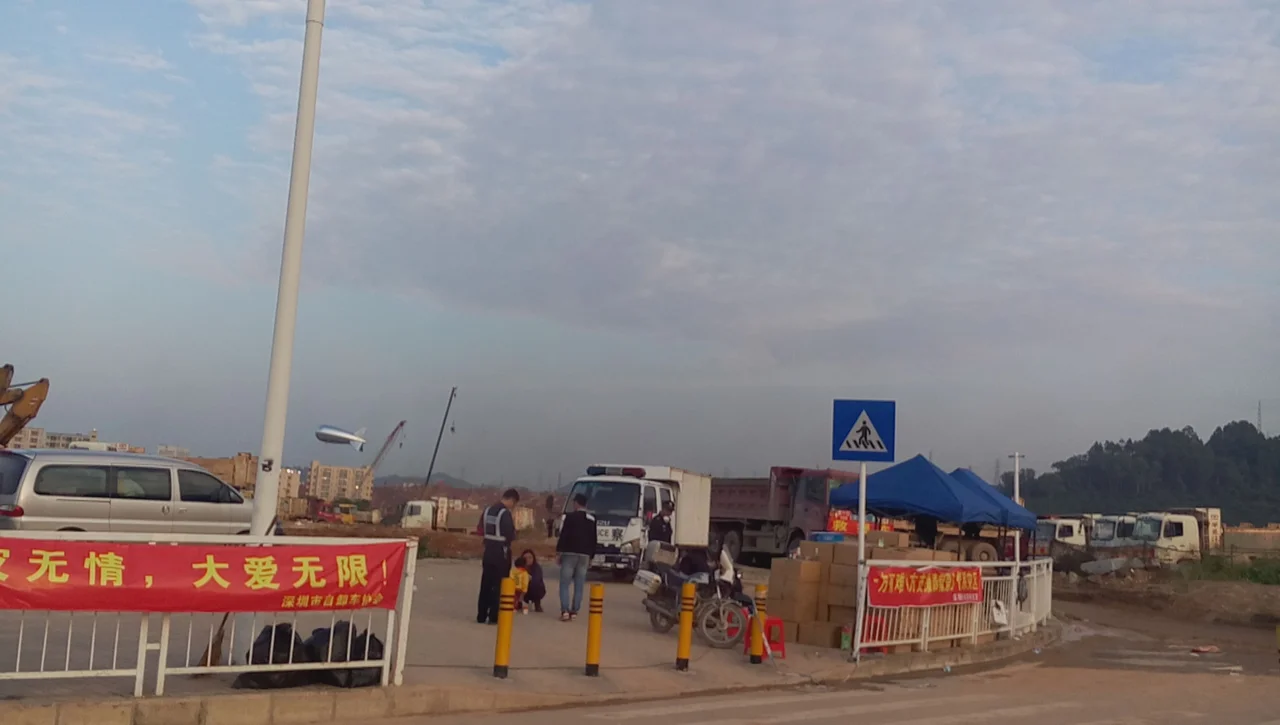

2015 Shenzhen Landslide
The ground at Hengtaiyu industrial park began to move shortly after 11 a.m. on 20 December 2015. What came next was not an earthquake, and it was not a natural landslide — it was an artificial mountain of construction waste collapsing under its own weight onto the workers, buildings, and dormitories below. Seventy-three people died. Four were never found. The Ministry of Land and Resources confirmed what many already suspected: the adjacent natural hillside had not moved. Only the dumped earth had.
How the Mountain Grew
Over the previous two years, construction projects across Shenzhen — one of China's fastest-growing cities — had generated enormous quantities of excavated soil and debris. That material needed somewhere to go, and a former quarry in the Guangming New District became its destination. Truckload by truckload, the spoil accumulated until it had reached the height of a twenty-storey building. No natural hill had been disturbed. The mound was entirely man-made, and regulators had either not noticed or had not acted. Later investigations would reveal that approvals had been granted by officials who should not have approved them, and that warnings, if any were raised, went unheeded. The disaster was not the result of an unpredictable geological event. It was the result of decisions made by identifiable people over an extended period of time.
The Morning It Fell
When the saturated mass gave way, it moved fast. The collapse buried industrial buildings and the residential quarters where workers lived and slept. More than 2,900 rescue personnel — including around 800 from the People's Liberation Army — descended on the site within hours. More than 1,500 additional emergency responders joined the search for survivors. Seven people were pulled from the debris alive. Approximately 900 residents were evacuated from surrounding areas. The scale of the response reflected both the severity of the disaster and the political urgency it created. Ma Xingrui, Shenzhen's Communist Party Secretary, cut short his attendance at the Central Economic Work Conference in Beijing and returned to the city to oversee the response in person.
The People Who Were Lost
The victims were workers — people who had come to Shenzhen to build the city and had made their homes in the industrial park's dormitories. Their families waited for news that, for many, never came. On 27 December, seven days after the collapse and in accordance with Chinese mourning tradition, rescuers and officials gathered at the debris field to honor those who had died. White flowers were scattered on the rubble. UN Secretary-General Ban Ki-moon extended his condolences to the families of the victims. Five days earlier, on 25 December, Ma Xingrui and other city officials had issued a public apology to the people of Shenzhen — a formal acknowledgment that the city's own institutions had failed to protect its residents.
Accountability and Aftermath
The investigation moved quickly. Within weeks, police had arrested a number of people connected to the irregular operation of the dump site. In April 2017, forty-five people — among them government officials — were charged in local courts with negligence and corruption. Prison sentences and large fines followed. On 27 December 2015, the official who had signed off on the construction of the dump site — identified as Xu Yuan'an, former director of the Shenzhen Guangming New District Urban Management Bureau — jumped from a building in Nanshan District. The prosecutions and the tragedy surrounding Xu Yuan'an did not restore what was lost. But they drew a clear line between natural catastrophe and institutional failure. This was not something that had to happen.
A City's Reckoning
Shenzhen had been, for decades, a symbol of China's capacity for rapid transformation. A fishing village in 1979, it became a metropolis of millions in a single generation. The pace of construction required to sustain that growth was extraordinary — and so was the volume of debris it produced. The 2015 landslide became a symbol of a different kind: a warning about what happens when growth outruns the systems meant to govern it. The disaster prompted nationwide scrutiny of construction waste management practices in China. The site in Guangming New District still bears its scars, though the industrial park around it has been rebuilt. The names of the 73 people who died that December morning are the real measure of what the negligence cost.
From the Air
The collapse site is located at approximately 22.72°N, 113.93°E in the Guangming New District of Shenzhen, in Guangdong Province. From the air, the area appears as a dense patchwork of industrial parks and residential developments on the northwestern outskirts of the Shenzhen metropolitan area. Nearest major airport is Shenzhen Bao'an International (ZGSZ), approximately 15 kilometers to the southwest. At cruising altitude, the Pearl River Delta's extraordinary density of development is visible stretching in every direction. Visibility is frequently reduced by haze in this region.
Nearby Stories
- Tai Fu Tai Mansion 0.6 km away
- Cuiheng 6.4 km away
- Battle of First Bar 9.3 km away
- 2024 Lixinsha Bridge Collapse 12 km away
- Mount Luofu 32 km away
- Nanxiong Formation 60 km away
- Heyuan 110 km away
- Liuqiu Island 592 km away