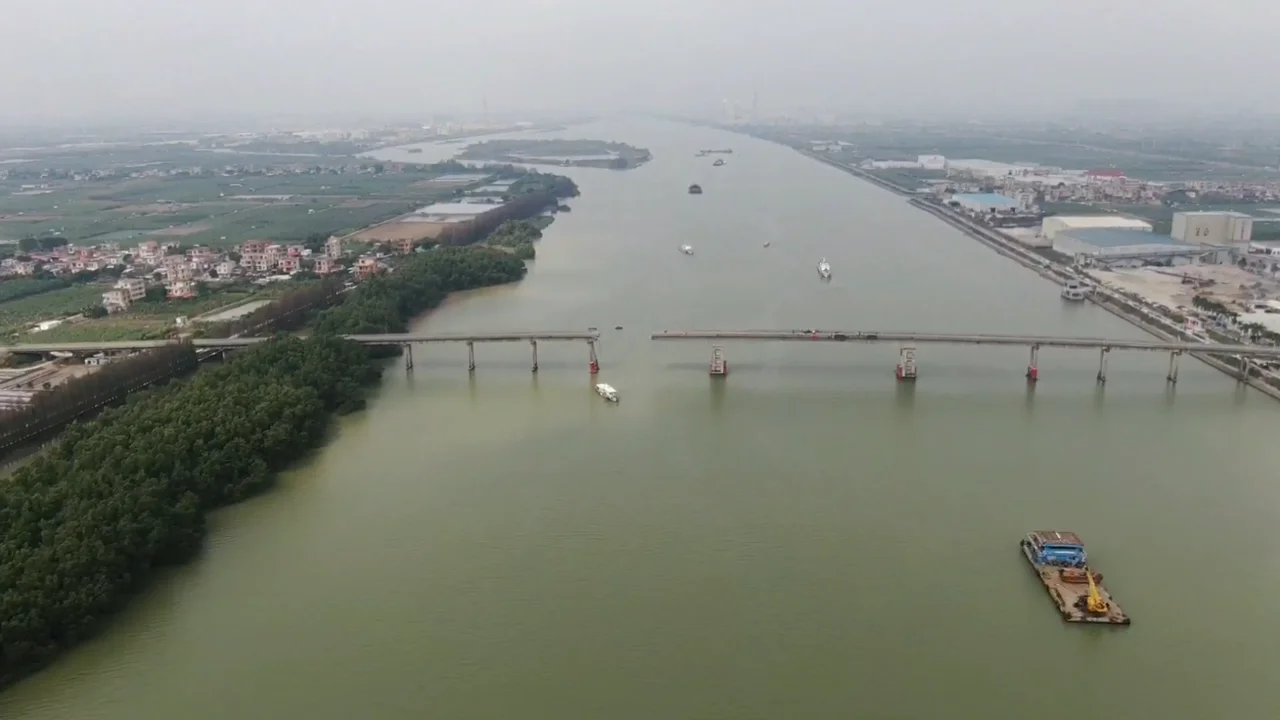

2024 Lixinsha Bridge Collapse
The morning of 22 February 2024 was ordinary for the people crossing the Lixinsha Bridge in Guangzhou's Nansha district — a bus driver starting his route, a scooter rider, truck drivers hauling cargo across the Pearl River. A barge moving through the waterway below struck one of the bridge piers. The span fractured. Vehicles fell. Five people died that morning: a bus driver, a scooter rider, and three people in trucks that went into the river. Three others were injured.
The Bridge and the River
The Lixinsha Bridge crosses a channel of the Pearl River in the Nansha district of Guangzhou, connecting Sanmin Island — a farming community — to the mainland. Nansha had been growing rapidly, and the bridge carried not just road traffic but the island's utility lifelines: water supply pipes, fiber optic cables, and electrical cables all ran across it. For the people living on Sanmin Island, the bridge was not an abstraction. It was how they got to work, how their goods reached market, how water came from the tap.
Guangzhou sits at the head of the Pearl River Delta, one of China's most densely navigated waterways. Container ships, barges, and cargo vessels move constantly through its channels, sharing water with bridges that span them at relatively modest clearances. That proximity between heavy maritime traffic and road infrastructure creates a tension that most days passes unnoticed.
The Morning of the Collapse
When the barge struck the 19th pier of the Lixinsha Bridge, the impact caused a section of the span between the 19th and 20th piers to fracture and fall. Two vehicles plunged into the river; three others dropped onto the barge below. The barge was trapped beneath the collapsed section.
Rescuers from the China Rescue and Salvage Bureau arrived from their Guangzhou base. From Shenzhen, the high-speed rescue boat Nanhai Rescue 321 was also dispatched. By 4:10 that afternoon, the two trucks that had fallen into the water were recovered from the river. The bodies of their drivers and a passenger were found later that evening. The Guangzhou Maritime Safety Administration closed the waterway to all but official vessels within 500 meters of the bridge in both directions while the search continued.
The five people who died that morning — a bus driver, a scooter rider, and three people in the trucks that went into the river — were ordinary people on an ordinary commute. The captain of the barge was detained as investigators began examining what had gone wrong.
An Island Cut Off
For the residents of Sanmin Island, the collapse meant more than grief. The bridge had carried everything the island depended on. Water supply to the island was cut off within hours. Fiber optic cables were severed, briefly disrupting communications. Electrical cables survived intact — Nansha had completed a second power line through the nearby Nanzhong Expressway just six months earlier, which proved crucial.
Local authorities moved quickly. Water trucks arrived to supply residents. A temporary dock was built overnight, allowing people and goods to move by boat. A temporary water pipeline was connected through infrastructure still under construction nearby. The Guangzhou Transportation Management Bureau confirmed at an evening press conference that the 19th pier had been seriously damaged and tilted, and that the damaged span beams would need to be replaced. Repair work was expected to take four to five months.
Investigation and Recovery
Demolition of the damaged span began on February 25, three days after the collapse. The investigation found that the accident had been caused by the barge crew's operational errors. The shipping company cooperated with authorities throughout the inquiry.
Re-erecting the span beams was completed by late May 2024. On June 12, the reconstructed bridge was certified for use following safety assessments. On June 22, exactly four months after the collapse, the Lixinsha Bridge reopened to traffic at 10 a.m. — the same bridge, rebuilt over the same river, carrying the same people again.
The collapse was one in a long series of bridge-vessel collision incidents on China's busy inland waterways. Each one prompts the same questions about clearances, navigation protocols, and inspection standards. The answers come slowly, while the rivers and the bridges continue to coexist.
From the Air
The Lixinsha Bridge crosses the Hongqili waterway in Nansha district, Guangzhou, at approximately 22.654°N, 113.551°E — in the southern reaches of the Pearl River Delta, where the river fans into multiple distributary channels visible clearly from altitude. From the air at 3,000–5,000 feet, the delta's web of waterways and low-lying islands is distinctive; Sanmin Island is one of many such islands connected by bridges to the mainland. The nearest major airport is ZGGG (Guangzhou Baiyun International), approximately 60 km to the north. The Nansha port complex is visible to the southeast.
Nearby Stories
- Fu Guohao Incident 1.9 km away
- Nantou (historic town) 4.7 km away
- Taishan City 11 km away
- Chimelong Paradise 18 km away
- Zhuhai 20 km away
- Mount Guanyin (Dongguan) 21 km away
- Kaiping 29 km away
- Erlitou Site Museum of the Xia Capital 1316 km away