
Nantou (historic town)
The walled city of Nantou has been destroyed three times and rebuilt, shrunk, absorbed, and reinvented across seventeen centuries — and it still exists. Hidden inside the dense urban fabric of Nanshan District in modern Shenzhen, the town that once governed a coastline stretching from the Pearl River to the South China Sea now coexists with illegal multi-story townhouses, street food vendors, and more than 20,000 residents crowded into an area of roughly 70,000 square meters. History and the present do not occupy separate zones here. They share the same street.
The Gatekeeper of the Pearl River
Nantou's story begins in 331 CE, when the settlement was established as the capital of Dongguan Prefecture — an administrative unit that encompassed the territories now occupied by Dongguan, Shenzhen, Hong Kong, Huizhou, Zhongshan, Zhuhai, and Macau, all before European colonial presence in the region. The city's position facing Qianhai Bay made it a natural control point for maritime traffic on the South China coast, and local records describe it as a prosperous salt production center across successive dynasties. In 736 CE, during the Tang dynasty, the settlement was fortified with imperial troops and renamed Tunmen. The walls that define the town today were built in 1394, when the early Ming dynasty revived coastal defenses after ending Mongol Yuan dynasty rule. The logic of the location — controlling access to the Pearl River and Guangzhou — remained constant across a thousand years of dynastic change.
Zheng He and the Sea Route South
Historic records suggest that the great Ming dynasty admiral Zheng He — whose treasure voyages between 1405 and 1433 took Chinese fleets as far as East Africa — passed through the waters near Nantou and encountered hazards in the area. According to these accounts, Zheng He went ashore and prayed for luck at the Tianhou Temple in nearby Chiwan before continuing his voyages. Whether this connection is precisely documented or part of local tradition, the geography is plausible: Chiwan sits just south of Nantou, and the sea route southward from Guangzhou passed directly through these waters. The Tianhou Temple there was dedicated to the goddess of the sea, a natural place for sailors to seek blessing. If Zheng He did stop here, Nantou was already more than a thousand years old.
Three Waves of Destruction
The town has been damaged deliberately three times, and each wave reshaped what remained. The first came during the Kangxi Emperor's Great Clearance of 1661 to 1669, when Qing dynasty authorities forcibly evacuated coastal settlements — displacing the inhabitants of Xin'an County to counties further north, destroying buildings and city walls, and constructing a boundary 50 li inland to cut off coastal communities from sea-based rebels. Nantou was effectively depopulated and much of its fabric demolished. The second destruction came during the Japanese occupation in the Second Sino-Japanese War, when Japanese forces built military fortifications into the existing walls. The third — and in some ways the most total — came after 1980, when Shenzhen's designation as a Special Economic Zone brought rapid urbanization. Migrants flooded in, and more than 900 unplanned and illegally built multi-story townhouses replaced historic structures. Some of these buildings used stone cut directly from the ancient city walls as their construction material.
What Remains of the Walls
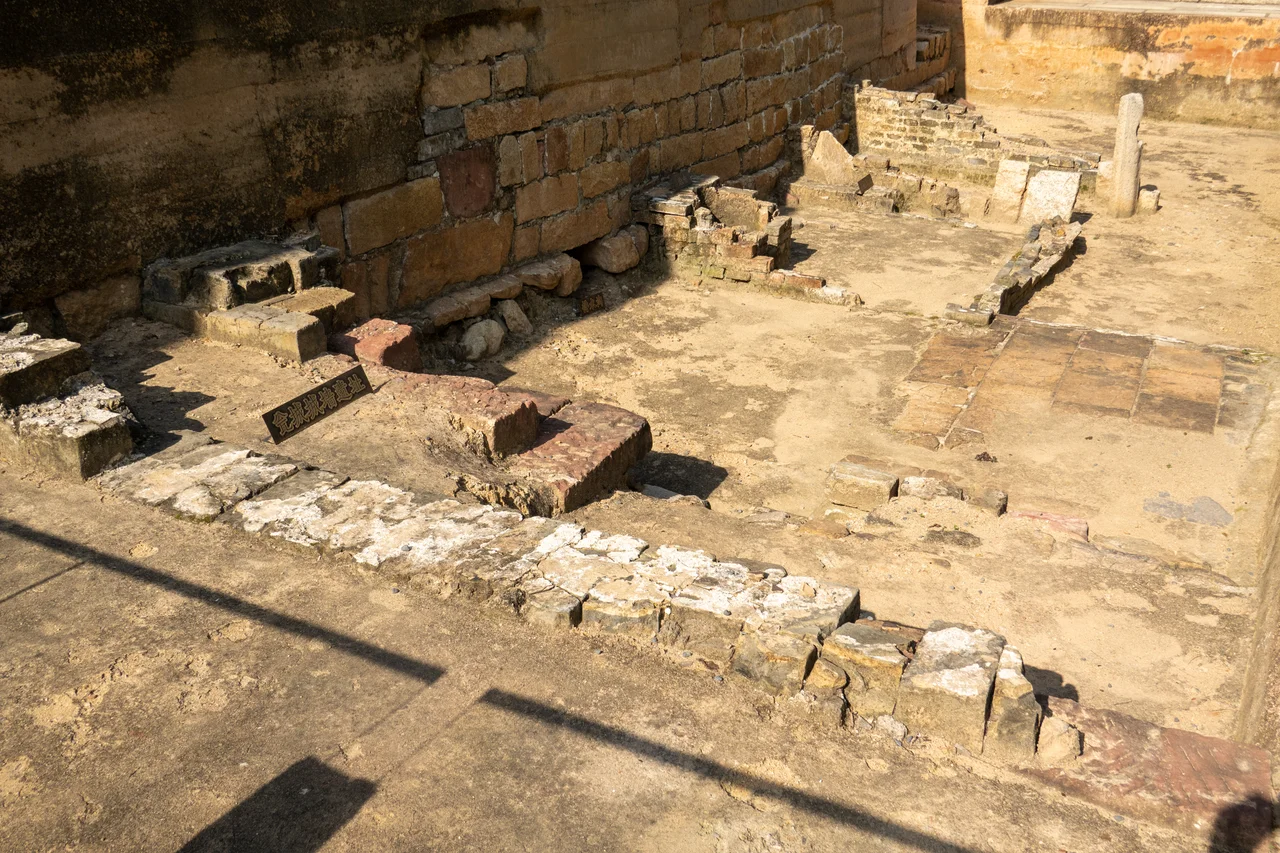
The city walls of Nantou were founded on yellow sand, with defensive trenches running around the perimeter. Today almost all of them are gone. The south gate survives: 10 meters wide and 4.5 meters tall, though the gate tower above it was destroyed. A few sections of wall to the north survive within Zhongshan Park. The east gate also remains in some form. The town itself covers an irregular quadrilateral of roughly 70,000 square meters, widest east to west at 680 meters, and 500 meters north to south. Eight of the original nine streets still exist within this footprint, though the buildings along them have changed almost beyond recognition.
An Urban Village in an Economic Miracle
Nantou is now classified as an urban village — a category that exists throughout Chinese cities where old rural settlements have been surrounded and engulfed by urban development but retain their pre-urban land rights and governance structures. More than 20,000 people live here. Preservation efforts exist but have been, as the sources note directly, fairly minor in effect. The Shenzhen government renamed the area Xin'an Ancient City (新安故城), opened the Nantou Ancient City Museum inside the former county government building, and designated the area as a heritage trail. Around 40 buildings dating to the Qing dynasty or the first half of the twentieth century still stand. The tension between the ancient town Nantou once was and the dense, informal, alive place it is today is unresolved — and that tension may be the most accurate thing about it.
From the Air
Nantou historic town is located at approximately 22.55°N, 113.92°E in Nanshan District, Shenzhen, facing Qianhai Bay to the west. At low altitude from the west, the bay and the Shenzhen Bay Bridge crossing to Hong Kong's New Territories are visible landmarks. The town itself is embedded in the dense urban grid of Nanshan and is not visually distinct from altitude, though the slightly lower rooflines of the old district can be distinguishable against the surrounding high-rise development. Shenzhen Bao'an International Airport (ZGSZ) is approximately 14 nautical miles to the northwest. Hong Kong International (VHHH) is approximately 25 nautical miles to the southwest.
Nearby Stories
- Hong Kong Disneyland 4.1 km away
- Mount Guanyin (Dongguan) 7 km away
- 2024 Lixinsha Bridge Collapse 7.4 km away
- Portas do Cerco 12 km away
- Lotus Hill 15 km away
- Nanxiong Formation 78 km away
- Heyuan 130 km away
- Checheng Fu'an Temple 629 km away