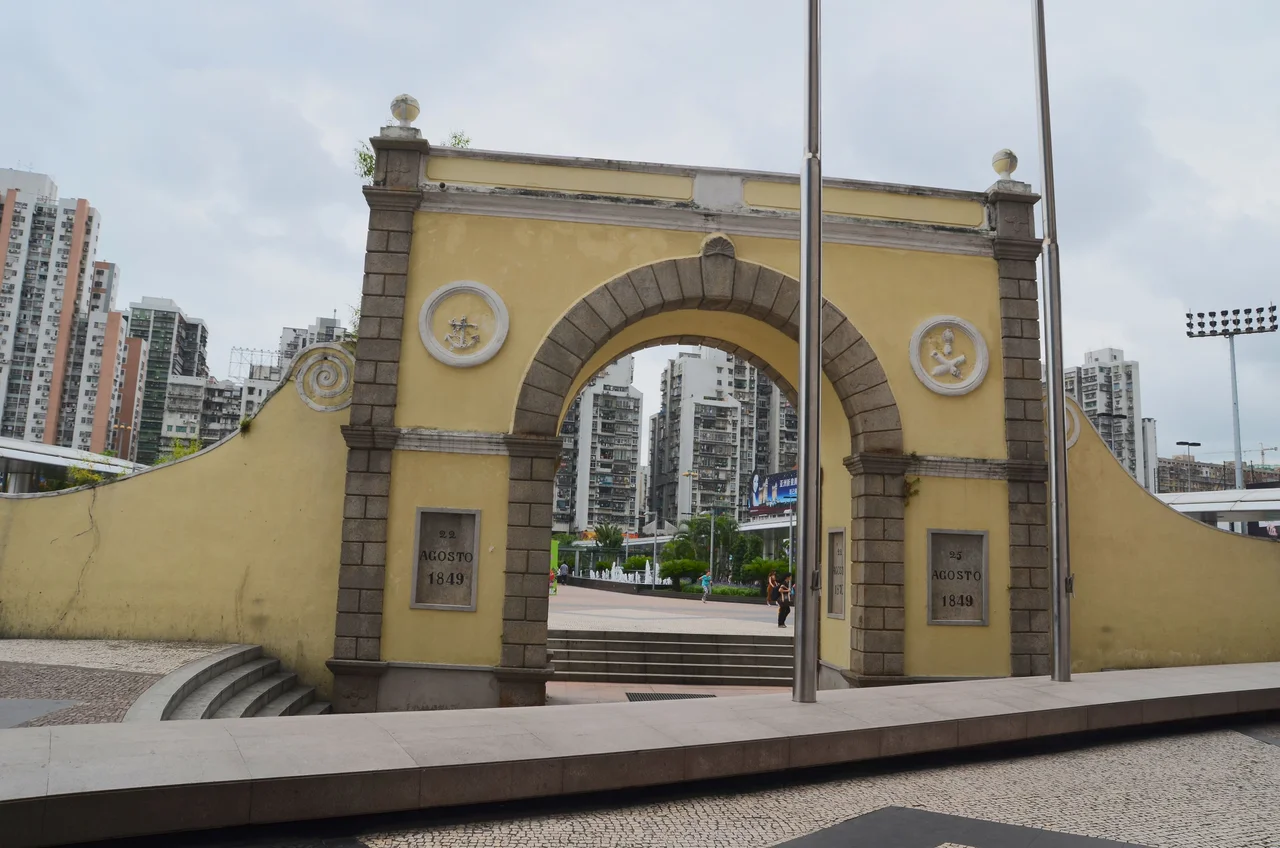

Portas do Cerco
"Honor your fatherland, for your fatherland looks over you." Those words — *A pátria honrai, que a pátria vos contempla* — are carved into the inner arch of the Portas do Cerco, the Barrier Gate that closes off the northern tip of the Macau Peninsula. The inscription was placed in 1849, the same year Macau's governor was assassinated just outside it, and the same year a thirty-six-man Portuguese charge seized a Qing imperial fort to defend the city. The gate has always been about what gets through, what gets stopped, and who gets to decide.
The Wall That Kept Macau in Its Place
The first fortified border crossing here dates to 1573, built by the Ming dynasty to control the flow of people and goods between the Portuguese trading post and the Chinese mainland. The wall was not meant to keep enemies out — it was meant to keep Macau contained, to prevent the small Portuguese enclave from expanding northward into Chinese territory. Guards manned the crossing; passage required permission; the terms were set by the Chinese side. For the Portuguese, this was a continual reminder that their presence in Macau was conditional. The wall was repaired and rebuilt several times over the following centuries as the structures crumbled and as the politics shifted. The present gate structure was begun in 1870 and completed in 1871, replacing an earlier version, and stands as a neoclassical arch rather than the military fortification that preceded it.
August 1849: Assassination and Its Aftermath
The gate is inseparable from the violence of August 1849. Governor João Maria Ferreira do Amaral — who had spent his tenure dismantling Chinese administrative authority in Macau — rode through the Portas do Cerco on 22 August to deliver alms to an elderly Chinese woman he supported. He was ambushed and killed by seven men. Three days later, the guns of the Qing fort of Passaleão opened fire on Macau's walls from just north of the city, and a sub-lieutenant named Mesquita led a charge of thirty-six men that broke the Chinese garrison. The Portuguese then rebuilt the gate with the fatherland inscription on its arch — a declaration of sovereignty carved in stone at the exact location where that sovereignty had just been tested. The Barrier Gate now marked not the limit of Chinese tolerance but the frontier of a newly assertive Portugal.
Four Centuries of Threshold
Between the Ming dynasty wall and the present gate, the crossing at the northern tip of the peninsula witnessed nearly every significant shift in Macau's political life. It was the site of the Battle of the Barrier on 19 August 1840, when British and Chinese forces clashed here during the First Opium War. During the 1950s and 1960s, journalists and analysts took to calling the Portas do Cerco the "Far Eastern Checkpoint Charlie" — the reference to Berlin's most famous crossing was not hyperbolic. In 1952, Portuguese African troops and Chinese Communist border guards exchanged fire at the gate; the exchange reportedly lasted one hour and forty-five minutes, leaving at least one dead and several dozen injured on the Macau side, with claims of more than one hundred casualties on the Chinese side. The Cold War had arrived at a four-century-old gate.
The Border That Was Never Formally Drawn
One of the persistent curiosities of the Portas do Cerco is that the precise limits of Macau's border were never formally demarcated. The gate served as a de facto boundary rather than a legally defined line, a condition that persisted through centuries of Portuguese administration and into the territory's return to China in 1999. Today Macau is a Special Administrative Region of China, with its own customs and immigration controls, and the new Posto Fronteiriço das Portas do Cerco — a modern border post opened on 15 January 2004 — handles the actual crossings just meters behind the old gate. Millions of people pass through the border with Zhuhai annually. The old arch with its 1849 inscription still stands, no longer functional as a crossing but preserved as a monument to the complicated history it witnessed. The fatherland it addressed is no longer Portugal's. The gate remains.
From the Air
The Portas do Cerco stands at 22.2158°N, 113.5492°E at the northernmost point of the Macau Peninsula, immediately adjacent to the border with Zhuhai, China. From the air at 2,000–3,000 feet, the narrow land border crossing is clearly visible — the only land connection between the peninsula and mainland China. The Pearl River Delta opens to the west; the bridge and tunnel links to Hong Kong are visible in the distance on a clear day. The nearest airport is Macau International Airport (VMMC), approximately 2.5 nautical miles south on Taipa Island. The entire peninsula, from the Barrier Gate in the north to Penha Hill in the south, is visible in a single view.
Nearby Stories
- 2024 Shenzhen Stabbing 0.8 km away
- Lantau Peak 1.5 km away
- Kweilin Incident 2.4 km away
- Taishan City 7 km away
- Wanshan Archipelago Campaign 38 km away
- Hong Kong 12 68 km away
- Battle of Nanpeng Island 82 km away
- Erhai Lake 1335 km away