
Hong Kong 12
Before dawn on August 23, 2020, twelve people boarded a speedboat at a dock in Sai Kung, on the eastern edge of Hong Kong. Their ages ranged from 16 to 33. Most had been arrested during the 2019 protests; several were out on bail and facing serious charges. They were heading for Taiwan-controlled Pratas Island, intending to seek safety abroad. At around 9 a.m., approximately 78 kilometers from Hong Kong Island, the boat was intercepted. For three days, nothing official was said. When the China Coast Guard finally confirmed the detention on August 26, a case had begun that would draw in families, lawyers, foreign governments, and hundreds of thousands of people who had never met any of the twelve.
The Twelve People
Their identities were pieced together slowly, first from pro-Beijing media, then from family members — not from any official announcement. They included Andy Li, 29, a founding member of the pro-democracy advocacy group Hong Kong Story and the only one suspected of violating the new national security law; Tang Kai-yin, 30, charged with being the group's leader on the boat; and Hoang Lam Phuc, 16, the youngest, a Vietnamese citizen who had been arrested the previous year. Others were university students. One, 18-year-old Kok Tse-Lun, held Portuguese citizenship through Macanese heritage; Portugal's consul general confirmed this and vowed to press for his rights, though Chinese officials responded that any Hong Kong resident would be treated as a Chinese citizen regardless of other passports. The twelve were held at Yantian Detention Centre in Shenzhen. Their families were not notified for days. The lawyers their families hired were turned away at the gate.
Walls of Silence
What followed the detention was a months-long struggle by families to reach their children, siblings, and partners — a struggle that met, repeatedly, a sealed door. Human rights lawyers Lu Siwei and Ren Quanniu, appointed by the families, were denied access. Chinese officials attempted, according to both lawyers, to dissuade them from continuing the case. Detention authorities told families the twelve had accepted government-appointed lawyers; the families said this was false and that the letters that eventually arrived, handwritten and stressing good treatment, appeared to have been dictated. By September 30 — the 37-day limit under Chinese criminal procedure for pre-charge detention — formal charges had been filed: two accused of organizing illegal border crossing, ten accused of crossing illegally. The families had by then gone to the Hong Kong Liaison Office in person to petition. Six lawyers had withdrawn from the case under pressure; thirteen more had been warned off by Chinese justice bureaus; ten had been turned away from the facility itself.
The Hong Kong Government's Position
Chief Executive Carrie Lam's position, stated consistently across months of press conferences and legislative sessions, was that the case fell under mainland jurisdiction and that Hong Kong could not and would not intervene. In October, when a journalist asked what she was doing to protect the twelve as she prepared to visit Shenzhen, she said she no longer wished to discuss the matter. A request in the Legislative Council to put the case on the agenda was voted down by the pro-Beijing majority. Secretary for Security John Lee told television interviewers that all twelve were in good health and had chosen their own lawyers. The families disputed every one of these claims. The gap between the official account and the families' account — about lawyers, about access, about health, about prior notification — was never publicly reconciled.
A City Responds
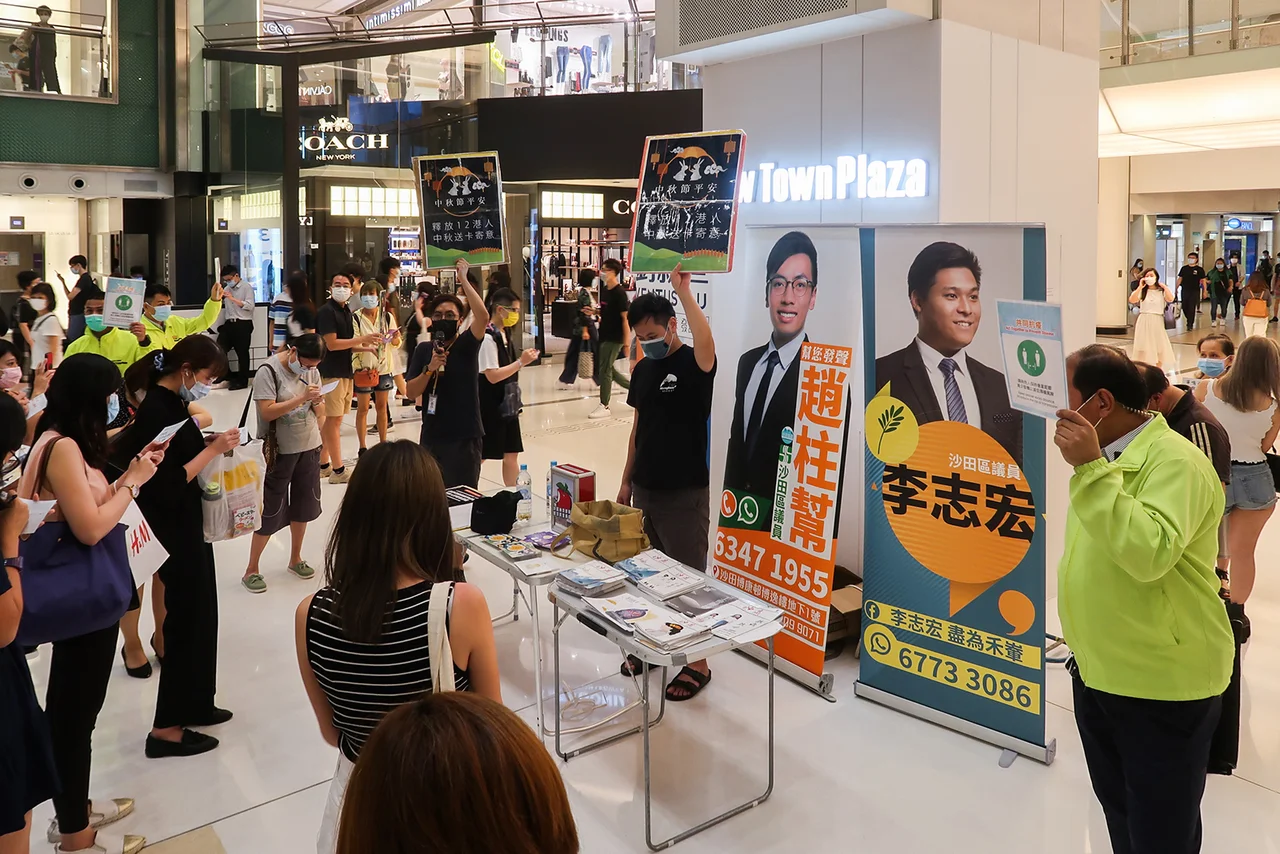
Across Hong Kong, people found ways to make the twelve visible. Hikers climbed Lion Rock and illuminated a 'Save 12' neon sign. Students at the University of Hong Kong set up awareness booths. District councillors held street stalls until police arrived. On the 100th day of detention, a virtual rally livestreamed on Facebook drew 320,000 viewers. Locks bearing the twelve names were placed on fences outside Polytechnic University. Balloons were released toward Shenzhen from Kat O island. None of it reached the people it was meant for. Over 150 parliamentarians from 18 countries added their voices by December 2. The trial, when it came on December 28, was closed in practice if not in law: when diplomats from the United States, United Kingdom, Canada, France, Germany, Portugal, Australia, and the Netherlands arrived to observe, they were told the gallery was full and turned away.
Sentences and Aftermath
Eight of the ten adult defendants received seven-month sentences for illegal border crossing and were returned to Hong Kong police in March 2021. The two underage detainees had already been transferred to Hong Kong in late December. Quinn Moon and Tang Kai-yin received longer terms — two and three years respectively — served in mainland China, and both faced additional charges on return. Tang, who had originally faced conspiracy to commit arson with intent to endanger life, pleaded guilty in January 2024 to a lesser charge and was jailed for three years and ten months. By the time the last of them had been sentenced, the Hong Kong political landscape they had fled had changed beyond what any of them had navigated before their departure. The national security law, the mass emigration, the restructured legislature — all of it had unfolded while they were held, tried, and returned.
From the Air
The interception occurred at approximately 21°54'N, 114°53'E, in the South China Sea roughly 78 km southeast of Hong Kong Island. The boat departed from Sai Kung district on Hong Kong's eastern coast. Yantian Detention Centre, where the twelve were held, is in Yantian District, Shenzhen, visible from altitude as a district along the eastern Shenzhen waterfront. Hong Kong International Airport (VHHH) is on Lantau Island to the southwest. The waters of the interception zone lie under international approach and departure corridors for both VHHH and nearby Shenzhen Bao'an International Airport (ZGSZ). At 3,000–5,000 feet southbound from VHHH, the eastern Hong Kong approaches and the open South China Sea where the interception occurred are visible.
Nearby Stories
- Fan Lau Fort 7.9 km away
- Waglan Island 14 km away
- Wanshan Archipelago Campaign 18 km away
- Battle of Nanpeng Island 177 km away
- Temple of the Five Lords 460 km away
- Battle of Penghu 488 km away
- Penghu Air Raids 501 km away
- Mavulis Island 726 km away