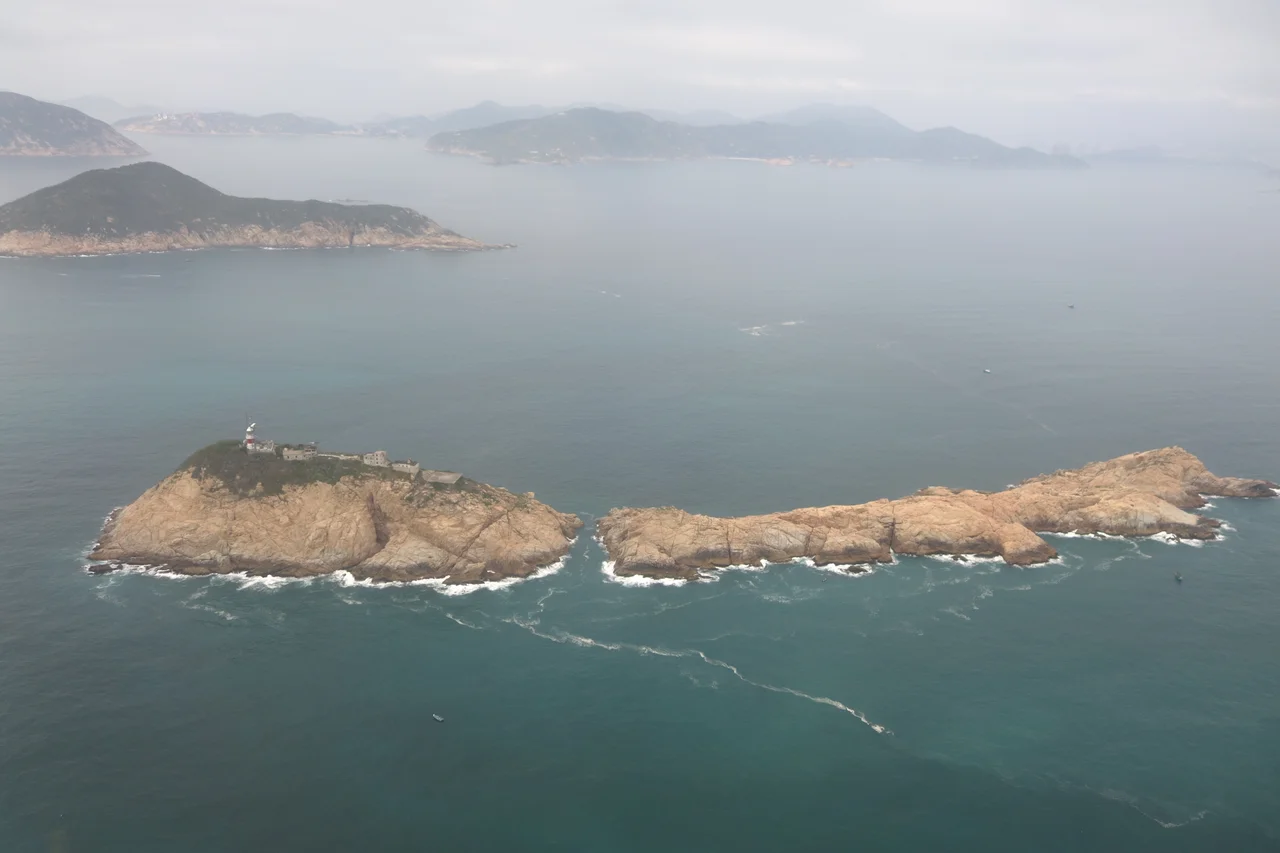

Waglan Island
Push a finger against an eight-tonne lens and watch it spin. That was the miracle Waglan Island offered the shipping world when its lighthouse entered service on 9 May 1893 — a mercury bath rotating system so finely balanced that almost no force was required to keep the massive first-order lens turning through the night. The technology came from the Paris workshop of Barbier, Bénard & Turenne, and Waglan was one of only two places on Earth where it debuted simultaneously. The other twin lens went to Beiyushan Lighthouse. Both were built for the Chinese Maritime Customs Marine Department, then shipped in pieces — cast iron sections packed for a sea voyage — to be reassembled on their respective rocks. On Waglan, that rock sits at the southeastern tip of Hong Kong, where the South China Sea opens wide and the approach lanes to the colony's growing harbour demanded a dependable fixed light.
Why This Rock, Why This Light
Before the Treaties of Nanking, Peking and Tientsin reshaped the region between 1842 and 1860, sea traffic around Hong Kong was modest. Those treaties forced the Qing government to open more trading ports, and European merchant vessels began threading through unfamiliar waters in far greater numbers. Waglan Island sat directly on the natural approach from the open South China Sea, making it the obvious sentinel. The lighthouse's layout was designed by David Marr Henderson, Engineer in Chief of the Chinese Maritime Customs, and the original station included living quarters, a freshwater collection tank, and a derrick for hoisting people and supplies onto the island's steep flanks — because without that derrick, there was no other way ashore. The station was managed from Shanghai, and its first keepers were German, a reflection of the international character of the Customs service in those years.
Life on the Rock
The working team at any given time consisted of one principal keeper, two assistant keepers, five attendants responsible for grass cutting and cleaning, and a cook. Their rotation was demanding: one month on the island, then one week's leave. That schedule placed men in real isolation on a speck of land surrounded by open water, with no ferry stop, no neighbours, and fog signals loud enough to be heard five miles away. Those signals evolved over time. Three 18-pounder cannons were installed in the early British period for fog warnings and defence. By 1923 the cannons were replaced by a twin-type Diaphone — a diesel-powered device producing a two-tone blast, an upper note followed by a longer, lower rumble. In the 1930s two Chinese keepers rose to second-class rank: Wong Kai Chung, arriving in 1930, and Leung Chiu Tung in 1933, both transferred after apprenticeships at Gap Rock Lighthouse. Their promotions represented a shift in how the colonial lighthouse service was staffed.
War Comes to Waglan
On 13 December 1941, at 10:30 in the morning, the keeper and his staff were evacuated and taken by boat to Aberdeen. Before they left, the Royal Navy destroyed the original lens, the lamp assembly, and the communication equipment — denial of assets to the approaching Japanese forces. The lighthouse itself was extensively damaged in the months that followed, caught between Japanese occupation and Allied aerial bombardment. When the war ended in 1945, a temporary light was installed to restore some navigational function immediately. The full reckoning came in January 1946, when the Hong Kong Civil Affairs Committee approved HK$2,050,000 for reconstruction and modernisation. Damaged air-raid shelter tunnels were back-filled. The lighthouse was rebuilt to resume its permanent role. What had been destroyed was painstakingly replaced.
Monument and Measure
In 2000, the Waglan Island Lighthouse was designated a declared monument of Hong Kong — one of five surviving pre-war lighthouses in the territory still standing. The recognition acknowledged more than architectural heritage. Waglan also serves as one of Hong Kong Observatory's key weather stations, recording sea-level meteorological data that feeds into typhoon tracking and marine forecasts. The island's position at the territory's southeastern edge makes it a first point of contact for weather systems moving in from the South China Sea. The lighthouse that merchants once needed to find the harbour mouth now also helps the city understand what the sky is about to do. Two functions, one rock, one hundred and thirty years of unbroken service.
Reaching It from the Air
Waglan Island sits at approximately 22.18°N, 114.30°E, about 12 nautical miles southeast of Hong Kong International Airport (VHHH). From a light aircraft at 2,000 feet, it appears as an isolated wedge of rock distinct from the larger Po Toi Islands to its northwest. The lighthouse tower is the island's most visible feature, white against the darker vegetation when the sky cooperates. The waters around it are active shipping lanes — bulk carriers and container vessels tracking inbound to Kwai Chung terminals frequently pass within a few miles. Approaching from the southeast, Waglan provides a clean VFR waypoint before the controlled airspace of Hong Kong's busy terminal area begins to compress routing options.
From the Air
Waglan Island: 22.18°N, 114.30°E. Viewing altitude 1,500–2,500 ft. The white lighthouse tower is the primary visual landmark on this isolated rock at the SE tip of Hong Kong. Nearest major airport: VHHH (Hong Kong International), approximately 12 nm to the northwest. Active shipping lanes surround the island — expect vessel traffic below. Cap-Saint-Jacques bearing approximately 230 nm to the southwest for oceanic context. Visibility often reduced by South China Sea haze; morning light from the east typically offers the best contrast for spotting the lighthouse compound.
Nearby Stories
- Shek Pik 1.7 km away
- Tung Ping Chau 4.8 km away
- Hong Kong 12 14 km away
- Wanshan Archipelago Campaign 16 km away
- Pearl River Delta 18 km away
- Battle of Penghu 478 km away
- Penghu Air Raids 487 km away
- Cape Maobitou 596 km away