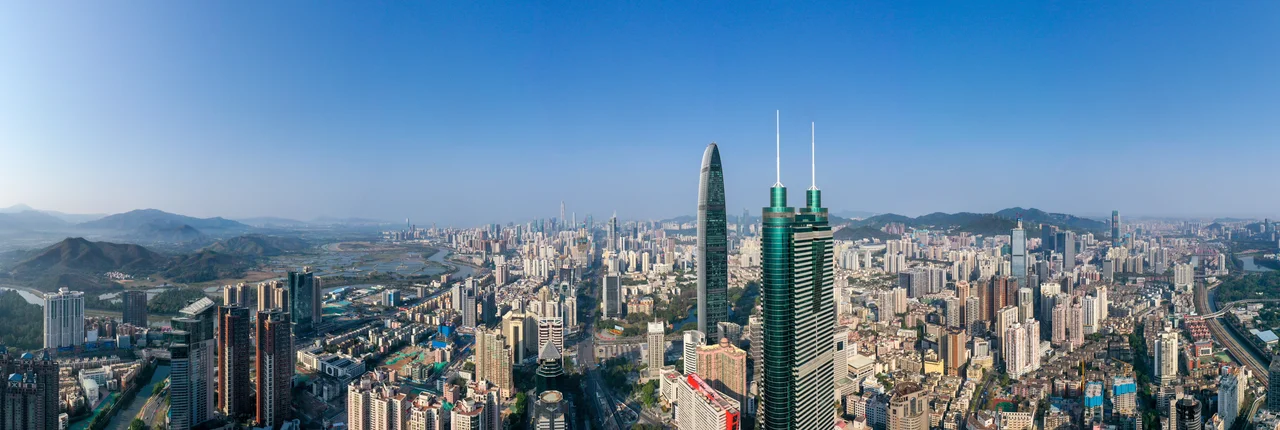

Pearl River Delta
In 1978, a small workshop in Dongguan started making handbags for export to Hong Kong. It was the first export processing business in the People's Republic of China, and almost nothing about it suggested what was coming. Within a decade, the Pearl River Delta — the broad estuary where the Pearl River empties into the South China Sea between Hong Kong and Macau — had become the engine of the fastest economic expansion in recorded history. The region grew at roughly 15 percent a year for nearly three decades. GDP doubled every five years. Fishing villages became cities of millions. Shenzhen, which barely existed as a settlement in the 1970s, now approaches 20 million people and anchors China's technology industry. The Pearl River Delta didn't just change China — it changed how the world makes things.
Before the Factories
The delta's role as a trading centre is ancient. Guangzhou — Canton, as it was known to Western merchants — has been a port city for thousands of years, a node on the Maritime Silk Road where Arab, Indian, and later European traders came to buy Chinese goods. During much of the Qing dynasty, Canton was the only port in China where foreigners were legally permitted to trade, which concentrated enormous wealth and merchant culture in the region. This history of commercial orientation meant that when Deng Xiaoping's reform policies opened China to foreign investment in the late 1970s, the Pearl River Delta had existing infrastructure, existing trading relationships with Hong Kong and Macau, and a population that understood commerce. Two Special Economic Zones — Shenzhen adjacent to Hong Kong, and Zhuhai adjacent to Macau — were established to channel that energy, and the investment followed with extraordinary speed.
Eight Cities, One Workshop
The Pearl River Delta comprises eight prefecture-level cities: Guangzhou, the provincial capital; Shenzhen, the tech hub; Dongguan, centre of the garment trade; Foshan, an industrial city that encompasses Shunde, famous for Cantonese cuisine; Huizhou to the northeast; Jiangmen to the west, whose ancestral villages sent hundreds of thousands of emigrants to the United States and Canada; Zhongshan, birthplace of Sun Yat-Sen; and Zhuhai, the quieter SEZ next to Macau. Together they form what the region calls 'the world's workshop' — producing clothing, electronics, furniture, pharmaceuticals, and an enormous range of other goods. Guangdong province as a whole produces around a third of China's total exports, and most of those come from the delta. The industrial base is not just large; it is diverse in a way that makes the region resilient to sector-specific downturns.
The Architecture of Speed
Moving people and goods across the delta required infrastructure built at the same frenzied pace as the factories. All eight cities connect to China's high-speed rail network. Guangzhou and Hong Kong are major international airports; Shenzhen, Zhuhai, and Macau have large airports as well. A system of fast ferry hydrofoils links the main cities on the Pearl River estuary — Hong Kong and Shenzhen on the east, Macau and Zhuhai on the west — cutting travel times that would otherwise require long road journeys around the river mouth. The opening of the Hong Kong-Zhuhai-Macau Bridge in 2018 further compressed the western and eastern sides of the delta into a single functional unit. Guangzhou's metro is among the world's largest; Shenzhen's is vast and still expanding. The transportation infrastructure and the manufacturing base grew in tandem, each making the other more viable.
Lingnan Culture, Canton Table
Amid the factories and highways, the Pearl River Delta preserves a distinctive cultural identity rooted in the Lingnan tradition — the architecture, cuisine, and social patterns of Cantonese-speaking southern China. The region's traditional buildings, particularly its temples, are constructed primarily from stone (unlike the wood-frame architecture of northern China) and decorated with dense relief carvings and sculptures. In Kaiping, the diaolou watchtowers built by overseas Chinese returnees in the early 20th century — combining Western, Chinese, and sometimes Middle Eastern architectural elements — earned UNESCO World Heritage status in 2007. The Cantonese kitchen is the source of what the world calls 'Chinese food': dim sum, the ritual of morning tea with bamboo steamers of dumplings and rice rolls, the emphasis on fresh ingredients and subtle seasoning rather than the heavy spicing of Sichuan or Hunan. At any dim sum house in the delta, carts move between tables carrying a dozen choices minimum, some establishments offering over a hundred. It is the one thing about this region that the pace of development has not simplified.
The Names on the Other Side
The Pearl River Delta's story is inseparable from the two territories that bracket its mouth. Hong Kong, on the east bank, was a British colony from 1841 until 1997, when it became a Special Administrative Region of China under the 'one country, two systems' framework. Macau, on the west bank, was a Portuguese colony and the first European enclave in East Asia; it became a Special Administrative Region in 1999. Both are administratively distinct from the delta's eight mainland cities, and both are covered by different visa regimes — a practical complexity for travellers that the region has built substantial infrastructure to manage. Economically and culturally, though, the separation is largely nominal. Residents of Hong Kong and Macau routinely cross to Shenzhen and Zhuhai for cheaper shopping and services; mainland residents cross the other way for entertainment, luxury retail, and casinos. The delta functions as a single economic zone that acknowledges, but is not bounded by, its internal political lines.
From the Air
The Pearl River Delta centres on 22.53°N, 113.73°E, the broad estuary where the Pearl River enters the South China Sea between Hong Kong and Macau. From cruising altitude, the delta is unmistakable: a densely built urban sprawl extending for hundreds of kilometres across a low-lying river plain, broken by the wide arms of the Pearl River estuary and the South China Sea coastline. The contrast between the grid of factory districts and the meandering river channels is vivid from above. Major airports within the region: VHHH (Hong Kong International), ZGGG (Guangzhou Baiyun International), ZGSZ (Shenzhen Bao'an International), VMMC (Macau International), and ZGSD (Zhuhai Jinwan). The region is under Class A airspace for most of its extent; the delta is best observed from high altitude or approached via the coastal corridors. Morning light reveals the delta's scale best, when the Pearl River's multiple channels catch the sun against the urban grey.
Nearby Stories
- Death of Chow Tsz-lok 1.6 km away
- Ap Chau 4.2 km away
- Hong Kong–Zhuhai–Macau Bridge 6.5 km away
- Jiangmen 12 km away
- Battle of Yamen 14 km away
- South China Mall 21 km away
- Foshan Wong Fei-hung Memorial Hall 22 km away
- West Lake (Huizhou) 31 km away