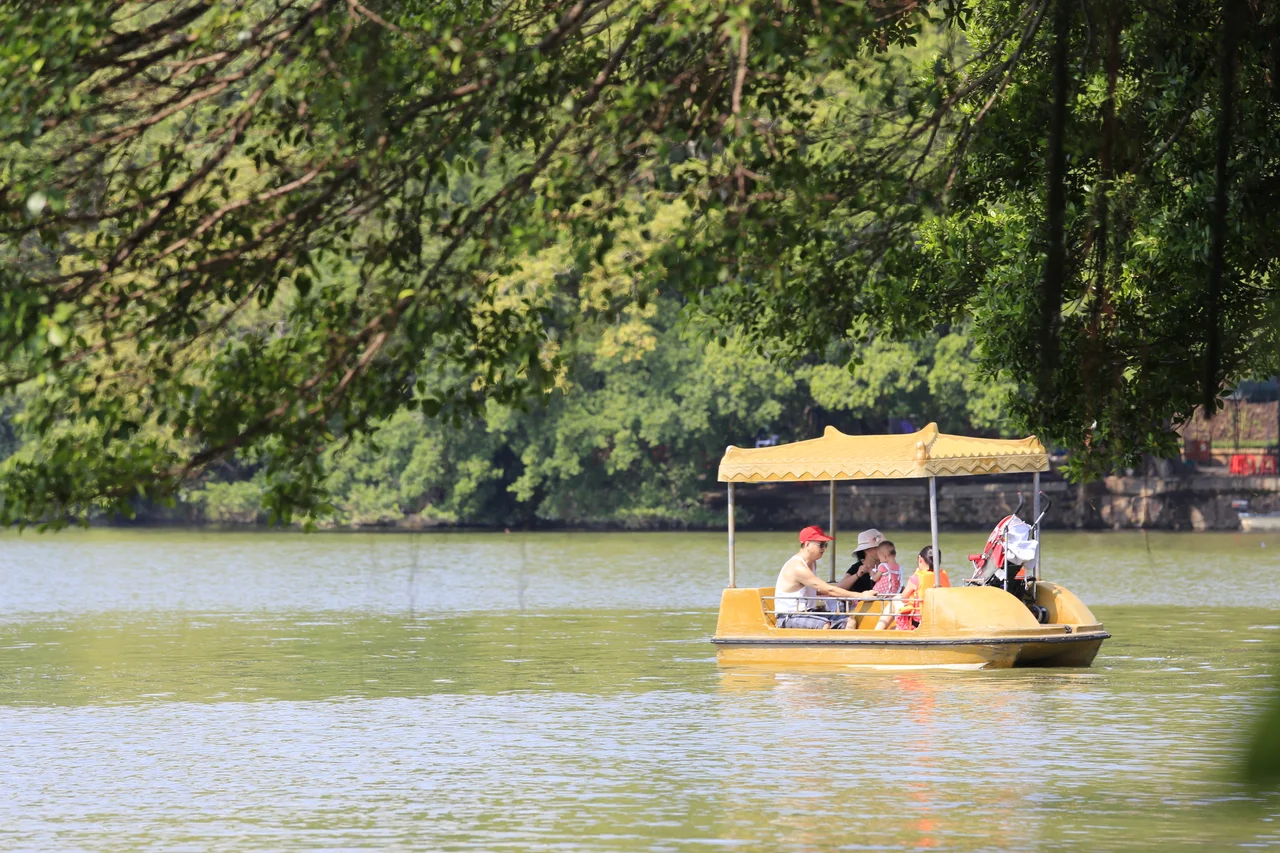

West Lake (Huizhou)
In 1094, the poet Su Shi arrived in Huizhou under circumstances he had not chosen. He had been exiled from the imperial court — a bureaucratic fall from grace — and the subtropical heat, the strange birds, and a lake called Feng Lake (meaning 'bumper harvest') were his compensation. He wrote poems about the lake anyway, and in one of them he compared it to a more famous West Lake in Hangzhou. That comparison, once written, proved irresistible. The lake's name changed. The comparison outlasted the dynasty. And nine hundred years later, the lake at the heart of Huizhou is still called West Lake because a great poet once drew an analogy in exile.
A Name Born from Homesickness
Su Shi lived beside the lake for three years, from 1094 to 1097. During that time he wrote prolifically — poetry, letters, essays — and the lake wove itself into his work. After Su Shi left, the people who remained did not forget him. In 1096, they built a causeway named the Su Causeway in his memory, and also the Xixin Bridge. The previous year, in 1095, Wang Zhaoyun — Su Shi's most beloved companion, who had followed him into exile — died in Huizhou and was buried near the lakeshore. Su Shi built a pavilion, the Liuru Pavilion, to honor her. The lake became a place of devotion, grief, and memory layered over generations of ordinary life.
Centuries of Cultivation and Loss
Long before Su Shi arrived, the lake had been taking shape. During the Eastern Jin dynasty (317–420), a Buddhist temple called Longxing Temple was built on its banks. By the Tang dynasty, emperors renamed and enlarged it. In 1066, Magistrate Chen Cheng deepened the lake and added bridges, towers, and pavilions. In 1244, a school called the Juxian Hall was founded within the lake grounds, later renamed the Fenghu Academy — one of the most significant educational institutions in Huizhou through the Ming and Qing dynasties, rebuilt again in 1801. All of this accumulation — temples, schools, pavilions, causeways — was almost undone in the 20th century. From the 1950s to the 1980s, real estate development shrunk the lake's water surface by 46 percent. Recovery took political will: in 2007 the Huizhou Municipal Government allocated 150 million yuan for reconstruction.
Water, Birds, and the Work of Restoration
Today West Lake covers a combined area of 20.91 square kilometers, of which 3.13 square kilometers is open water — divided into five linked basins: South Lake, Feng Lake, Ping Lake, E Lake, and Ling Lake. Nine bridges cross various points. The biological inventory is substantial: as of 2004, the lake supported 117 species of phytoplankton, 127 plant species, 50 species of birds, 50 species of reptiles and amphibians, and more than 50 fish species. But by the 1970s, sewage inflow had triggered severe eutrophication — nutrient overload that robs water of oxygen. Recovery was neither fast nor simple. In 2018, one basin was successfully restored through biomanipulation: introducing species that rebalance the aquatic food web. The improvement was real, though the work of restoration continues.
The Lake That China Recognizes
West Lake Huizhou holds a National AAAAA-level Scenic Spot designation — the highest rating China's tourism authorities award, shared with a very short list of sites. The park's paths loop past the Su Causeway, a memorial to Wang Zhaoyun, and the rebuilt Fenghu Academy. On clear mornings the water is calm enough to reflect the green hills behind the city. Families walk circuits of the lake; older residents practice tai chi beside the shore. None of it feels performed. West Lake in Huizhou has been a working part of daily life for so many centuries that the tourism designation, however prestigious, is almost beside the point. The poet who named it is long gone, but the name he gave it has stayed.
From the Air
West Lake Huizhou is centered at approximately 23.09°N, 114.40°E, within the urban core of Huizhou city. The linked lake basins form a distinctive water feature visible from the air — an irregularly shaped expanse of water set within the city grid. The nearest major airport is Shenzhen Bao'an International Airport (ZGSZ), approximately 70 km to the southwest. Huizhou Pingtan Airport (ZGHZ) is a domestic-only facility about 12 km to the northeast. At 5,000 feet, the lake is clearly visible as a navigation reference against the surrounding urban fabric. The subtropical climate brings frequent haze and afternoon cloud buildup.
Nearby Stories
- Dongguan 18 km away
- China Southern Airlines Flight 3456 26 km away
- Dapeng Fortress 29 km away
- Heyuan 49 km away
- Qingyuan Maglev Tourist Line 82 km away
- Penghu Air Raids 465 km away
- Battle of Penghu 468 km away
- Republic of China Air Force Academy 544 km away