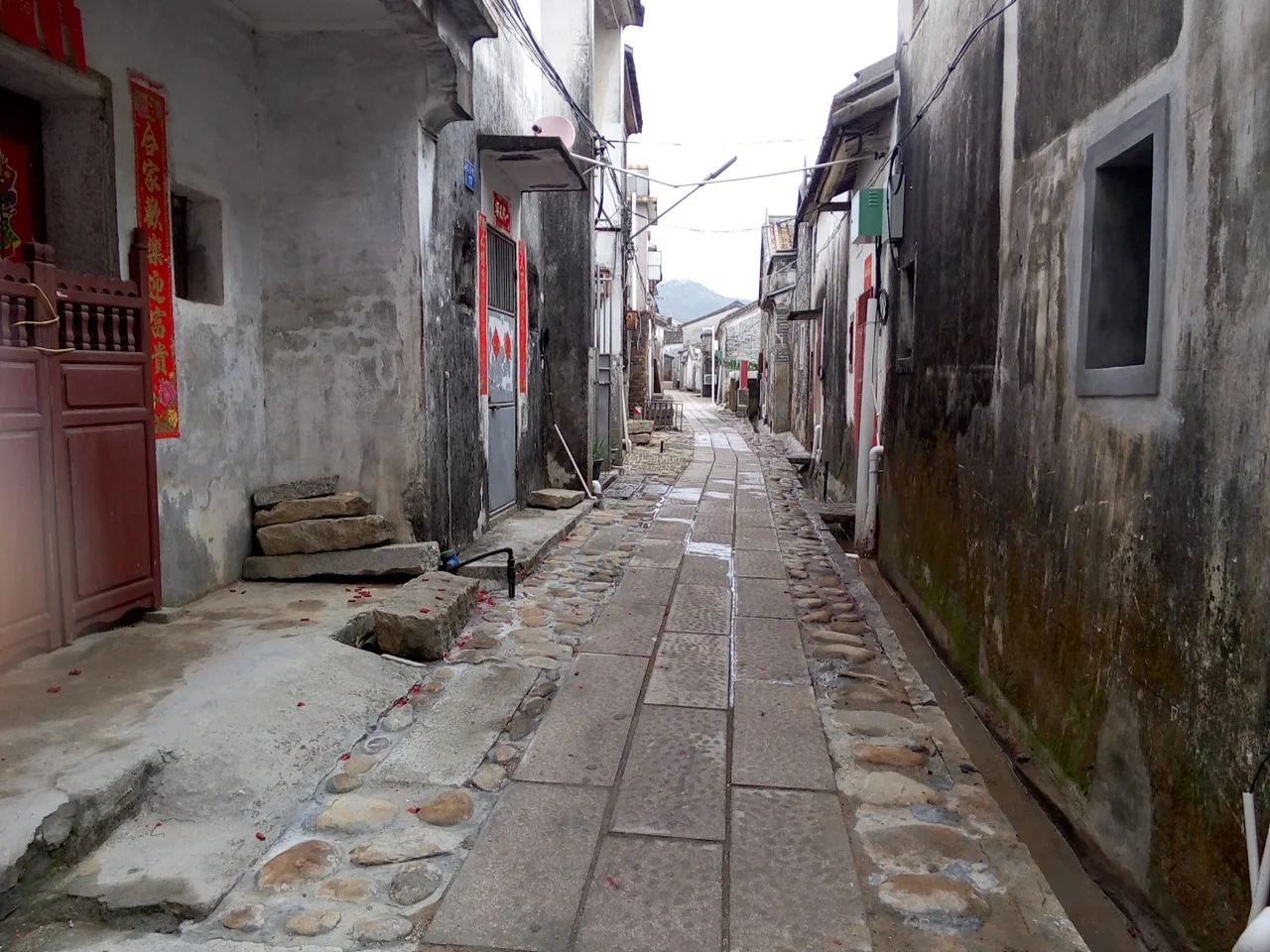

Dapeng Fortress
The great wall of Dapeng was built to keep pirates out. Six hundred years later, it still stands. Fifty-five kilometres from the center of Shenzhen, in the Dapeng Peninsula's southeastern corner, the walled garrison town known as Dapengsuocheng — Dapeng Fortress — rises from the low hills above the South China Sea. Its gates are still intact. Its alleys still wind between the courtyard houses of the soldiers' descendants. In a city that remade itself from a fishing village into a global metropolis in a single generation, Dapeng Fortress is something rare: a place where six centuries of continuous history can be read in stone.
Built Against the Pirates
The fortress was constructed in 1394, during the 27th year of the Hongwu Emperor's reign — the founding decades of the Ming dynasty. Its purpose was military and specific: to guard this stretch of the Guangdong coast against the Japanese pirates known as wokou, who raided coastal settlements with enough regularity to make permanent defenses necessary. The Ming court designated Dapeng a Thousand Household City — a garrison settlement garrisoned by a hereditary military force whose families would live within the walls and whose sons would inherit their fathers' obligations to defend them. The walls enclosed not just barracks but a functioning community: homes, temples, administrative offices, all organized around the imperative of coastal defense. In 1571, that imperative was tested when Japanese pirates equipped with scaling ladders besieged the fortress for more than forty days. The walls held.
The Qing Era and the Opium War
Under the Qing dynasty, Dapeng's role expanded. The garrison became the Dapeng Marine Master Camp, responsible for a network of nine subordinate districts stretching from Dongyongkou in the east to Lantau in the west — the same Lantau Island where Hong Kong International Airport now stands. In the flood season, the camp extended jurisdiction over additional forts at Fotangmen, Nantou, and Tuotu. Two battalions operated from this structure: the headquarters and left battalion at Dapeng itself, the right battalion stationed at the newly built Tung Chung Fort on Lantau. During the Daoguang period, as Britain pressed the Qing court to open its ports to opium trade, Dapeng became one of the military strongholds from which the Qing navy mounted its resistance. The fortress produced generals, including one known by the honorific Zhenwei — Guardian of Might — who became celebrated for his role in the anti-British campaigns of the First Opium War.
The Language of the Garrison
One of the more unusual legacies of Dapeng's six centuries as a garrison settlement is linguistic. The descendants of the original Ming soldiers developed their own dialect — the Dapeng dialect — which blends elements of Hakka and Cantonese in proportions found nowhere else. The soldiers who came to Dapeng in 1394 were drawn from different parts of the empire, bringing different speech patterns with them. Isolated within the fortress walls, speaking among themselves and intermarrying across generations, they produced a dialect distinct enough to be studied by linguists as a separate variety of Chinese. It is still spoken by some residents of the Pengcheng Community today, though its speakers are aging and the dialect's future is uncertain. Language, like stone, can survive for centuries — but both require people to maintain them.
What Remains
Dapeng Fortress was listed as a cultural relics protection unit in Shenzhen in 1983. The Guangdong Provincial Government added its own designation in 1989. The Dapeng Ancient City Museum opened in May 1996 to manage and interpret the site. Within the walls, traditional courtyard houses survive alongside the museum exhibits, and the fortress community remains inhabited — the Pengcheng Community of Dapeng New District occupies the same ground that soldiers once patrolled. Walking through the southern gate and into the alleys, visitors encounter the layered life of a place that has been continuously occupied for over six centuries: old stone and new plaster, ancestral halls and convenience stores, the past and the present negotiating the same narrow lanes. Shenzhen, the city that grew up around Dapeng's district, sometimes goes by an older name for the fortress: Pengcheng.
From the Air
Dapeng Fortress is located at approximately 22.60°N, 114.51°E on the Dapeng Peninsula, in the Longgang District of Shenzhen. From the air, the fortress walls are visible as a rectangular enclosure in the low hills above the eastern shore of Shenzhen Bay, with the South China Sea visible to the east and southeast. Nearest major airport is Shenzhen Bao'an International (ZGSZ), approximately 55 kilometres to the west. The Dapeng Peninsula extends southward into the sea between Daya Bay to the east and Dapeng Bay to the west, offering clear coastal landmarks for aerial navigation.
Nearby Stories
- Basalt Island 7.1 km away
- Ngong Ping 360 7.5 km away
- China Southern Airlines Flight 3456 11 km away
- Huizhou (Guangdong) 27 km away
- Dongguan 27 km away
- Battle of Penghu 471 km away
- Penghu Air Raids 477 km away
- Checheng Fu'an Temple 593 km away