
Huizhou (Guangdong)
"Where did this place come from?" That is the reaction many first-time visitors report when they arrive in Huizhou — a city of wide boulevards, lakeside promenades, and unmistakable prosperity, sitting 40 miles north of Shenzhen in verdant tropical countryside. Until the 1980s, Huizhou was a quiet Guangdong settlement on the Pearl River Delta. Then global manufacturing found it. Japanese, Korean, European, and American companies followed one another in, and within a generation the city had reinvented itself so thoroughly that the before-and-after barely seems like the same place.
A City of Surprises
Huizhou (惠州, pronounced Huìzhōu in Mandarin and Fui4ziu1 in Hakka) is consistently ranked among the most architecturally pleasing mid-sized cities in Guangdong — and among the richest. The combination is unusual. Rapid industrialization in the Pearl River Delta region has leveled many historic streetscapes, but Huizhou retained its lake, its older quarters, and a civic aesthetic that resists pure functionalism. West Lake sits at the heart of the city, a sculpted waterscape that has anchored urban life here since the Song dynasty. Walk its causeways at dusk and the scene feels more like a classical painting than a city of nearly eight million people.
Languages on Every Corner
Hakka is the primary language of Huizhou, spoken in the distinctive tonal cadences that mark this linguistic community across southeastern China and the global diaspora. But the city is a crossroads, and its soundscape reflects that. Cantonese drifts in from the Pearl River Delta cities to the south and west; Mandarin is the official medium in schools, government, and workplaces; and the city's large expat population has created pockets where English, Japanese, and Korean are entirely unremarkable to hear. Younger locals generally navigate between Hakka, Cantonese, and Mandarin with ease — a multilingualism that is less remarkable to residents than to visitors who grew up thinking cities picked one language and stuck with it.
Getting In, Getting Around
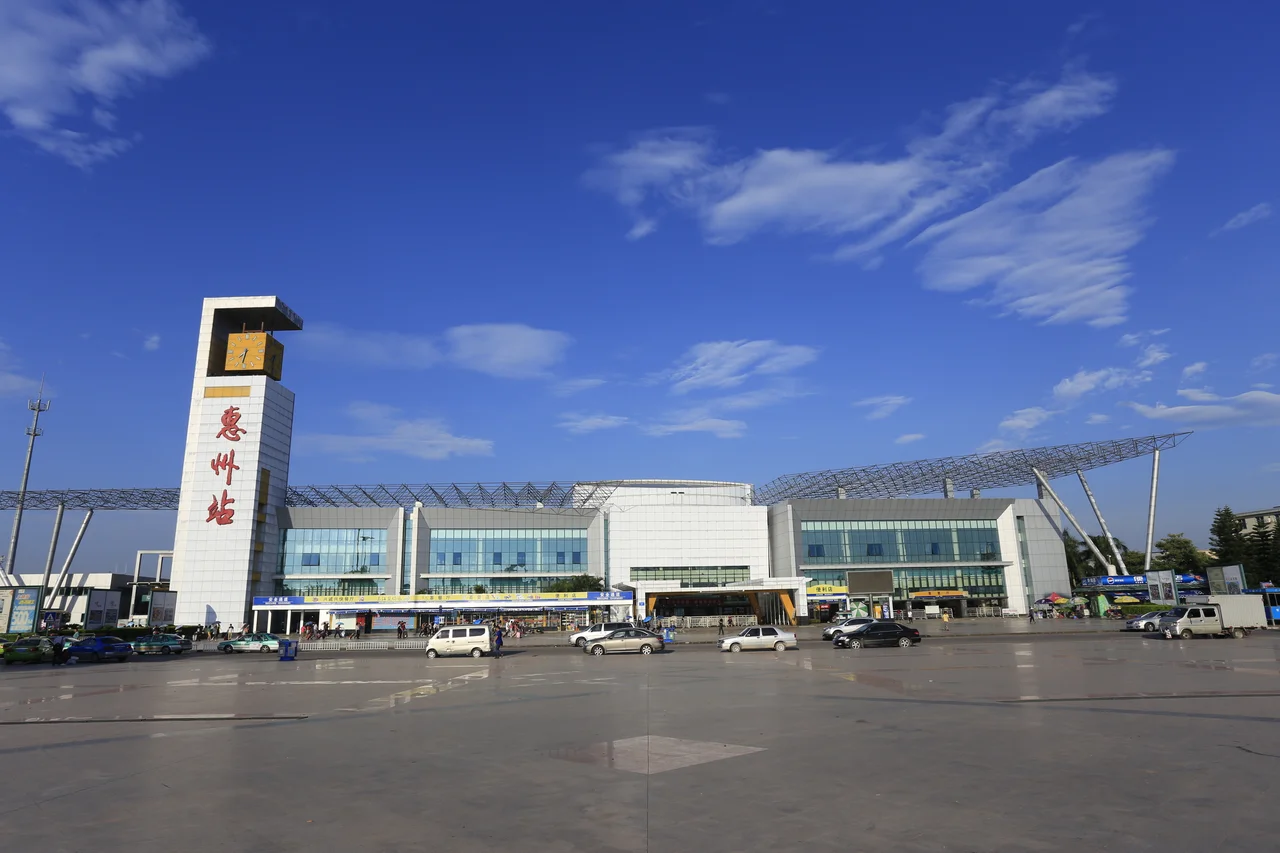
Huizhou Pingtan Airport (ZGHZ) offers domestic connections to cities across China, though travelers arriving internationally typically use Shenzhen Bao'an (ZGSZ, about 90 minutes by intercity bus) or Guangzhou Baiyun (ZGGG). Highways link Huizhou tightly to Guangzhou, Shenzhen, and Hong Kong — the border crossing for the latter is only about 90 minutes by bus. The city's rail network has expanded significantly: Huizhou Railway Station and Huizhou North Railway Station handle mainline services, while the intercity rail line connecting through Dongguan has been extended since May 2024 to reach Guangzhou South Station, placing Huizhou within easy reach of the entire Pearl River Delta transit web. Within the city, buses cost a flat ¥2 per ride, and taxis are plentiful.
Life at the Lake and Beyond
The fabric of daily life in Huizhou is shaped by West Lake — the green lungs and social center of the city — and by a food culture that pulls in all directions. Traditional Hakka cooking sits alongside Hong Kong-Cantonese food (enormously popular given the city's geographic and commercial ties to the south) and a full range of Japanese and Western restaurants brought in by the expat community. For self-caterers, international supermarkets including Walmart and Park'n'Shop stock imported goods. The riverfront bars draw expats for imported draft beer and cocktails; a few Buddhist vegetarian restaurants serve a quieter clientele. Huizhou is a city comfortable with contradiction — ancient and brand-new, industrial and scenic, local and international — and it wears none of those tensions with any particular anxiety.
From the Air
Huizhou is centered at approximately 23.09°N, 114.41°E, in the eastern Pearl River Delta region of Guangdong. The city is served by Huizhou Pingtan Airport (ZGHZ), a smaller regional facility with domestic routes only. The nearest major international hub is Shenzhen Bao'an International Airport (ZGSZ), approximately 70 km to the southwest; Guangzhou Baiyun (ZGGG) lies about 110 km to the west-northwest. From the air, West Lake is the most distinctive visual reference — a connected system of lakes and causeways visible near the city center. The Dongjiang River forms the northern boundary of the urban core. Haze is common in this region, particularly in summer.
Nearby Stories
- Dongguan 18 km away
- China Southern Airlines Flight 3456 26 km away
- Dapeng Fortress 29 km away
- Heyuan 49 km away
- Qingyuan Maglev Tourist Line 82 km away
- Penghu Air Raids 465 km away
- Battle of Penghu 468 km away
- Republic of China Air Force Academy 544 km away