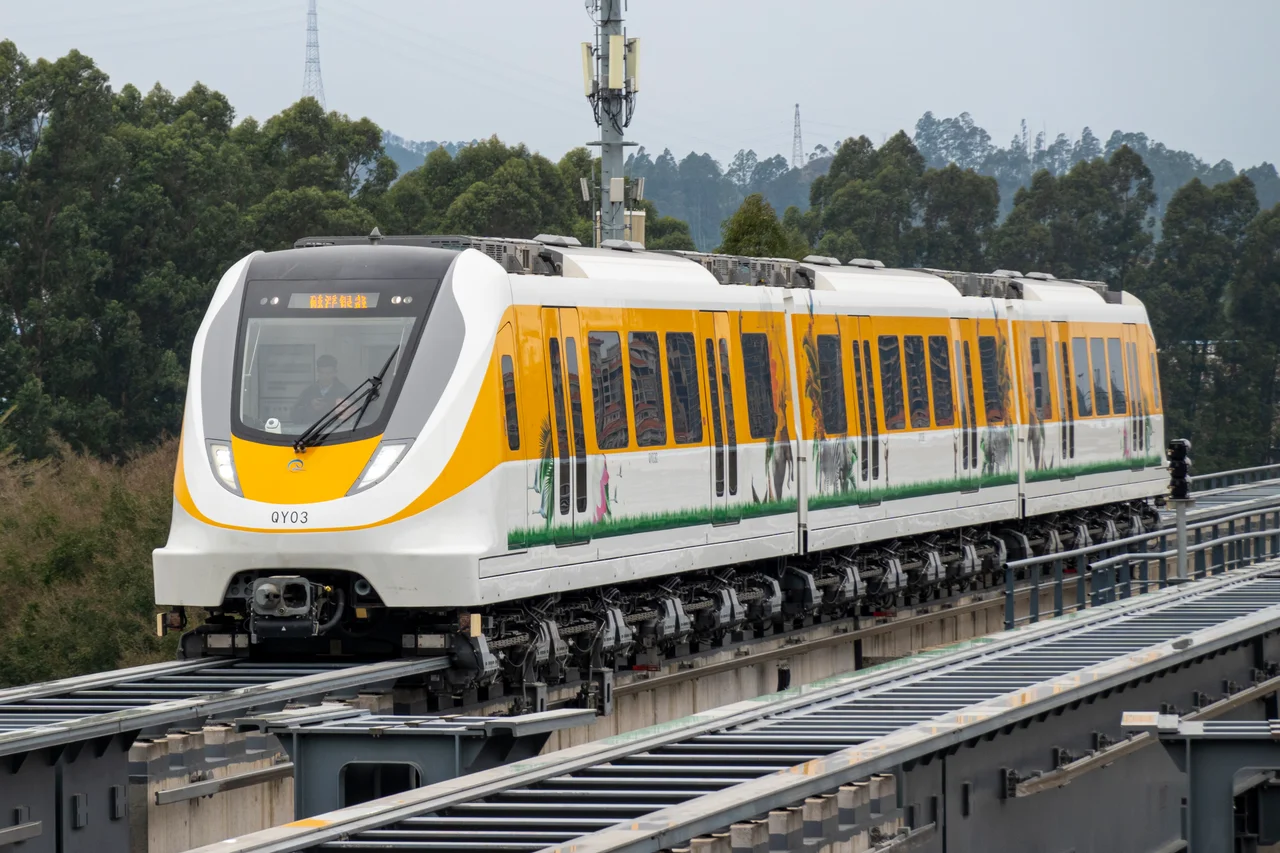

Qingyuan Maglev Tourist Line
There is something quietly radical about a train that never touches its tracks. The Qingyuan Maglev Tourist Line, which opened to the public in early 2025, does not clatter or screech. It floats — suspended by magnetic fields above its guideway — and moves at up to 120 kilometers per hour through the hills north of the Pearl River Delta with a smoothness that feels almost implausible. China has built high-speed maglev before, most famously the Shanghai Transrapid. But Qingyuan's line is different: this is the country's first maglev railway designed specifically for tourism, connecting a new theme park to the wider rail network in a way that makes the journey itself part of the attraction.
How a Maglev Works — and Why It's Quiet
Magnetic levitation eliminates the two greatest sources of noise and wear in conventional rail: the wheel on the rail, and the friction between them. Electromagnetic forces lift the Qingyuan train a few centimeters above its guideway and propel it forward without any contact at all. The result is a ride noticeably quieter than a bus and smoother than any steel-on-steel train. The technology is not new — engineers have understood the physics for decades — but deploying it at medium-low speed for a regional tourist corridor is a relatively recent Chinese innovation. CRRC Corporation, the state-owned rail manufacturer, developed and built the rolling stock. Commissioning began in early 2023, full track-laying finished in August 2023, and a public trial run in February 2024 drew curious crowds before the full opening.
The Route: Theme Park to Intercity Rail
The first phase covers 8.1 kilometers and serves three stations, with a site reserved for a fourth. At one end sits Maglev Yinzhan Station, connecting passengers to the Guangzhou–Qingyuan intercity railway — a link that puts Guangzhou's urban rail network within reach. At the other end is Qingyuan Chimelong Theme Park, the centerpiece of a large resort development that opened on the same day as the maglev line itself. In between is Butterfly Bay station. The fare structure is deliberately accessible: ¥5 for the short hop to Maglev Yinzhan, ¥10 from Butterfly Bay to the park, ¥15 for the full journey, and ¥35 for an all-day pass. Children below a certain height ride free with an adult. Students pay half price. Long-term, the line is planned to extend to 38.5 kilometers — more than four times its current length — threading deeper into Qingyuan's scenic north.
Qingyuan's Gamble on the Future
Qingyuan is a city still defining itself. Sitting just north of the Pearl River Delta, close enough to Guangzhou to be within easy reach but far enough to feel different — greener, quieter, more mountainous — it has been building toward tourism for years. The Chimelong Group, which operates theme parks, water parks, and wildlife parks across China, chose Qingyuan for a major new resort, and the city responded by building the maglev to serve it. It is a bet on experience tourism: the idea that getting there should be as memorable as being there. Whether that bet pays off depends partly on how the resort develops, and partly on whether Chinese travelers, accustomed to high-speed rail, find something genuinely novel in floating through the subtropical foliage at 120 kilometers per hour. Early signs suggest they do.
A Glimpse of the Schedule
Since February 2025, the Qingyuan Maglev has operated daily from 09:30 to 19:30. Three trains share the line, running at intervals of 12 to 20 minutes — frequent enough for a leisure destination, spaced enough to keep the quiet atmosphere intact. The hours and headways are calibrated for day-trippers: arrive from Guangzhou in under an hour by intercity train, board the maglev, spend the day at the park, float back before evening. The whole loop is designed to be completed without a car. For a city that has spent decades in Guangzhou's shadow, the maglev is as much a statement about ambition as it is a piece of transport infrastructure.
From the Air
The Qingyuan Maglev Tourist Line is centered at approximately 23.55°N, 113.12°E, in Qingyuan city, Guangdong. The guideway runs roughly north-south between the Yinzhan intercity rail terminus and the Chimelong Theme Park site. At 3,000–5,000 feet, the line's elevated guideway is visible against the green hills north of the Pearl River Delta plain. The nearest major airport is Guangzhou Baiyun International (ZGGG), approximately 50 km south. Qingyuan itself sits in a valley between low mountain ridges; the Bei River, a tributary of the Pearl, flows through the city. Approaching from the south on approach to ZGGG, the terrain transitions visibly from delta plain to rolling hills at Qingyuan's latitude.
Nearby Stories
- Liang's Garden 20 km away
- South China Mall 25 km away
- Mount Luofu 49 km away
- Heyuan 116 km away
- Battle of Nanpeng Island 186 km away
- Temple of the Five Lords 444 km away
- Mudouyu Lighthouse 669 km away
- Lugu Lake 1252 km away