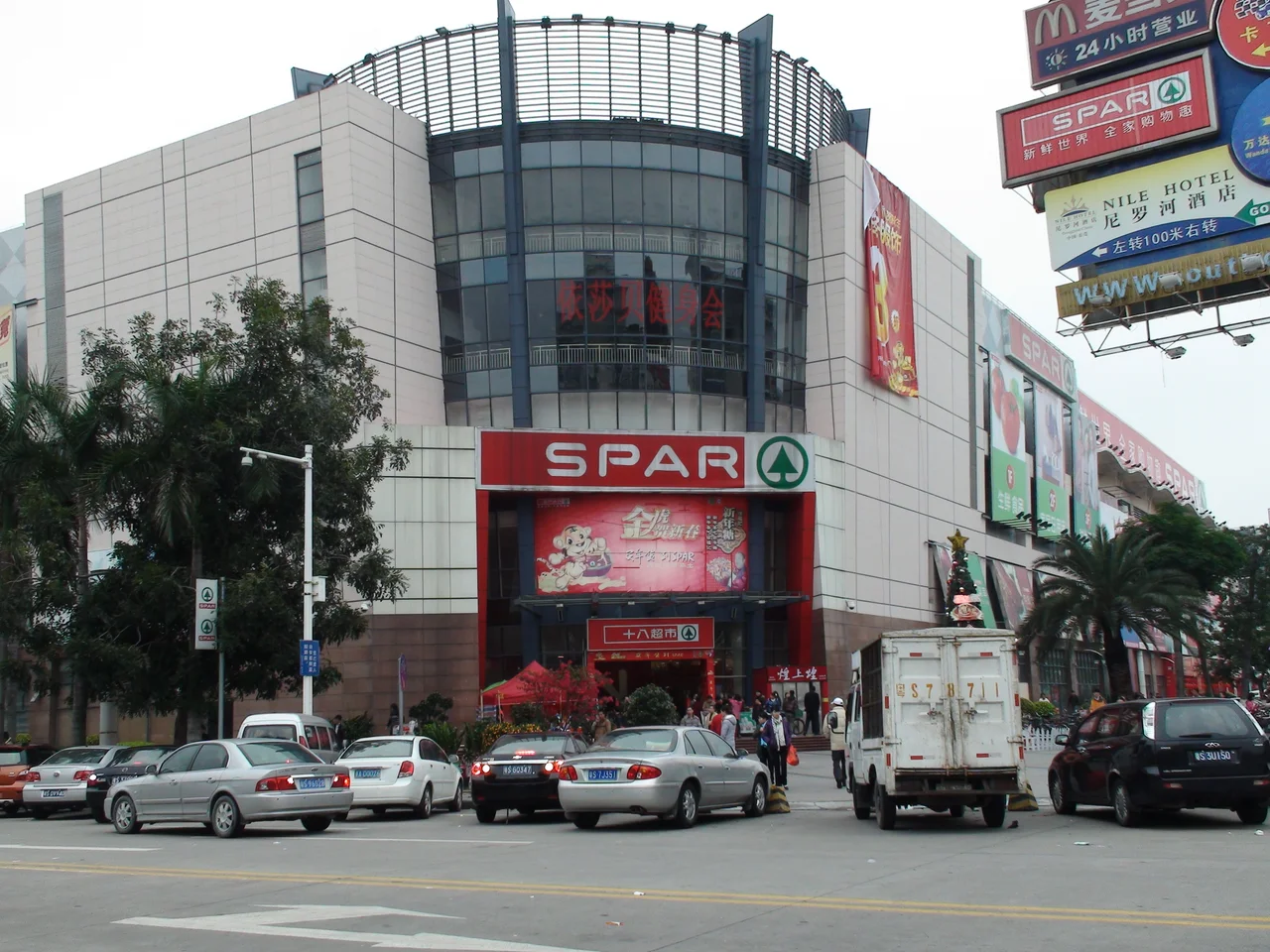

South China Mall
The indoor canal water had turned green. Four full floors sat empty. A parking structure had been repurposed as a go-kart track because there was nothing else to put there. A filmmaker came and called his documentary Utopia, Part 3. This was South China Mall in its ghost years — the period after it opened in 2005 and before anyone quite figured out what to do with it — and the images from those years became shorthand for a particular kind of Chinese economic ambition that had outrun its market. The mall was built sufficient for as many as 2,350 stores on farmland in Dongguan's Wanjiang District. It has seven zones modeled on international cities: Amsterdam, Paris, Rome, Venice, Egypt, the Caribbean, California. It contains a 25-meter replica of the Arc de Triomphe, a replica of St. Mark's bell tower, and a 2.1-kilometer canal with gondolas. Nobody came to shop.
Built on Ambition and Farmland
South China Mall opened in 2005, the creation of developer Hu Guirong (also known as Alex Hu), whose company Dongguan Sanyuan Yinghui Investment & Development built the complex on former agricultural land in Wanjiang District. The scale was extraordinary. The mall was designed to be the world's largest shopping center, organized into themed international zones that would give visitors the sensation of traveling across multiple continents without leaving Dongguan. A planned Shangri-La Hotel was part of the original vision. A controlling interest in the mall was eventually sold to Founder Group, a division of Peking University, and the property was rebranded as New South China Mall, Living City in September 2007. None of these ownership transitions, and none of the theming, resolved the fundamental problem: the anchor tenants and smaller retailers the mall needed to attract simply didn't materialize. The only reliably occupied area near the entrance featured Western fast-food chains. The rest echoed.
A Decade of Empty Corridors
The vacancy that defined South China Mall in its early years was not subtle. In 2013, a writer for Vagabond Journey toured the complex and documented what he found: four full floors unused, artificial canal water that had gone green, an IMAX cinema that drew visitors despite the emptiness around it, a play area where families gathered in a building designed for thousands. A Sundance Film Festival documentary had already captured the scene — filmmaker Sam Green's Utopia Part 3: the World's Largest Shopping Mall premiered in 2009 and was later broadcast on PBS, reaching American audiences who found the spectacle of an enormous near-empty mall both familiar and strange. By then the mall had become something of a cultural object, referenced in discussions about Chinese economic development, the pace of urbanization, the dangers of building retail supply before retail demand. A planned superlative had become a famous cautionary example.
The Long Comeback
South China Mall did not stay empty forever, though its recovery was slower and more complicated than its promoters had hoped. A CNN story in 2015 reported that large parts of the mall had been renovated and now contained functioning shops, restaurants, and entertainment venues — but also acknowledged that significant portions remained vacant or were still under renovation. By 2018, industry observers expected most retail spaces to fill soon. In 2020, China Times reported an occupancy rate of 91%, with projections reaching 98% the following year. Footage from 2024, however, showed that substantial vacant areas remained, particularly on upper floors. The pattern that emerged over two decades was one of incremental, uneven recovery: the mall gained occupancy in waves tied to major renovations and ownership changes, never quite achieving the saturated, fully-activated status that its original concept promised.
Venice Canals and IMAX Screens
What South China Mall became, in its reinvented form, is worth understanding on its own terms rather than simply against what it was supposed to be. The experience-based entertainment pivot that Chinese malls broadly adopted in response to the decline of big-box retail found a particularly elaborate canvas here. The mall's central square was updated with greenery and lighting and a marine park called Sea Cube. Night markets with food stalls were installed. The IMAX cinema — which had been one of the few reliable draws since opening — remained a centerpiece. The seven international zones, with their replica Arc de Triomphe and gondola-equipped canals, function less as sophisticated illusions than as theatrical backdrops for the selfie-taking, food-grazing, entertainment-seeking behavior that now defines Chinese mall culture. It is a different destination than what was built in 2005. Whether it is a better one depends on what you were looking for.
What the Ghost Mall Meant
South China Mall achieved its greatest cultural resonance during the years it was emptiest. The images of vast vacant corridors beneath elaborate theming — the Venetian campanile rising above silent escalators, gondolas floating through the green-tinged water — captured something real about the speed and scale of China's development era, and about the gap that could open between infrastructure and the human activity infrastructure is built to serve. Those images circulated widely in Western media, usually as evidence of overreach, sometimes as comedy. What they rarely acknowledged was that the mall was also a genuine experiment: an attempt, in one of the world's most dynamic economies, to build the future slightly ahead of schedule. The future, in this case, arrived eventually — partially, imperfectly, and much later than planned. The mall that was built for the world's largest ambitions is still there in Wanjiang District, considerably fuller than it once was and considerably emptier than it was meant to be.
From the Air
South China Mall is located at approximately 23.038°N, 113.721°E in the Wanjiang District of Dongguan, Guangdong. The nearest major airport is Shenzhen Bao'an International (ZGSZ), approximately 55 km to the south. Guangzhou Baiyun International (ZGGG) is approximately 70 km to the northwest. From altitude, the mall's large footprint is distinguishable amid the surrounding industrial and residential development of Wanjiang District. The Pearl River runs to the west, offering a navigation reference. At lower altitudes on approach to ZGSZ from the north, the mall and the broader Dongguan urban area are visible beneath the typical Pearl River Delta haze. Clear days offer the best visibility of this section of the delta.
Nearby Stories
- Fengjian Village 6.5 km away
- Opium War Museum 8.2 km away
- Liang's Garden 13 km away
- West Lake (Huizhou) 14 km away
- Qingyuan Maglev Tourist Line 21 km away
- Horizontal Skyscraper – Vanke Center 28 km away
- Heyuan 61 km away
- Qingyuan 77 km away