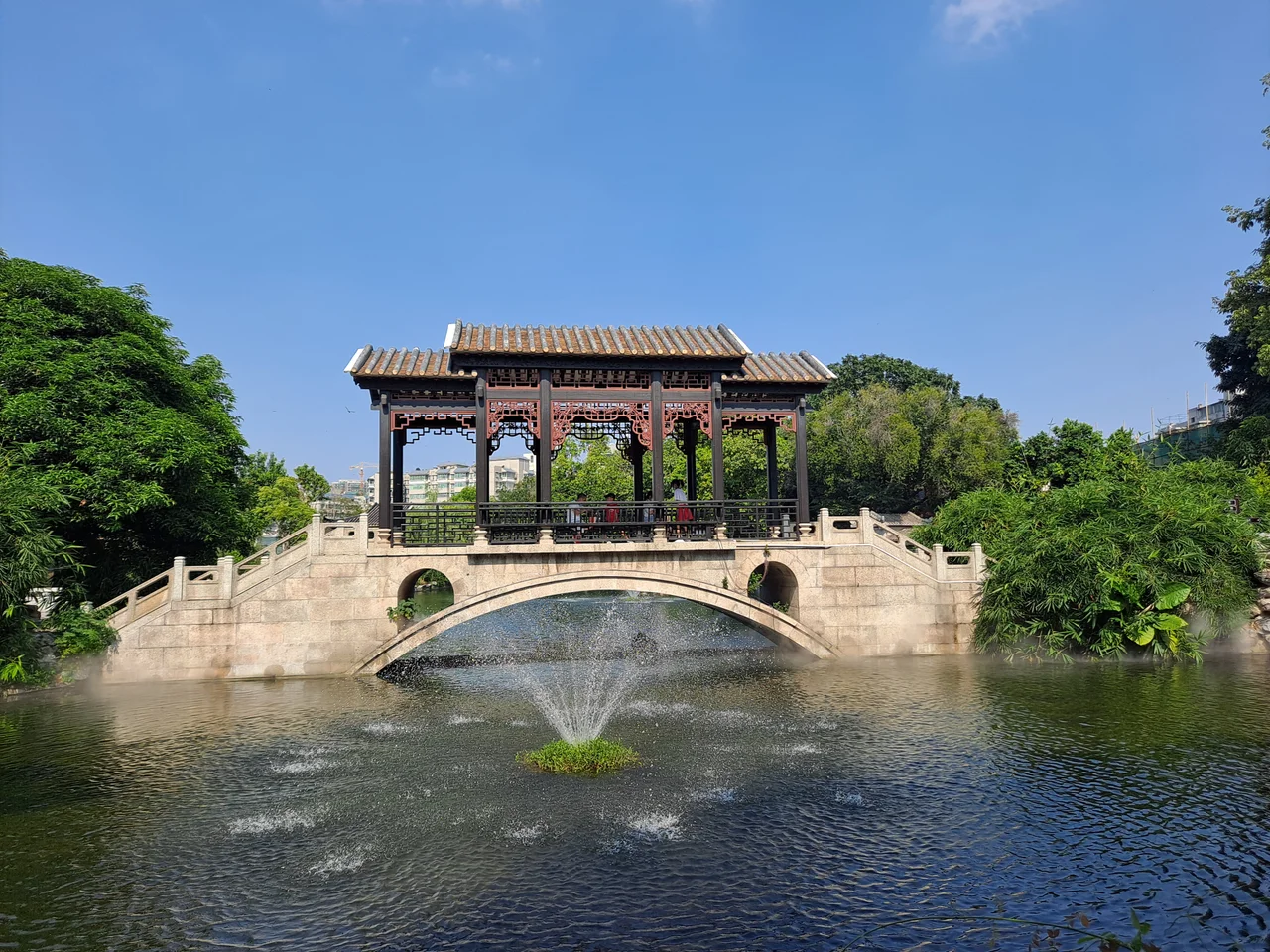

Liang's Garden
Four men — uncles and nephews of the same family — spent forty years making a garden. They began in 1796, during the reign of the Qing dynasty, and the work passed between generations like a slow conversation about beauty. Liang Airu started it. Liang Jiuzhang, Liang Jiuhua, and Liang Jiutu continued it. By the time they finished, they had created something that would outlast them by two centuries, though the garden would first have to survive near-destruction before anyone could be sure of that.
A Family's Four Decades of Work
Liang's Garden — known in Chinese as Liang Yuan — sits in the heart of Foshan, a city in Guangdong Province that has been a center of Cantonese culture and craft for a thousand years. The garden belongs to a tradition of private scholar-gardens: spaces where educated Chinese families created miniature worlds of stone, water, and planting, designed for contemplation, poetry, and the quiet pleasures of a cultivated life. This was not a commission from an emperor or a merchant guild. It was a family project, built on a domestic scale, and its intimacy shows.
The Liang family constructed several distinct spaces within the compound. The Twelve-Stone House (十二石斋) takes its name from twelve extraordinary stones gathered for display — prized for their unusual shapes and textures, stones being as important in classical Chinese gardens as flowers are in Western ones. The Qunxing Thatched Cottage (群星草堂) gave the family a place for scholarly gatherings. The Fenjiang Thatched Cottage (汾江草芦) and the Hanxiang House (寒香馆) added further rooms for retreat and study. Pagodas, sculptures, lakes, and gardens of trees and shrubs filled the spaces between.
The Architecture of Lingnan Style
What distinguishes Lingnan garden design from the better-known gardens of Suzhou or Beijing is a frank engagement with the subtropical climate of southern China. Lingnan gardens favor open, airy structures with wide eaves, latticed screens, and corridors that catch the breeze. They tend to feel less formal than their northern counterparts — more lived-in, more domestic — and they make liberal use of the region's particular aesthetic vocabulary: carved wooden screens, decorative tilework, and the distinctive grey-brick architecture of the Pearl River Delta.
Liang's Garden expresses all of this. The pavilions are built to encourage airflow; the courtyards are scaled for human use rather than imperial display. Walking through it, you get the sense that someone actually lived here, that poetry was read aloud in these rooms, that the stones were chosen by someone who genuinely cared which stone went where. That quality of personal attention — accumulated over four decades and four people — is what makes the garden feel different from a designed public space.
Survival and Rescue
By the time of the early Republic period, around 1912, the garden was in serious danger. Political upheaval, changing fortunes, and decades of neglect had taken their toll. The compound that the Liang family had so carefully assembled came close to being lost entirely. That it survived at all is partly a matter of luck, and partly a matter of later recognition.
In 1982, the Foshan city government stepped in to save and protect the Qunxing Thatched Cottage — the first formal official intervention on behalf of the garden. Eight years later, in 1990, the Guangdong provincial government granted the garden cultural relic protection status, securing its future. Large-scale restoration work began in 1994, covering an area of 21,260 square meters, bringing the compound back to a condition that reflects what the Liang family originally built. Today it stands alongside the Yuyin Garden, Keyuan, and Qinghui Garden as one of the four most celebrated classical gardens in Guangdong Province.
What Remains
Visitors today find a garden that rewards slow attention. The stones of the Twelve-Stone House are still here, weathered and singular. The thatched cottages have been restored to something close to their nineteenth-century character. Water reflects the pavilions; trees provide shade that the subtropical summer makes welcome. The garden is not large by the standards of famous Chinese pleasure grounds, but size was never the point. The Liang family made something precise and personal, and that scale is exactly right for what the place was always meant to be.
Foshan itself has grown into one of the largest cities in Guangdong, but inside the garden walls the pace slows down. The forty years the family spent building this place have left something that cannot be hurried through.
From the Air
Liang's Garden sits at 23.041°N, 113.108°E in central Foshan, part of the Pearl River Delta. From the air at 3,000–5,000 feet, Foshan appears as a dense urban fabric immediately southwest of Guangzhou, the two cities almost continuous. The garden itself is too small to resolve from cruising altitude but sits in the historic Shiwan district, visible as a pocket of older rooftops amid modern development. The nearest major airport is ZGGG (Guangzhou Baiyun International), approximately 30 km to the northeast. The Pearl River's main channels fan visibly across the delta to the south.
Nearby Stories
- Humen 7.6 km away
- Birds' Paradise 11 km away
- South China Mall 19 km away
- Qingyuan Maglev Tourist Line 22 km away
- Heyuan 123 km away
- Battle of Nanpeng Island 148 km away
- Temple of the Five Lords 410 km away
- Lugu Lake 1268 km away