
Humen
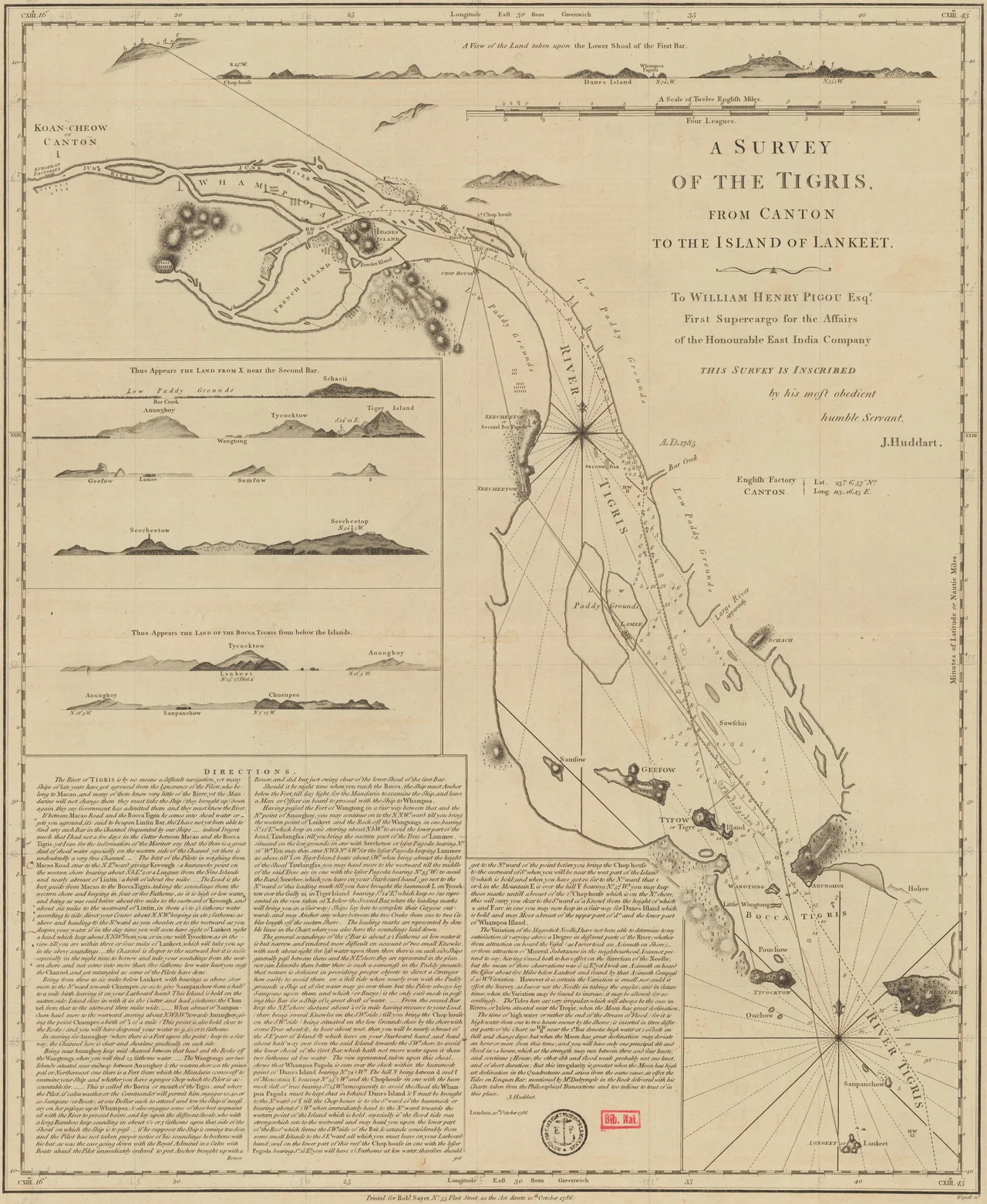
Matthew Perry, not yet famous for opening Japan, passed through the Humen strait in the 1850s and noted that the hills on either side did, upon reflection, resemble a tiger's head. Chinese and Cantonese speakers had seen it for centuries: Humen, the Tiger Gate. Portuguese traders transliterated it as *Boca do Tigre*, which the British further corrupted to "the Bogue." Whatever name you give it, the strait is the same thing: a narrow pinch point where the Pearl River squeezes between rocky shores before widening into the Lingdingyang estuary and opening to the South China Sea. For several hundred years, every foreign ship that wanted to reach Canton — the only port where China officially permitted trade with the outside world — had to pass through it.
The Gate the World Had to Pass
Canton's role as China's sole open trading port made the Humen one of the most strategically significant waterways in Asia. British and Dutch tea merchants, Portuguese traders, American ships loaded with silver — all of them funneled through this narrow channel before they could reach the warehouses and quays of Canton. The Qing dynasty understood its value and fortified it accordingly: stone forts on the islands of Chuenpi, Anunghoy (also called Weiyuan), and North Wangtong controlled the passage, their cannon trained across the water. The western shore is the Nansha District of Guangzhou; the eastern shore is Humen Town in Dongguan. Between them, the Hengdang Islands — also called the Wangtong Islands — sit in the middle of the channel, further compressing the navigable width. Even without fortifications, it is not a comfortable strait. With them, it was supposed to be impregnable.
The Destruction of the Opium
In June 1839, the Imperial Commissioner Lin Zexu did something extraordinary at Humen. Acting on direct orders from the Daoguang Emperor to suppress the opium trade that was devastating Chinese society, Lin had already compelled foreign merchants in Canton to surrender their stocks of opium. At Humen, he oversaw the destruction of more than 19,000 chests — approximately 1,016 metric tons — of the drug. The method was not burning: workers dug three large pits, lined them with timber, flooded them with seawater, broke up the opium into the brine, and added quicklime. The chemical reaction generated intense heat, essentially dissolving the opium into liquid that was then flushed into the Pearl River estuary with the tide. The process took 23 days. An American missionary who witnessed it described the pits as forming a kind of boiling soup. For Lin Zexu, it was a moral act — a statement that China would not be a market for addiction. For British merchants who lost their cargo, it was the provocation that preceded a war.
The Wars at the Gate
The Humen forts saw combat repeatedly across the nineteenth century. The First Opium War's opening major engagement came at the strait's entrance in November 1839; British forces captured the Bogue forts in January 1841 and again in February of that year at the Battle of the Bogue, when Admiral Guan Tianpei died defending Weiyuan Fort. The forts changed hands in the 1847 British Expedition to Canton and again in the Second Opium War in 1856. Each capture opened the river and closed another chapter of Qing confidence in its ability to hold the outside world at bay. Today the Weiyuan Fort still stands on what was Anunghoy Island, its cannon silent, preserved as a national relic. The Shajiao Fort in Humen Town is preserved as well, part of a landscape in which the physical traces of these conflicts coexist with a modern industrial port complex.
The Port That Grew From the Gate
The Port of Humen serves Dongguan, one of the Pearl River Delta's great manufacturing cities, and ranks as one of the region's significant logistics hubs. Its main navigation channel runs 13.5 meters deep — sufficient for vessels of 100,000 deadweight tons — and it encompasses 72 square kilometers of territorial waters. Originally called Taiping Port, it was formally opened as a state-approved port in 1983 and merged with the Shatian port in June 1997. Five specialized port areas divide its functions: containers and chemicals at Shatian, grain and bulk at Mayong, passenger services at Shajiao, deep-water industry at Chang'an, and inland waterway cargo at Neihe. The transformation from contested military strait to industrial shipping hub was not gradual — it was rapid, reflecting the Pearl River Delta's broader reinvention in the reform era.
The Bridge Across the Tiger's Mouth
Since 1997, a bridge has crossed the Humen. The Humen Pearl River Bridge, with its 888-meter suspension span, replaced the ferry crossing that had long been the only way over the strait. A second crossing, the Nansha Bridge, opened in 2019. The arrival of fixed road crossings has transformed what was once a natural barrier into a seam: the eastern and western shores of the delta are now parts of a continuous urban fabric. Shipping still flows through the channel beneath the towers, tankers and container vessels threading the same water that British warships steamed up in 1841. The Tiger Gate remains open — just to very different traffic than the one it was built to control.
From the Air
The Humen strait is centered at approximately 22.80°N, 113.61°E in the Pearl River Delta, Guangdong Province. From altitude, it is visible as the narrow waist of the Pearl River system where the broad Shiziyang basin to the north compresses before widening again into the Lingdingyang estuary to the south. The Humen Pearl River Bridge and the newer Nansha Bridge are both visible crossing this section of the river. The Weiyuan Fort on the eastern bank is a small but historically significant structure visible at lower altitudes. Nearest major airport: Guangzhou Baiyun International (ICAO: ZGGG), approximately 60 km to the northwest. Shenzhen Bao'an International (ICAO: ZGSZ) is approximately 35 km to the southeast. The delta below is one of the most densely populated and economically productive regions in the world; the strait runs through its heart.
Nearby Stories
- South China Mall 1.5 km away
- Sham Chung 7.1 km away
- Fengjian Village 7.4 km away
- Foshan Wong Fei-hung Memorial Hall 9 km away
- Nei Lingding Island 12 km away
- West Lake (Huizhou) 16 km away
- Horizontal Skyscraper – Vanke Center 19 km away
- Yamen, Guangdong 27 km away