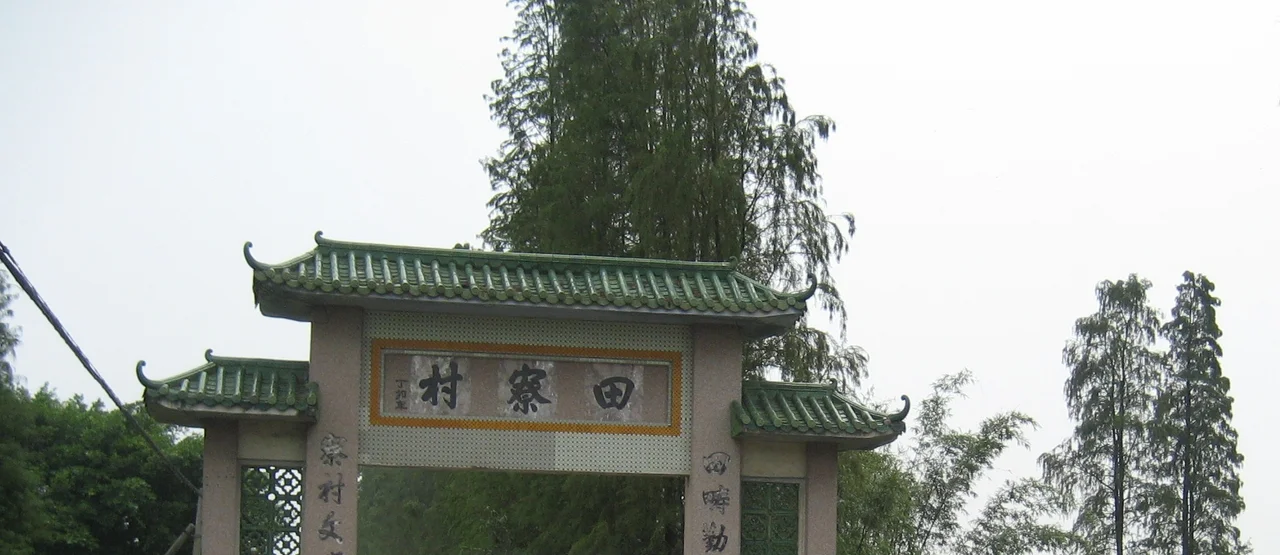

Yamen, Guangdong
Most towns carry their history quietly, tucked into street names and local temples that visitors pass without noticing. Yamen carries its history in the water itself. This small town on the southern coast of Xinhui District in Jiangmen has a population of roughly 40,000 and seventeen administrative villages spread across 318 square kilometers of low-lying coastal land. It would be unremarkable — except that in 1279, one of the most consequential battles in Chinese history was fought in its bay. The Song dynasty, three centuries of Chinese civilization, ended here. A seven-year-old emperor drowned here. And for centuries afterward, temples, memorial stones, and eventually a full museum complex have made Yamen a place of remembrance for a defeat that Chinese people have never entirely stopped mourning.
Where the Bay Holds Its Memory
Yamen sits in the south of Xinhui District, opening toward the Pearl River estuary and the South China Sea beyond. The coastal geography has changed somewhat since 1279 — land reclamation and development have reshaped parts of the shoreline — but the basic character of the place, a sheltered bay ringed by low hills, is recognizable in the historical accounts. The town's name itself may derive from the administrative offices, or ya, that governed this coastal area during imperial times. It absorbed two formerly separate towns, Yaxi and Yanan, whose populations combined to form the present community. Most of the seventeen villages that make up Yamen are small agricultural settlements, growing rice and vegetables on the flat delta land. The rhythm of life here is determined more by the agricultural calendar and the fishing tides than by the tourism traffic that comes for the Song-Yuan Yamen Sea Warfare Culture Tourist Zone east of town.
Seven Hundred Years of Remembrance
In the years and centuries after the battle, the people of the region built temples to the men who died defending the Song. Wen Tianxiang, the poet-official who fought the Mongols across southern China before his capture in 1278, is venerated here. So are Lu Xiufu, the prime minister who drowned with the boy emperor, and Zhang Shijie, the general whose escape ended in a storm. In the 1980s, a memorial was erected near Shekou in Shenzhen — where the body of the last emperor reportedly washed ashore — to honor Zhao Bing. The Teochew people developed a dish called patriotic soup, a leafy greens preparation, as a way of remembering the young emperor across the generations. These are small acts of memorialization, accumulated across centuries — evidence that the defeat at Yamen never settled into the comfortable distance of history but remained something rawer, a wound that the Chinese literary and political imagination kept returning to.
A Place Between Past and Present
Contemporary Yamen is a working town, not primarily a heritage site. The road network connects it to the larger cities of Xinhui District and Jiangmen. The Song-Yuan Yamen Sea Warfare Culture Tourist Zone — the museum complex that commemorates the battle — lies just east of the main settlement, drawing visitors from across Guangdong and beyond. But most of Yamen's life is not oriented toward that past. The village names — Tianshui, Jingmei, Longwang, Gudou — carry their own local histories. The older residents know the stories; the younger ones have largely moved to the cities. What remains is a town that lives beside its history without being consumed by it, the way many places in Guangdong do: aware of what the ground and water beneath them have witnessed, but not pausing every morning to speak of it.
From the Air
Yamen lies at approximately 22.30°N, 113.05°E on the southern coast of Xinhui District, Jiangmen, Guangdong. The town faces the Pearl River estuary; from 3,000–5,000 feet the coastal indentation of Yamen Bay is visible, with the low-lying delta land behind it. The Song-Yuan Yamen Sea Warfare Culture Tourist Zone is just east of the town center. Nearby airports include Guangzhou Baiyun International (ZGGG), about 100 km north-northeast, and Zhuhai Jinwan Airport (ZGSD), roughly 50 km southeast. Coastal haze is common in the Pearl River Delta; clearest views in October through February.
Nearby Stories
- Xinhui, Jiangmen 2.3 km away
- Zhuhai Fisher Girl 4.4 km away
- Pearl River Delta 19 km away
- Wanshan Archipelago Campaign 20 km away
- Battle of Nanpeng Island 56 km away
- Hong Kong 12 159 km away
- Temple of the Five Lords 333 km away
- Erhai Lake 1300 km away