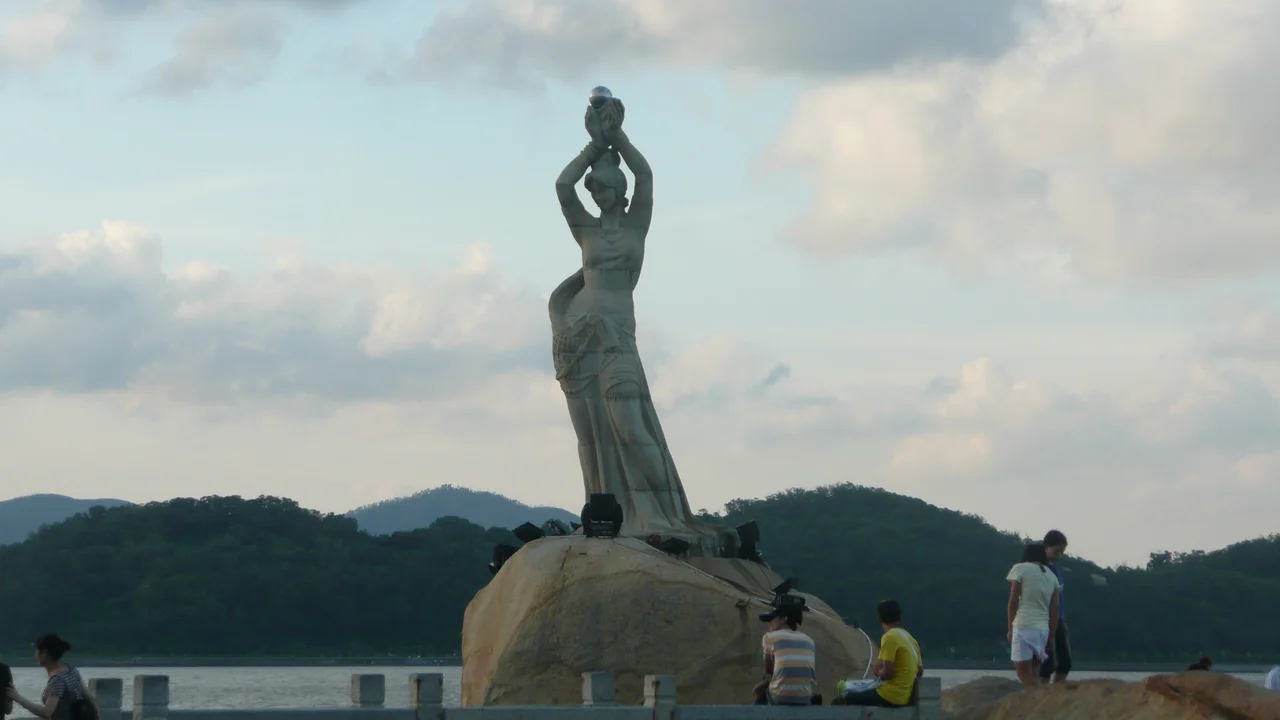

Zhuhai Fisher Girl
She stands on a rock at the water's edge, trouser leg rolled high, a fishnet draped across her shoulders, both hands lifting a pearl toward the sky. The Zhuhai Fisher Girl has occupied Xianglu Bay since 1982, and in that time she has become something the people who commissioned her couldn't have fully anticipated: not just a civic landmark, but the city's face. Before Zhuhai was a Special Economic Zone — before the development money, before the airport, before the highway bridges — this stretch of the Pearl River Delta coast was, as the sculptor later described it, replete with wormwood and undergrowth. The statue arrived before the city did.
A Celestial Daughter in Disguise
The legend behind the statue exists in multiple versions, but one runs like this: the daughter of the Dragon King visited the Pearl River delta, fell in love with the beauty of the Zhuhai region, and disguised herself as an ordinary fisherwoman. She lived among the people there, weaving baskets and healing locals with powers she kept hidden, until she fell in love with a fisherman named Haipeng.
Rumors spread. Haipeng confronted her and demanded she prove her love by giving him her magical pearl bracelets. She told him the truth: if she removed even one pearl, she would die. He turned to leave. She took off the bracelets anyway, dying in his arms. Guilt-stricken, Haipeng searched until an elder told him he could revive her by cultivating a special grass with his own blood. He did. She returned, became mortal, and the two married. She later found a large pearl and gave it to the elder in gratitude.
The figure Pan He designed holds that pearl aloft — the symbol of sacrifice transformed into a gift, raised above her head as if offering it to the sky.
The Sculptor and the Controversy
Pan He was commissioned to create the statue ahead of Zhuhai's formal designation as a Special Economic Zone. The commission itself was not without tension — the cost was considered controversial at the time, and early design proposals leaned toward male imagery rather than the female figure that was ultimately chosen. The completed design, with its specific rendering of a young woman in working clothes holding a pearl, was selected and installed on its boulder in Xianglu Bay in 1982.
The statue is approximately 8.7 metres tall (with the boulder). Pan He worked in a Chinese sculptural tradition that drew on both classical and socialist-realist influences, and the Fisher Girl stands outside both categories — too mythological for socialist realism, too contemporary for classical bronze-work. That ambiguity may be part of why it endures. She isn't a revolutionary figure, and she isn't a goddess. She's a woman from a legend, made permanent in a city that was just beginning.
Recognition and a Companion Piece
In 2005, China Post issued a commemorative stamp titled "Beautiful Zhuhai" to mark the 25th anniversary of Zhuhai's designation as a Special Economic Zone. The Fisher Girl was its image — a confirmation that the statue had become inseparable from the city's identity in the decades since its installation. Nine years later, in 2014, it was officially designated a cultural relic.
The following year, Pan He returned to the Fisher Girl story with a companion piece. Working with his son Pan Fen, he completed Mother River in 2015. Installed in Zhuhai's Doumen District, the newer statue depicts the same young fisherwoman years later: she has settled the land, is teaching her child to swim, and still carries a fishing net and a pearl oyster. The arc from the pearl-offering girl to the teaching mother traces something about what the city imagined itself becoming — and what it hoped to give its children.
The View from Xianglu Bay
Today the statue stands on its boulder in the bay, accessible by a boardwalk along the shore that allows visitors close views from the water's edge. The surrounding area — once overgrown, as the sculptor noted — is now one of the more developed stretches of Zhuhai's coastline, with Lovers Road running along the waterfront and the city rising behind it.
Proposals have been made to expand the area around the statue into a mixed-purpose recreational zone. Whether or not those plans proceed, the Fisher Girl already occupies a place in the landscape that goes beyond physical location. She is on stamps, on city branding, in memory. The woman who gave up her immortality for love, and got it back — held aloft in bronze above a bay that was wormwood and undergrowth when she arrived — has become more durable than the city she predates.
From the Air
The Zhuhai Fisher Girl stands at approximately 22.2654°N, 113.5832°E on the Xianglu Bay shoreline, southeast of central Zhuhai. From the air, the statue itself is small but the bay's curved coastline and the Lovers Road waterfront promenade are identifiable landmarks. Zhuhai Airport (ZGSD) is approximately 30 km to the southwest. The nearby Macau International Airport (VMMC) is approximately 15 km to the south-southeast across the estuary. The city of Zhuhai's urban core and the characteristic grid of the Special Economic Zone development are clearly visible on approach. Recommended altitude for viewing the coastal geography is 3,000–5,000 feet; the statue is best located by identifying Xianglu Bay's horseshoe shape on the southeast coast of the Zhuhai peninsula.
Nearby Stories
- Tai Tau Chau (Southern District) 0.7 km away
- Lai Chi Wo 3 km away
- Wanshan Archipelago Campaign 3.2 km away
- Pearl River Delta 3.7 km away
- Battle of Yamen 13 km away
- Jiangmen 15 km away
- Hong Kong 12 32 km away
- Battle of Nanpeng Island 114 km away