
Battle of Yamen
The boy was seven years old. His name was Zhao Bing, and he was the last emperor of the Song dynasty, a civilization that had lasted three hundred years and produced gunpowder, printing, the compass, and paper money. On March 19, 1279, with his fleet surrounded in the bay at Yamen and every hope of escape gone, his Prime Minister Lu Xiufu gathered him in his arms and jumped into the sea. Both drowned. Many of the officials and court ladies who witnessed this followed suit. Seven days later, the History of Song records, thousands of corpses floated to the surface of the water. The Song dynasty was over. The Mongol-led Yuan dynasty, under Kublai Khan, now controlled all of China — an outcome that had taken decades of relentless conquest to achieve and one afternoon to finalize.
A Dynasty in Flight
The Battle of Yamen was the last act of a war that had been going badly for years. The Mongol armies had taken the Song capital of Lin'an — modern Hangzhou — in 1276, capturing the child Emperor Gong. Two of Gong's younger brothers escaped with the fleeing court. The older, Zhao Shi, was declared emperor, but his boat capsized in a storm near Leizhou and he eventually died of illness, seeking refuge on Lantau Island. His younger brother Zhao Bing, then perhaps five or six years old, became emperor in his place. The Grand General of Song, Zhang Shijie, built a vast fleet to keep the court mobile — moving from port to port, hoping the situation would improve. It did not. In 1278, the poet-official Wen Tianxiang, who had organized resistance across Guangdong and Jiangxi, was captured. The last Song land forces in the region were gone. Zhang Shijie brought the court to Yamen, a bay in present-day Xinhui County, Jiangmen, and made his final stand there.
The Chained Fleet
Zhang Shijie's defensive strategy at Yamen was desperate and, in retrospect, fatally flawed. He ordered about a thousand Song ships chained together in a long formation across the bay, with the emperor's vessel in the center. The intent was to prevent individual ships from breaking away — to force his soldiers to fight or die together. He also burned the palaces and forts on shore, eliminating any possibility of retreat to land. The Yuan commander Zhang Hongfan blockaded the bay and cut off the Song's supply of fresh water and firewood from the land side. The Song forces, many of them non-combatants from the court, were reduced to eating dry food and drinking seawater. Nausea and vomiting spread through the fleet. Zhang Hongfan sent the kidnapped nephew of Zhang Shijie three times, demanding surrender. Zhang Shijie refused each time. When Zhang Hongfan considered using cannons in the assault, he rejected the idea because the explosions might break the chains holding the Song ships together and allow them to scatter — the one outcome he wanted to prevent.
The Afternoon of March 19
Zhang Hongfan divided his naval forces into four parts for the assault. The north flank attacked first and was repelled. Then the Yuan fleet played festive music, leading the exhausted, starving Song forces to relax their guard, believing the enemy was celebrating rather than regrouping. At noon, Zhang Hongfan attacked from the front with soldiers hidden beneath large pieces of cloth on his decks. When the Yuan boats closed on the Song fleet, horns sounded, the cloth was thrown aside, and the hidden soldiers were revealed. Waves of arrows hit the chained ships. The Song fleet lost seven ships immediately. The weakened, ill soldiers could not fight effectively in close combat; the chained formation made coordinated defense impossible. Zhang Shijie managed to cut about a dozen ships free and escape with a small group of his best soldiers. The Yuan forces moved to the center of the formation where Zhao Bing's boat was anchored. Prime Minister Lu Xiufu — seeing no way out, unwilling to allow the last Song emperor to be captured — made the choice that ended a dynasty.
What the Water Gave Back
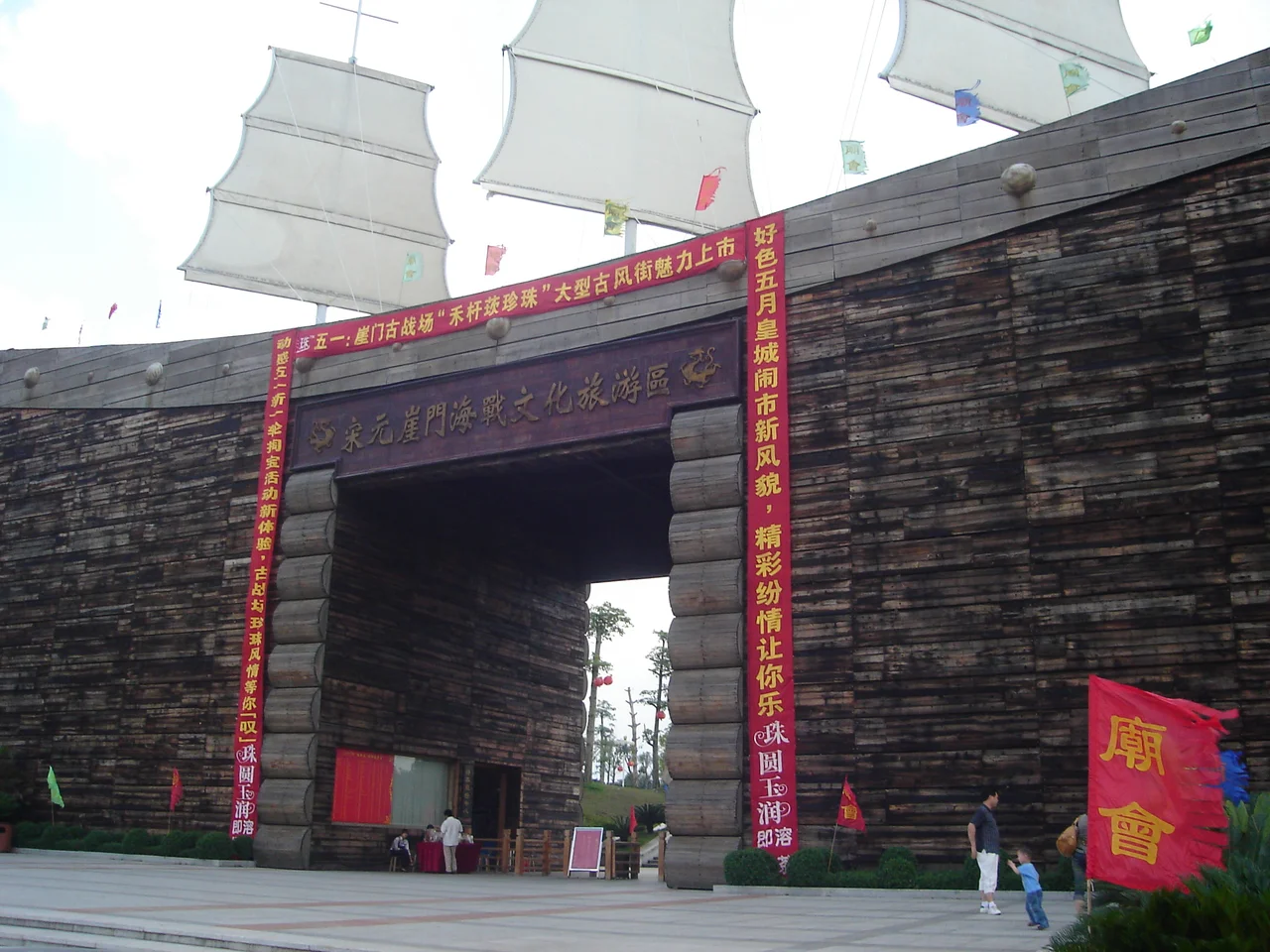
Seven days after the battle, thousands of bodies floated to the surface of Yamen Bay. The Song chronicle records that the body of the boy emperor was found near what is today Shekou in Shenzhen, though no confirmed grave has ever been located. Zhang Shijie, who had escaped, tried to continue the resistance. After the Dowager Yang heard that the boy emperor had died, she too committed suicide at sea. Zhang Shijie buried her on shore. He and his remaining soldiers were then caught in a tropical storm and disappeared — whether they drowned or survived is unknown; the Mongols claimed he died, but no remains were ever found. The Yuan dynasty would rule China for 89 years, until the Ming dynasty drove out the Mongols in 1368. Temples were built throughout the area in memory of those who died — Wen Tianxiang, Lu Xiufu, Zhang Shijie — their loyalty to a lost cause elevated by later generations into moral exemplars. A museum complex, the Song-Yuan Yamen Sea Warfare Culture Tourist Zone, now marks the battle site east of the bay. The water looks ordinary. It is not.
From the Air
The battle site lies at approximately 22.27°N, 113.08°E near the town of Yamen in Xinhui District, Jiangmen, Guangdong. The bay opens toward the south into the South China Sea. At 3,000–5,000 feet, the coastal geography of the Pearl River estuary is clearly visible — the broad water channels, the low-lying delta islands, and the industrial development that now lines much of the shore. Nearby airports include Guangzhou Baiyun International (ZGGG), roughly 100 km north, and Zhuhai Jinwan Airport (ZGSD), about 50 km to the southeast. The area is often hazy; best visibility in cooler months.
Nearby Stories
- Xinhui, Jiangmen 2.3 km away
- Zhuhai Fisher Girl 4.4 km away
- Pearl River Delta 19 km away
- Wanshan Archipelago Campaign 20 km away
- Battle of Nanpeng Island 56 km away
- Hong Kong 12 159 km away
- Temple of the Five Lords 333 km away
- Erhai Lake 1300 km away