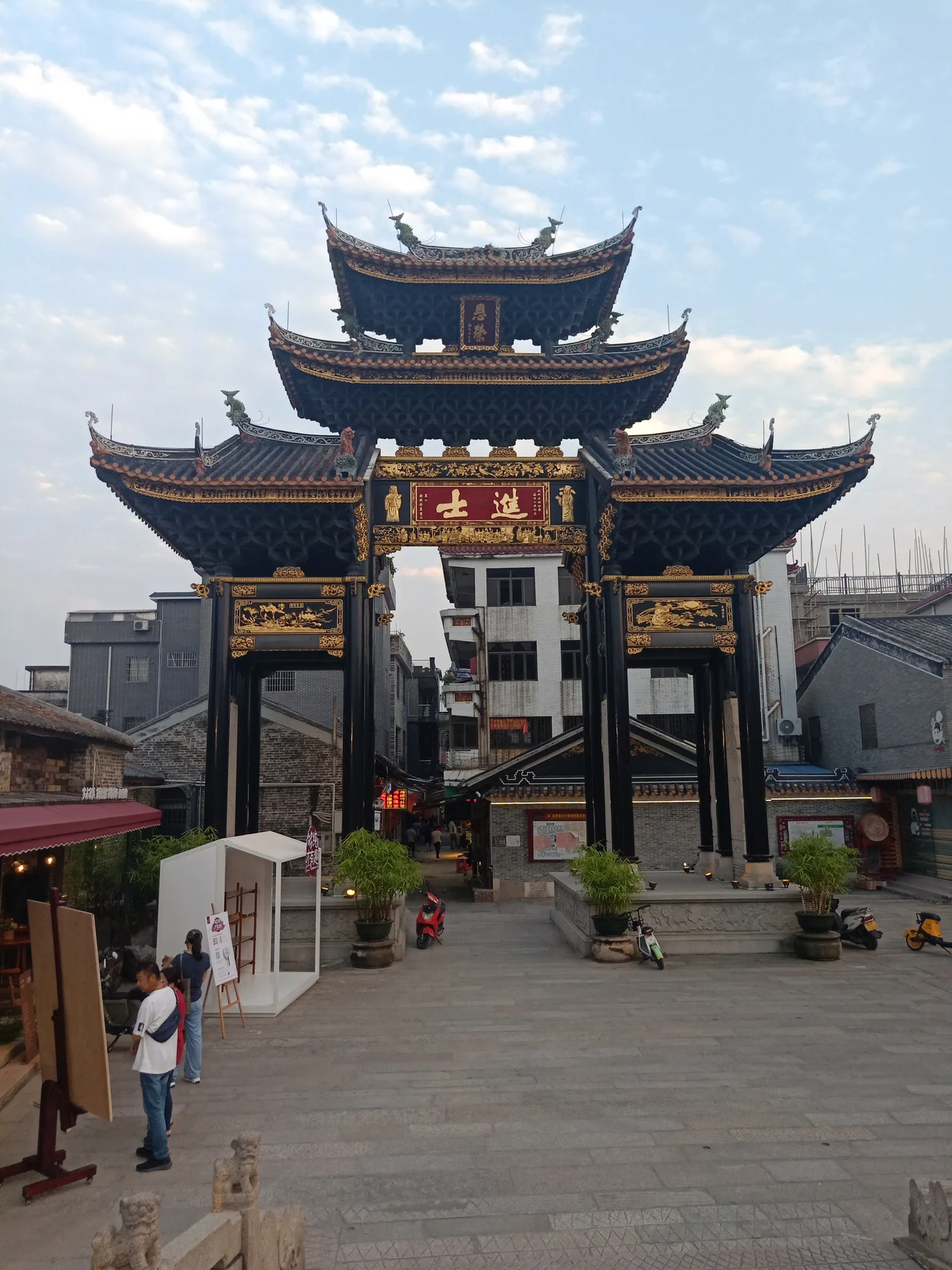

Fengjian Village
Three stone-arch bridges cross the streams of Fengjian Village, and each one was built by a different dynasty. The Juji and Mingyuan Bridges date to the Song Dynasty, somewhere between 960 and 1279 CE. The Jin'ao Bridge came later — constructed during the Qing Dynasty after the Kangxi Emperor himself authorized its building. Walk across them today and the stonework holds as it has held for centuries, spanning water channels that thread through a village so intricately woven with rivers and streams that comparison with Zhouzhuang — the celebrated water town of Jiangsu — comes naturally. In Shunde, they call it the 'Zhouzhuang of Shunde': 顺德周庄. The title is earned.
Two Thousand Years of Habitation
Fengjian is not a young place. Archaeological evidence of human activity in the area dates to the Western Han dynasty, which means people have lived here for over two thousand years. Artifacts from the Han, Song, Ming, and Qing periods have been excavated at the Biwu Western Han Dynasty Site within the village's territory — a stratigraphic record of continuous occupation spanning every major Chinese dynastic period.
The village lies in Xingtan Town within Shunde District of Foshan, covering 5.22 square kilometers. Shunde itself is one of the culinary capitals of Guangdong — famous for its Cantonese cuisine tradition — and Fengjian sits within that broader cultural landscape, shaped by the Pearl River Delta's combination of riverine geography, fertile farmland, and long trading connections.
Bridges, Archways, and Ancestral Halls
The physical fabric of Fengjian is remarkable for how much of it survives. The three stone bridges are the most photogenic landmarks, their arches reflected in the green channels below. But the village also contains a Jinshi Archway — a ceremonial gate of the kind erected to honor imperial examination scholars, marking the family that produced a man learned enough to pass the civil service examinations and earn the title that the archway proclaims.
Ancestral halls punctuate the residential lanes. The Liu family ancestral hall and the Li family ancestral hall (formally called Song Shenzheng Li's Ancestral Hall) are the principal examples — multi-courtyard complexes of the Lingnan style, with carved stone columns, decorated ridge beams, and the kind of accumulated clan history that requires reading the plaques and genealogical tablets to fully decode. These are not ruins. They are maintained, used for ceremonial occasions, and still understood by local families as expressions of who they are.
An Emperor's Gift and a Flowering Tree
Among Fengjian's distinguishing features is a Golden Osmanthus tree — an osmanthus fragrans, known in Chinese as guihua, which blooms in autumn with tiny flowers that fill the air with one of the most immediately recognizable fragrances in Chinese horticulture. The tree at Fengjian is not just old; it has a specific provenance. It was a gift from the Guangxu Emperor to Li Chiangming, a native of the village, during the Qing Dynasty.
Osmanthus is inseparable from Chinese culture: its flowers appear in moon cakes, are used to make osmanthus wine, and appear throughout classical poetry as a symbol of autumn, of the moon, and of scholarly achievement. That an emperor presented one to a man from Fengjian Village is a small biographical fact, but it places the village in a web of imperial attention that the Jinshi Archway also attests. Powerful people noticed Fengjian, and the village kept what they left.
Water Town, Living Place
What distinguishes Fengjian from a preserved historic site is that it remains an inhabited village. The waterways are not decorative — they are part of the hydraulic system that has served agriculture and daily life for centuries in the Pearl River Delta. The bridges are crossed by people going about their days, not only by tourists pausing for photographs.
The 'Zhouzhuang of Shunde' comparison is useful but imperfect. Zhouzhuang in Jiangsu, with its canals and Song-dynasty houses, is now overwhelmingly a tourism destination. Fengjian is quieter, less visited, and consequently more itself — a Lingnan water town in Shunde where ancestral halls still host clan ceremonies, where the Guangxu Emperor's osmanthus still flowers each autumn, and where three dynasties' worth of bridge-builders left stonework that two thousand years of Pearl River Delta floods have not yet washed away.
From the Air
Fengjian Village lies at approximately 22.81°N, 113.16°E in Xingtan Town, Shunde District, Foshan, Guangdong Province. From altitude, the Pearl River Delta's characteristic mosaic of fish ponds, waterways, and dense village settlements is visible across the landscape; Shunde's agricultural-urban fabric is identifiable southwest of central Foshan. The nearest major airport is Guangzhou Baiyun International (ZGGG), approximately 50 km to the north-northeast. Foshan Shadi Airport (ZGFS) lies roughly 30 km to the north. Recommended viewing altitude: 1,500–3,000 m to resolve the river channel and pond geometry of the Shunde water-town landscape. The village itself is too small to resolve from cruising altitude but is located within the Shunde river-delta zone visible as a network of reflective waterways.
Nearby Stories
- Humen Bridge 6.4 km away
- Foshan 8 km away
- Qi'ao Island 13 km away
- South China Mall 17 km away
- Yamen, Guangdong 22 km away
- Battle of Nanpeng Island 110 km away
- Temple of the Five Lords 378 km away
- Erhai Lake 1283 km away