.jpg)
Humen Bridge
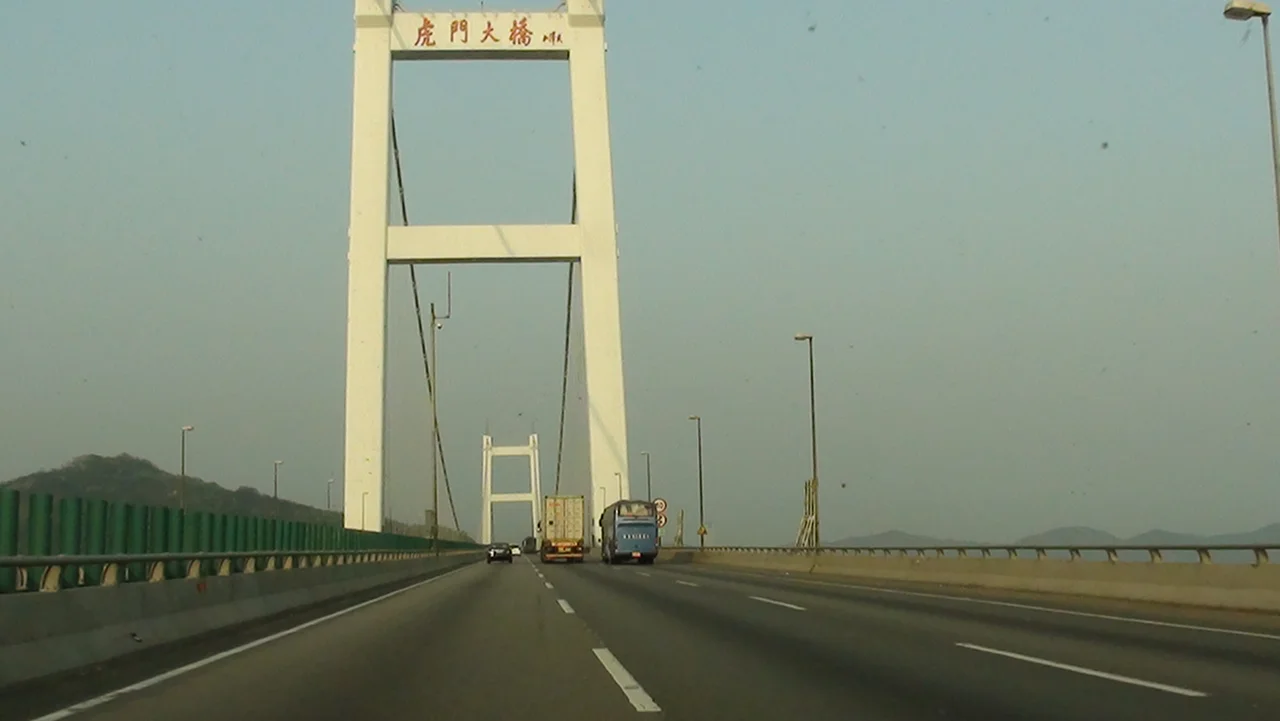
The number 888 was not chosen by accident. In Chinese culture, the digit eight carries connotations of prosperity, and when the engineers of the Humen Bridge settled on a main suspension span of exactly 888 meters, the symmetry pleased everyone. But the bridge earns its place in the landscape without any help from numerology. Completed in 1997 — the same year Hong Kong returned to China — the Humen Pearl River Bridge crosses the strait the Qing dynasty's defenders once held at gunpoint, linking Guangzhou to Dongguan across water that witnessed both colonial conflict and dramatic industrial transformation. From above, it announces itself as a slender white thread drawn between two shores of a region that barely pauses to look back at its own history.
The Tiger's Mouth Crossing
The strait the bridge crosses has been known to Chinese sailors for centuries as Humen — the Tiger Gate — and to Western traders as the Bocca Tigris, from the Portuguese *Boca do Tigre*. It is the point where the Pearl River narrows before opening into the broad Lingdingyang estuary and ultimately the South China Sea. For a long time, crossing this water meant a ferry or a long overland detour. The Pearl River Delta is a landscape defined by its waterways: rivers, channels, distributaries, and estuaries divide it into a mosaic of peninsulas and islands that made road travel slow and economic integration difficult. The Humen Bridge was built to change that calculation. Connecting the Nansha District of Guangzhou on the western shore to Humen Town in Dongguan on the east, it became a key link in the G9411 Dongguan–Foshan Expressway, stitching two of Guangdong's most productive cities together across what had historically been a barrier.
Two Spans, One Structure
What makes the Humen Bridge architecturally unusual is that it is not one bridge but effectively two, joined by a common purpose. The main crossing is a conventional suspension bridge with that 888-meter main span — its two towers rising over the strait's navigation channel, cables fanning downward to the deck. But the approach from the western shore required crossing a secondary waterway, and for that the engineers chose a segmental concrete bridge, its main span of 237 meters among the longest of its type in the world at the time of construction. The full structure is divided into five sections: east approach, suspension span, middle approach, segmental concrete span, and west approach. The Pearl River Delta sits in the path of Pacific typhoons, and the design wind speed at deck level was set at 61 meters per second — nearly 220 kilometers per hour — accounting for the storms that periodically rake this coast.
When the Bridge Shook
On 5 May 2020, dashcam footage and surveillance cameras captured something alarming: the Humen Bridge was rippling, its roadway undulating in visible waves. Traffic police shut the bridge at 15:32. The images spread rapidly online, and the bridge briefly became the subject of intense public scrutiny and anxiety. Engineers inspected the main structure promptly and found it intact; experts explained to Chinese media that the movement was a resonance phenomenon — wind-induced oscillation within tolerable engineering limits, not structural failure. The bridge reopened on 15 May after passing a formal structural safety assessment, though buses with more than 40 seats and heavy trucks were initially prohibited from using it. The episode underscored both the engineering challenges of spanning a typhoon-exposed estuary and the public sensitivity around infrastructure that carries hundreds of thousands of vehicles per year.
Companion and Competition
The Humen Bridge was, for years, the primary fixed crossing of the Pearl River at this point — and its success created its own problem. Traffic volumes on the Pearl River Delta's road network grew far beyond what planners in the early 1990s had modeled. By the 2010s, the bridge was congested to a degree that affected the broader regional economy. The response was the Nansha Bridge, a parallel crossing completed in April 2019 with substantially greater capacity. The Nansha Bridge, with its main suspension span of 1,688 meters, is considerably larger than its predecessor. The Humen Bridge has not been rendered obsolete — it continues to carry heavy traffic — but the delta now has two options where it once had one, and the argument about whether that is enough continues as the Pearl River Delta's cities add millions more residents.
From the Air
The Humen Bridge spans the Humen strait at approximately 22.79°N, 113.61°E, a highly visible landmark from the air. Flying over the Pearl River Delta — one of the densest urban regions on Earth — the bridge appears as a pair of white suspension towers above a brown-green waterway separating urban Dongguan to the east from Guangzhou's southern districts to the west. The newer Nansha Bridge is visible a short distance to the south. Nearest major airport: Guangzhou Baiyun International (ICAO: ZGGG), approximately 55 km northwest. Shenzhen Bao'an International (ICAO: ZGSZ) lies roughly 35 km southeast. The bridge deck sits at low elevation above the water; at low altitudes the suspension cables and twin towers are clearly distinguishable. The Weiyuan Fort — where the Battle of the Bogue was fought in 1841 — sits on the eastern bank nearby, offering a striking contrast between the historic fortifications and the modern crossing just meters away.
Nearby Stories
- South China Mall 1.5 km away
- Sham Chung 7.1 km away
- Fengjian Village 7.4 km away
- Foshan Wong Fei-hung Memorial Hall 9 km away
- Nei Lingding Island 12 km away
- West Lake (Huizhou) 16 km away
- Horizontal Skyscraper – Vanke Center 19 km away
- Yamen, Guangdong 27 km away