
Birds' Paradise
Someone pushed a branch into the ground, and it grew. That is how it started — not with planning or investment or the attention of officials, but with a single act of planting on a small mound of earth that had itself been formed by accident. The island at Birds' Paradise in Tianma Village, Xinhui District, exists because of a geomancy dispute during the late Ming or early Qing dynasty: villagers who wanted to dredge a channel for irrigation were overruled by local authorities who feared the disruption to the local feng shui. They filled the channel with soil instead. Someone inserted a branch. The branch sprouted. Decades passed. The tree spread. And then there were more trees, and then there were birds, and then in 1933 a writer arrived and changed the place's fate entirely.
Ba Jin and the Essay That Named a Place
Ba Jin (1904–2005) was one of twentieth-century China's most important writers — a novelist and essayist whose work spanned decades of Chinese history from the Republican era through the Cultural Revolution to the post-Mao opening. In 1933, still a young writer, he happened to visit Tianma Village and encountered the banyan island. The experience moved him enough to write an essay he titled 'Birds' Heaven' (鸟的天堂, Niǎo de Tiāntáng), describing the eerie abundance of bird life in the dense canopy and the strangeness of the place — so lush, so teeming, so improbable in the middle of the Pearl River Delta farmland.
The essay became famous. Fifty years later, in 1984, Ba Jin returned and inscribed the characters 小鳥天堂 — Little Birds' Paradise — at the site, formally anchoring the literary name to the physical place. He was nearly eighty years old. The inscription is still there. In 2016, the local government designated Birds' Paradise a national wetland park.
A Forest on a Single Root
The ecology of Birds' Paradise is a study in what banyan trees can do when left alone. A banyan does not grow like other trees: it sends aerial roots down from its branches to the ground, where they thicken into secondary trunks, expanding the canopy outward indefinitely. Given enough time and space, a single banyan can cover an enormous area while looking like an entire forest. The island at Birds' Paradise began with one tree, and that tree became many — or many apparent trees that are, in some sense, one organism spreading.
Among the forest there is one especially large and ancient banyan, so thick that ten people holding hands cannot encircle it. Around it, management staff have planted weeping willows (Salix babylonica), white ginger lily (Hedychium coronarium), sacred lotus (Nelumbo nucifera), and other species to support the bird population and diversify the ecosystem. The island floats in a water channel whose banks are lined with more banyans, their roots trailing into the green water.
Nearly Forty Species in the Canopy
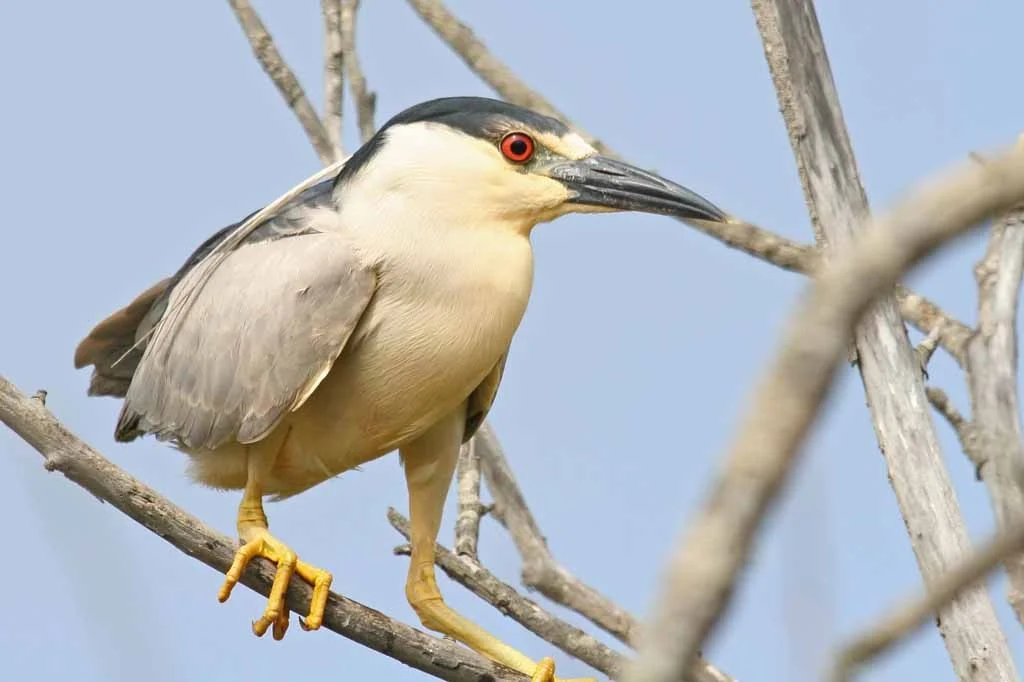
The forest supports close to 40 bird species. Black-crowned night herons, Chinese pond herons, and western cattle egrets are the most common residents, their calls distinct in the morning hours when the canopy is noisiest. Great egrets pick their way along the water margins. Oriental magpie-robins — one of the most striking songbirds of Southeast Asia, with their sharp black-and-white plumage and descending flute-like calls — move through the lower branches. Red-whiskered bulbuls and light-vented bulbuls, great tits and Eurasian blackbirds fill the middle and upper canopy.
The birds are not tame, but they are accustomed to the island's boat traffic. Visitors travel through the water channels in small boats under the banyan shade, listening to folk songs performed by professional singers — a tradition that sounds improbable but works, the music blending with the calls from above in a way that is somehow less incongruous than it should be.
Wu Guanzhong and the Painting in London
In 1989, the painter Wu Guanzhong (1919–2010) — one of the most significant Chinese painters of the twentieth century, known for his synthesis of Western oil technique with Chinese ink-painting aesthetics — visited Birds' Paradise. He had heard about it and imagined it might match his own vision of what a paradise might look like. It did. He painted it in ink wash, producing a work he called 'Paradise for Small Birds.'
In 1992, Wu Guanzhong donated the painting to the British Museum in London, where it entered the permanent collection. The work now hangs in a museum on the other side of the world, a record of a small banyan island in the Pearl River Delta that grew from a branch someone pushed into the ground four centuries ago. The British Museum's collection catalogue lists it under Wu Guanzhong's name, and the object details trace back to Tianma Village, Xinhui.
From the Air
Birds' Paradise lies at approximately 22.77°N, 113.08°E in Xinhui District, Jiangmen, Guangdong Province. From altitude, the Pearl River Delta's dense network of waterways and fish ponds is visible across the landscape, with the Tan River tributary system traceable to the south. The banyan island itself is too small to resolve from cruising altitude but is located within the urban-agricultural transition zone north of central Jiangmen. The nearest major airport is Guangzhou Baiyun International (ZGGG), approximately 55 km to the northeast. Foshan Shadi Airport (ZGFS) lies roughly 40 km to the north. Recommended viewing altitude: 1,500–2,500 m to appreciate the river channel geometry of the Xinhui wetland landscape in context.
Nearby Stories
- Humen Bridge 6.4 km away
- Foshan 8 km away
- Qi'ao Island 13 km away
- South China Mall 17 km away
- Yamen, Guangdong 22 km away
- Battle of Nanpeng Island 110 km away
- Temple of the Five Lords 378 km away
- Erhai Lake 1283 km away