.jpg)
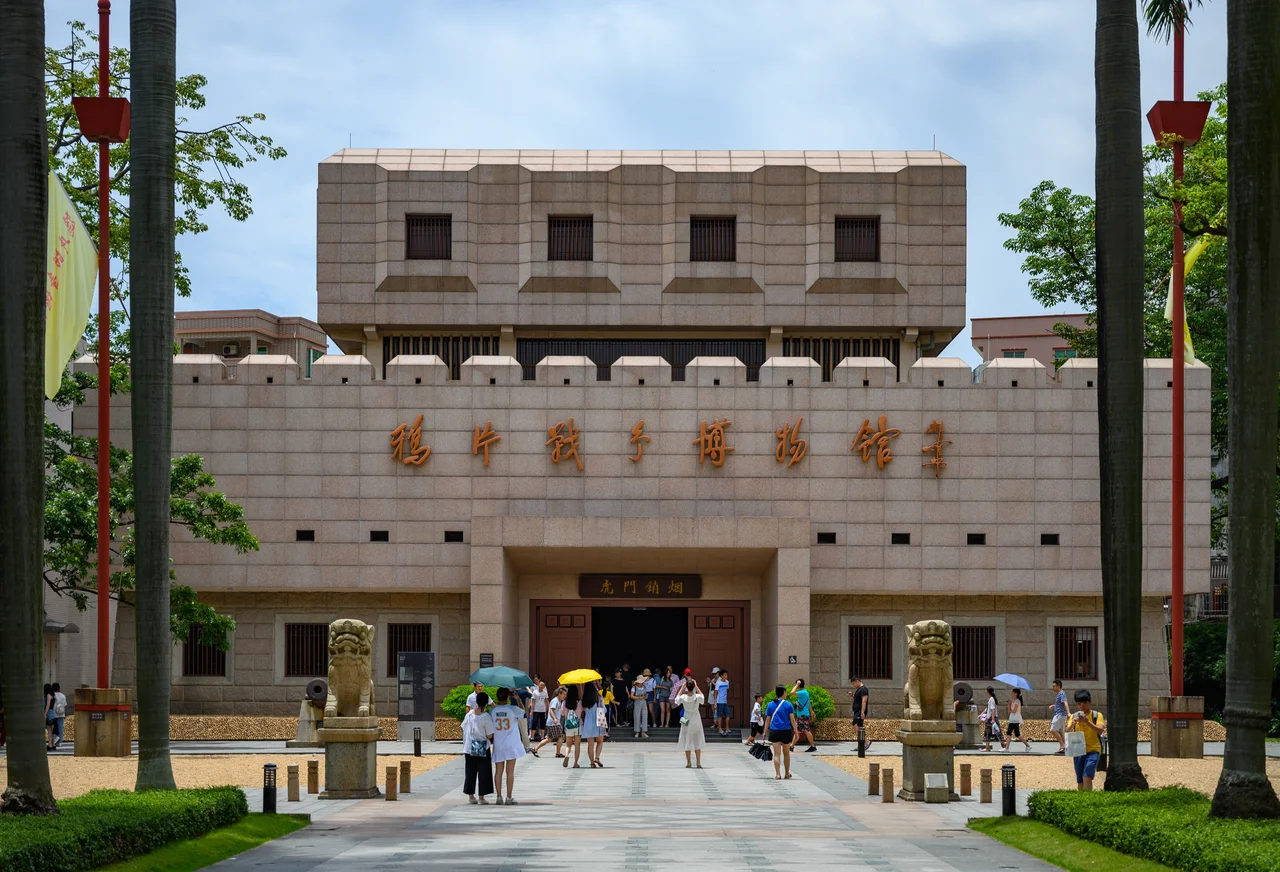
Opium War Museum
The pits where Lin Zexu's workers dissolved more than a thousand metric tons of opium in June 1839 are still here. They are called Lin Zexu's Smoke Pond — a somewhat misleading name, since the opium was not burned but chemically dissolved in brine and quicklime — and they are preserved as a national relic on the grounds of the Opium War Museum in Humen Town. The museum was built in 1957, less than a decade after the founding of the People's Republic, in a country that was still defining its relationship to the history of the nineteenth century. It stands on the exact terrain where one of modern Chinese history's most significant acts took place: a senior imperial official destroying a foreign nation's commercial goods in defiance of a trade that was reshaping Chinese society, and setting in motion a war that China lost.
What the Museum Holds
The Opium War Museum — also known as the Humen Lin Zexu Memorial Hall — opened in 1957 with a floor area of about 2,400 square meters. Its collection focuses on Lin Zexu's anti-narcotics campaign and the First Opium War that followed. Artifacts, documents, maps, and military relics from the early 1840s fill the exhibition halls: Qing dynasty cannon, records of diplomatic exchanges, and materials documenting both the destruction of the opium and the subsequent battles at the Humen forts. The museum has operated under several names since its founding — it was called the Opium War Humen People's Anti-British Memorial Hall from 1972 to 1985, a name that reflected the political framing of a particular era. In 1985 it was redesignated the Humen Lin Zexu Memorial Hall, centering the individual whose act of confrontation with British commercial power gave the site its defining moment. Today it is formally known as the Opium War Museum.
The Man at the Center
Lin Zexu arrived in Guangdong in early 1839 carrying the title of Special Imperial Commissioner — appointed personally by the Daoguang Emperor with a mandate to end the opium trade. He was a senior official with a reputation for integrity and administrative skill, and he pursued his task with methodical determination. He required foreign merchants in Canton to surrender their opium stocks — an extraordinary demand on foreign nationals operating under the protection of their own governments. British Superintendent of Trade Charles Elliot ultimately ordered British merchants to comply, calculating that surrendering the opium to the Chinese government would force the British government to seek compensation, creating a legal and diplomatic mechanism for escalation. Whether that calculation was correct depends on how you judge what came after. Lin, for his part, believed he had solved the problem. He had not.
The Smoke Pond
The Smoke Pond — Lin Zexu's Smoke Pond — is the name given to the site where the confiscated opium was destroyed over 23 days in June 1839. The name comes from the vapor and chemical reaction generated by the process: workers mixed broken-up opium into large pits filled with seawater and quicklime, the combination generating intense heat and a kind of boiling dissolution. Each evening the liquefied mixture was flushed through sluices into the Pearl River estuary with the ebbing tide. American missionary Elijah Coleman Bridgman, who witnessed the destruction, described the pits as forming "a scalding furnace, which made a kind of boiling soup of the opium." The site is preserved alongside the museum, its low stone basins marking the place where more than 19,000 chests of opium met an engineered end. In China, 3 June — the day the destruction began in 1839 — is observed as a precursor to International Day Against Drug Abuse.
The Fortress Next Door
The museum also administers the Humen Fortress — the network of Qing dynasty forts on the shores of the Humen strait, including the Shajiao and Weiyuan fortifications where the Battle of the Bogue was fought in February 1841. These fort sites are a short distance from the museum itself, and together they form a corridor of historical memory in Humen Town. Visiting all of them in sequence — Smoke Pond, museum, forts — gives the narrative its full shape: Lin Zexu's act of defiance at the ponds, the diplomatic breakdown that followed, and then the sound of British naval guns demolishing Qing defenses along the same stretch of shoreline two years later. The Weiyuan Fort, where Admiral Guan Tianpei died defending the passage, is among the preserved sites. The old cannon still point toward the water.
History in an Ongoing Place
Humen Town today is an industrial suburb of Dongguan — factories, logistics parks, container traffic, the vast Port of Humen a short distance away. The Pearl River Bridge overhead carries millions of vehicles per year across the very strait that Qing warships and British men-of-war contested. The Opium War Museum sits in the middle of all this as a deliberate act of remembrance: the People's Republic built it in 1957 to ensure that the history of the Opium Wars remained present in a country that had experienced foreign pressure as an acute, living wound. The museum's changing names over the decades — from anti-British memorial to Lin Zexu memorial — trace the evolution of how that history is framed. What has not changed is the physical evidence: the pits, the forts, the guns, the grounds where the opium boiled away into the Pearl River tide.
From the Air
The Opium War Museum is located in Humen Town, Dongguan, at approximately 22.83°N, 113.65°E in the Pearl River Delta, Guangdong Province. It lies on the eastern bank of the Humen strait, within easy sight of the Humen Pearl River Bridge. The Weiyuan Fort and Shajiao Fort, administered by the museum, are located nearby along the same shoreline. Nearest major airport: Guangzhou Baiyun International (ICAO: ZGGG), approximately 60 km northwest. Shenzhen Bao'an International (ICAO: ZGSZ) lies roughly 35 km southeast. Flying over this area at low altitude, the strait and its modern bridge crossings are clearly visible, with Humen Town on the eastern bank and the Nansha District of Guangzhou to the west. The old fort positions on the islands and riverbanks, now museum sites, are small structures best seen at lower approach altitudes.
Nearby Stories
- South China Mall 1.5 km away
- Sham Chung 7.1 km away
- Fengjian Village 7.4 km away
- Foshan Wong Fei-hung Memorial Hall 9 km away
- Nei Lingding Island 12 km away
- West Lake (Huizhou) 16 km away
- Horizontal Skyscraper – Vanke Center 19 km away
- Yamen, Guangdong 27 km away