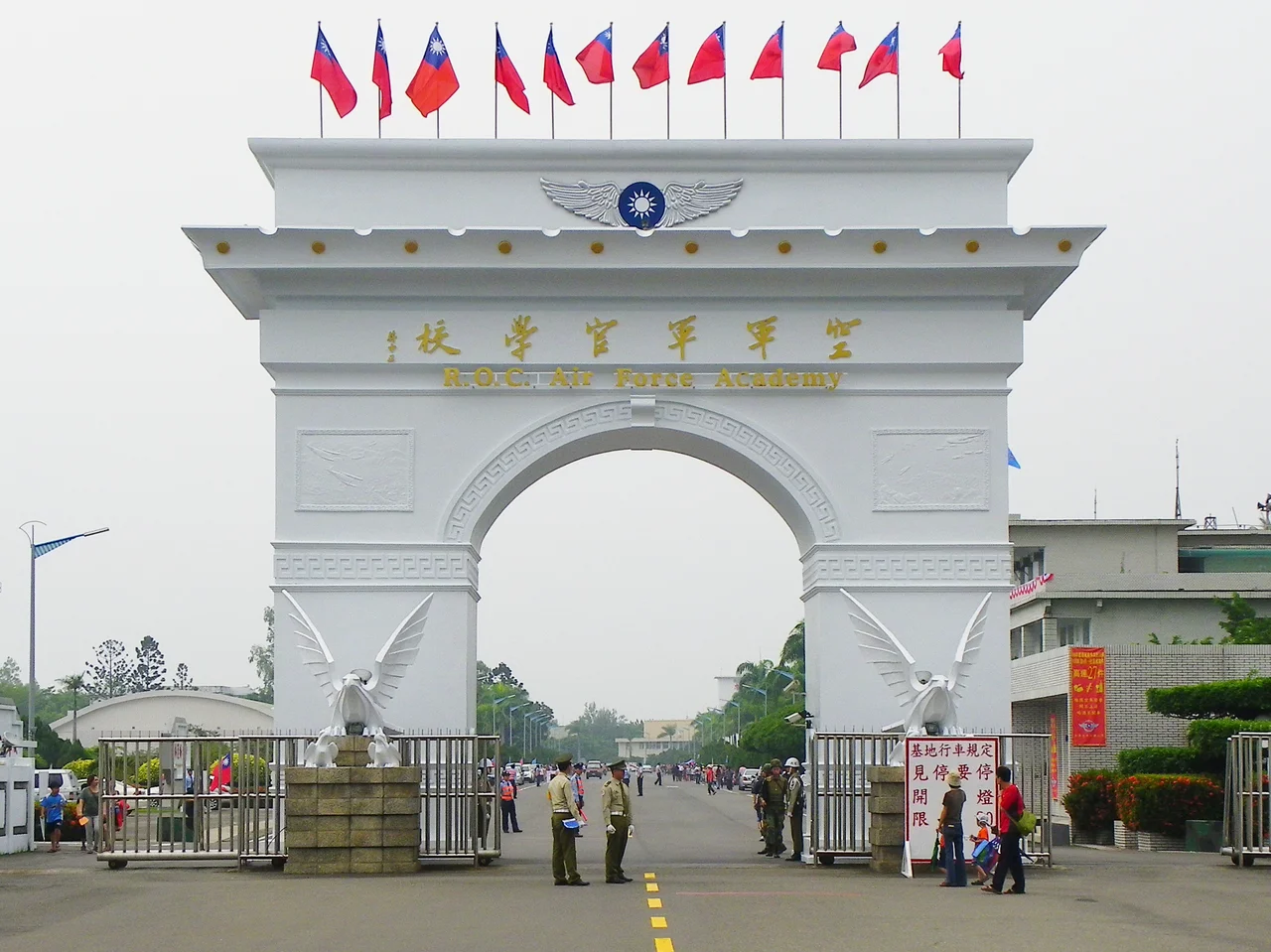

Republic of China Air Force Academy
The academy has been running from conflict since the day it was born. Established in Nanjing in 1928 as the Central Army Academy's Aviation Corps, it was reorganized the next year, moved to Hangzhou in 1931, renamed in 1932, and upgraded to Air Force Academy in 1938 -- all while Japan was closing in. After the Battle of Shanghai and the Battle of Nanjing, the school fled to Kunming's Wujiaba airbase in Yunnan province. When the Chinese Civil War ended in 1949, it crossed the Taiwan Strait entirely and landed in Gangshan, Kaohsiung, where it has remained. The Republic of China Air Force Academy is an institution shaped not by one campus but by the long geography of retreat.
From Nanjing to Gangshan
The academy's wartime migrations trace the arc of twentieth-century Chinese history. Its founding in 1928 coincided with the early years of the Republic of China, when military modernization was urgent and aviation was the frontier of warfare. The move from Nanjing's Dajiaochang Airport to Hangzhou's Jianqiao Airport in 1931 placed the school at one of China's premier aviation facilities. But the Second Sino-Japanese War shattered that stability. Japanese bombing campaigns targeted airfields throughout eastern China, and the academy was pushed westward to Kunming in Yunnan, far from the front lines. When the Nationalists lost the civil war to the Communists, the academy made its final move to Taiwan, joining the massive military and civilian exodus of 1949. In September 1960, the school was reorganized as a four-year university, a sign that its years of displacement were finally over.
Wings Over Gangshan
Today's campus in Gangshan District sits in northern Kaohsiung, accessible by the Kaohsiung Metro from Kaohsiung Medical University Gangshan Hospital station. The academy divides its curriculum between general and military education. The general field encompasses five departments: Aeronautics and Astronautics, Avionic Engineering, Aeronautical and Mechanical Engineering, Aviation Management, and Applied Foreign Languages. The military curriculum covers basic theory, joint warfare, military intelligence, and specialized knowledge. Teaching facilities include a flight simulator, a multimedia studio, a wind tunnel research laboratory, and classrooms dedicated to aircraft system models and weapons introduction. The academy library, which joined the Taiwan Academic E-book and Database Consortium in 2014, holds a collection of over 24,700 volumes of e-books.
Aces and Premiers
The academy's alumni list reads like a compressed history of Taiwan's military and political leadership. Gao Youxin and Yue Yiqin were flying aces during the Second Sino-Japanese War, the conflict that first drove the school into exile. Hua Hsi-chun became a pilot, a general, and the founder of Taiwan's aeronautical industry. Tang Fei rose to become Premier in 2000. Feng Shih-kuan served as Minister of National Defense from 2016 to 2018. Shen Yi-ming became Chief of the General Staff before his death in a helicopter crash in 2020. The school's twelve student clubs -- spanning academic, arts, and recreational fields -- seem modest compared to such a record, but they reflect an institution that has learned, across nearly a century of upheaval, to build community wherever it finds itself.
An Academy's Lesson
What distinguishes the Republic of China Air Force Academy from its counterparts elsewhere is not its facilities or curriculum but its biography. Most military academies project permanence: stone buildings, parade grounds, traditions rooted in a single hallowed location. This one has been displaced four times across two countries, driven by invasion, civil war, and political collapse. Gangshan is not where the academy was meant to be. It is where history deposited it. The cadets who study aircraft systems and practice joint warfare exercises here inherit a tradition defined less by place than by persistence -- the institutional memory of an air force that kept training pilots while the ground shifted beneath its runways.
From the Air
The Republic of China Air Force Academy is located at 22.783N, 120.266E in Gangshan District, northern Kaohsiung. The campus and its associated airfield are visible from altitude as a large military installation in the Kaohsiung plain. Nearby airports include Kaohsiung International Airport (RCKH) approximately 15 km to the south and Gangshan Air Force Base itself. The area is flat and easily identifiable from 3,000-5,000 feet. Note: this is an active military installation; observe appropriate altitude restrictions.
Nearby Stories
- Huang Family Historical Residence 3.1 km away
- Taivoan Language 9 km away
- Zhiben Hot Spring 12 km away
- Bunun Cultural Museum 26 km away
- Dongji Island 33 km away
- South Penghu Marine National Park 58 km away
- Orchid Island 79 km away
- Hong Kong 12 550 km away