
Taivoan Language
To reach the chieftain of Cannacannavo in the seventeenth century, a Dutch colonial official needed four interpreters. The chain ran from Dutch to Sinckan (Siraya), from Sinckan to Tarroequan, from Tarroequan to Taivoan, and only then from Taivoan to Cannacannavo. This single entry in *De Dagregisters van het Kasteel Zeelandia* — the journals kept at Fort Zeelandia between 1629 and 1662 — is one of the earliest documentary proofs that Taivoan was its own language, not a dialect of its neighbors, and that the Taivoan people occupied a distinct place in the web of languages and alliances that shaped southwestern Taiwan's indigenous world.
A People and Their Language
The Taivoan are a Plains indigenous people of Taiwan — part of the larger group sometimes called Pingpu, the peoples who inhabited the western coastal plains before Han Chinese migration transformed that landscape. Their ancestral territory covered parts of what is now southern Tainan and the foothills toward Kaohsiung. The Taivoan language belongs to the Austronesian family, the vast linguistic network that stretches from Madagascar to Hawaii and connects the indigenous peoples of Taiwan to communities across maritime Southeast Asia and the Pacific. Within that family, Taivoan sits in the Sirayaic branch, related to but distinct from Siraya and Makatao — sister languages spoken by neighboring peoples on the same southwestern plain.
The Long Debate About Classification
For a long time, Taivoan was treated as a dialect of Siraya rather than a separate language. The Dutch missionary George Candidius, writing in 1628, lumped Tevorang (the Taivoan settlement) into a group of eight villages he claimed shared "the same manners, customs and religion, and speak the same language." American linguist Raleigh Ferrell later examined the Dutch materials and concluded that the Taivoan people "were a distinct ethnolinguistic group, differing markedly in both language and culture from the Siraya" — and noted that Candidius almost certainly had never actually visited Tevorang when he made that claim. The first documented Dutch visit to Tevorang came in January 1636, eight years after Candidius wrote his famous account. What he described was an assumption, not an observation.
What the Linguists Found
By 2009, Li Paul Jen-kuei's comparative work had firmly established Taivoan as independent. Comparing numerals and phonological patterns across Siraya, Taivoan, and Makatao — and tracing those patterns back to Proto-Austronesian — Li proposed two possible family trees for the Sirayaic languages. In one, Taivoan is the earliest branch to diverge. In the other, Taivoan and Makatao form a subgroup together, distinct from Siraya. Li considered the second arrangement somewhat more likely. Either way, the conclusion was the same: Taivoan is a language in its own right, with its own history of sound changes, its own vocabulary, its own ceremonial songs. The word for "dog" — tsau. For "fish" — icikang. For the Highest Ancestral Spirit — Anag.
Songs That Survived
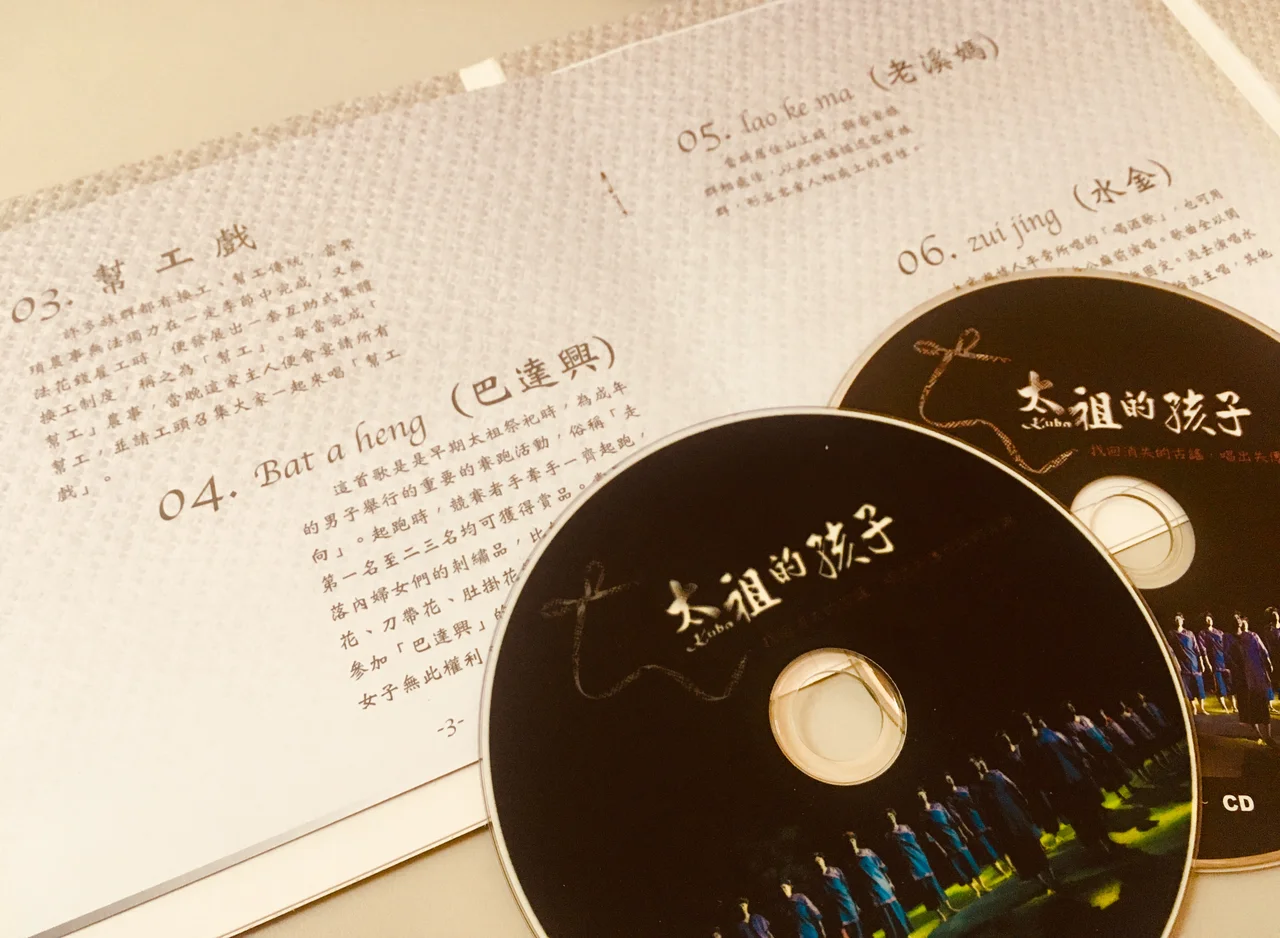
The most moving evidence of the Taivoan language's persistence is not in linguistic papers but in recordings. The ceremonial song "Kalawahe," sung by Taivoan community members in Lakku village (Vogavon dialect), preserves words that carry across centuries — *rarom*, *saviki*, *hahu*, *tamaku* — in a melody that belongs to the living tradition of Taivoan ritual practice. The "Song of Offerings" (*Panga*) follows a similar form. These songs were not museum pieces when they were recorded; they were and continue to be part of how the Taivoan people maintain connection to their cultural and spiritual life. Language revitalization efforts among the Taivoan people today draw on this living thread, working to pass knowledge of the language to younger generations who inherit both the history and the ceremonies.
The Plain and Its Languages
Southwest Taiwan's plains were once a multilingual landscape. Siraya served as a lingua franca across at least eight indigenous communities, but beneath that shared tongue lay a diversity of distinct languages — Taivoan, Makatao, Kanakanavu, and others — each belonging to a people with their own territory, alliances, and traditions. The Dutch needed four interpreters to cross that world in a single conversation. Centuries of Han Chinese migration, Japanese colonial administration, and postwar Mandarin-dominant policy compressed and eroded that diversity. But it did not erase it. The Taivoan people are still here, their language documented, their ceremonial practices alive, their claim to a distinct place in Taiwan's history recognized by linguists and increasingly by the state. A language once nearly lost to official indifference is finding its voice again.
From the Air
The Taivoan people's ancestral territory covers southwestern Taiwan's coastal plain, centered roughly at 23.10°N, 120.45°E — the area stretching from the Tainan basin southward toward the Kaohsiung foothills. From the air at 5,000–8,000 feet, this plain spreads across the western lowlands between the mountains and the Taiwan Strait, one of the most densely cultivated landscapes in Taiwan. Villages associated with Taivoan history, including Tevorangh and communities in Kaohsiung's foothills, are visible in the broader patchwork below. The nearest major airport is RCNN (Tainan Airport), with RCKH (Kaohsiung International Airport) as the regional hub to the south. On clear days the Central Mountain Range forms a dramatic eastern backdrop to this historically rich plain.
Nearby Stories
- 1941 Chungpu Earthquake 7.5 km away
- Paiyun Lodge 9.8 km away
- Fo Guang Shan Buddha Museum 11 km away
- Yakou Mountain Pass 17 km away
- National Museum of Prehistory (Taiwan) 19 km away
- Dongji Island 26 km away
- TransAsia Airways Flight 222 33 km away
- Daya Bay 548 km away