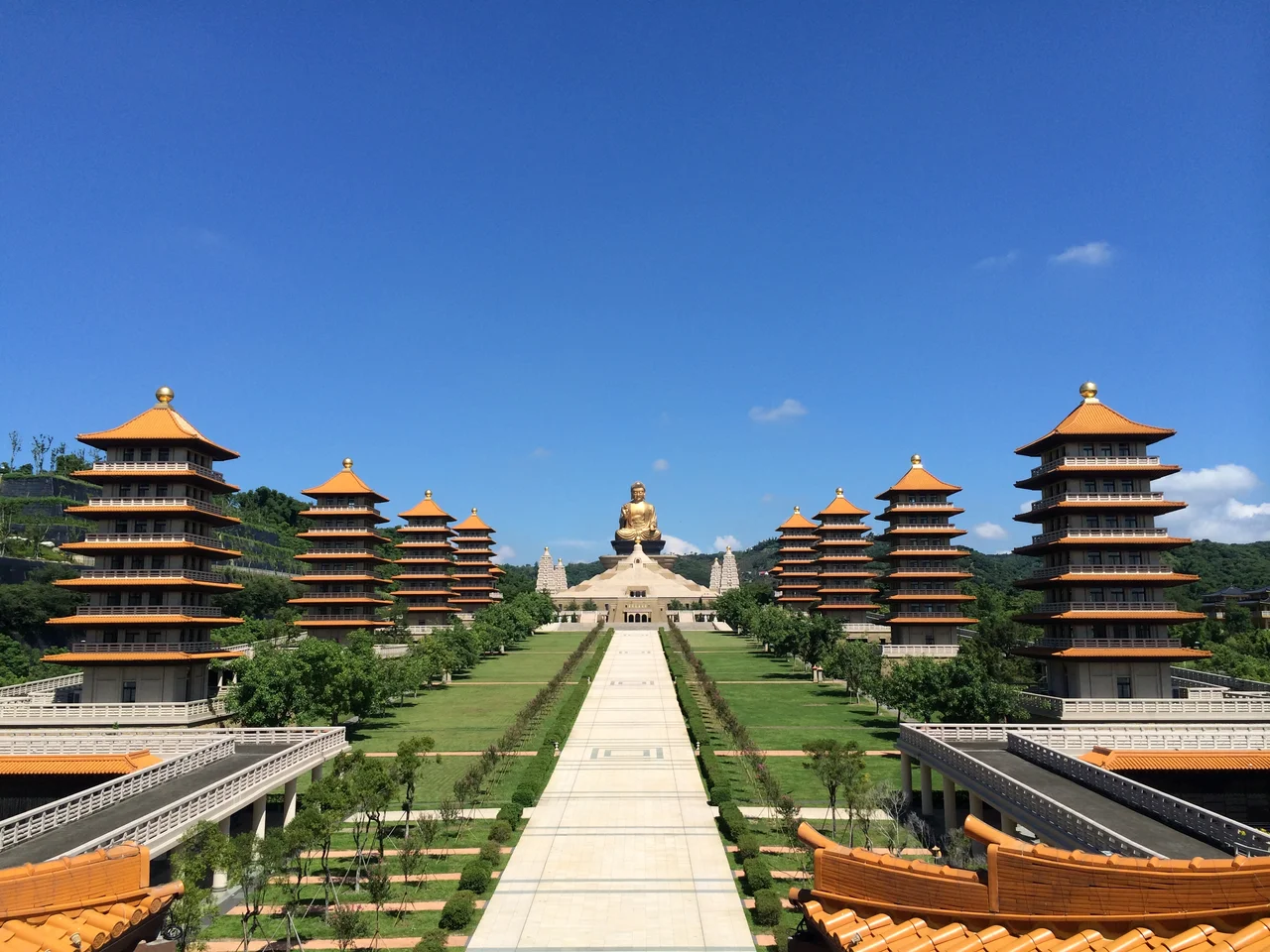

Fo Guang Shan Buddha Museum
The design started with a tissue box and some mineral water bottles. Before the foundation of the Fo Guang Shan Buddha Museum was even finished, its founder Venerable Master Hsing Yun sketched the basic plan using whatever was at hand -- bottles as pagodas, a tissue box as the main hall, newspapers as the grand avenue. More than 100 design revisions followed before the museum opened in December 2011 at an international ceremony. What emerged from those improvised models is one of the most ambitious Buddhist cultural projects on Earth: a complex covering more than 100 hectares in Dashu District, Kaohsiung, anchored by a 108-meter-tall seated Buddha made from 1,800 tons of metal and containing 48 underground palaces designed as time capsules to be opened one per century.
A Tooth and a Promise
The museum exists because of a relic and a act of trust. In 1998, Hsing Yun traveled to Bodh Gaya, India, to confer ordination precepts. There, a Tibetan teacher named Kunga Dorje Rinpoche entrusted him with a tooth relic believed to have belonged to Sakyamuni Buddha. Rinpoche had safeguarded the relic for nearly 30 years and was moved by Fo Guang Shan's efforts to bridge different Buddhist traditions. He hoped the relic could be enshrined in Taiwan as a symbol of Dharma preservation. Hsing Yun's response was characteristically practical and philosophical: "The Buddha does not need anybody's worship or reverence; it is living beings that need inspiration to develop wholesome thoughts." The tooth relic now rests in the Jade Buddha Shrine at the very back of the Main Hall, enshrined above a Reclining Buddha sculpted from Burmese white jade, flanked by jade reliefs of the Western and Eastern Pure Lands.
An Avenue of Eight Principles
The museum complex faces east and is organized along a central axial line that functions as both a physical pathway and a spiritual curriculum. Visitors enter through the Front Hall, passing between a five-meter elephant symbolizing Prince Siddhartha's conception and a lion representing the roar of the Buddha's teachings. Eight Chinese-styled pagodas line both sides of the main avenue, each named for a core Buddhist concept: Humanistic Buddhism, the monastic and lay assemblies, the Three Goodnesses of body, speech, and mind, the Four Givings, the Five Harmonies, the Six Perfections, the Seven Admonishments against drugs, pornography, violence, stealing, gambling, alcohol, and harsh words, and the Eightfold Path to liberation. Each pagoda serves a different practical function -- one is a bookstore, another a children's gallery with interactive 3D videos, another a venue for Buddhist weddings and birthday celebrations.
Art Across Traditions
The museum is as much an art complex as a religious site. Eighteen Arhat statues line the Bodhi Wisdom Concourse, designed by Taiwanese sculptor Wu Jung-Tzu and including, in a deliberate break with tradition, three female bhiksunis alongside the male figures -- Venerable Master Hsing Yun's statement on equality between the sexes. Eight patriarchs representing the founding teachers of China's Mahayana Buddhist schools stand before the Main Hall. Inside, the Thousand-Armed, Thousand-Eyes Avalokitesvara by glass artist Loretta Yang rises nearly five meters, the tallest work she has created. The Golden Buddha Shrine houses a statue gifted in 2004 by Thailand's Supreme Patriarch, who had 19 such statues made for his 90th birthday and chose Fo Guang Shan to represent Taiwan. A camphor wood carving in the lobby depicts the Buddha teaching at Vulture Peak. The museum became the youngest member of the International Council of Museums in 2014.
Time Capsules for the Next Five Millennia
Beneath the museum lie 48 underground palaces, sealed and not open to the public, containing artifacts both historic and contemporary. The plan is extraordinary in its ambition: one palace will be opened every hundred years, its contents examined and supplemented, then resealed for the next century. If the schedule holds, the last palace will not be opened for nearly five thousand years. The Main Hall above them is built as a domed stupa in the Indian style, its spire serving as a sutra repository housing one million copies of the Heart Sutra. From above, the museum's scale is apparent -- the great avenue stretching from the Front Hall to the seated Big Buddha at the rear, the eight pagodas standing in symmetrical pairs, the Main Hall's dome catching the subtropical light. The 2,000-seat Great Enlightenment Auditorium features a 360-degree screen and a rotating stage. Free admission ensures that the experience is accessible to all.
From the Air
Located at 22.757N, 120.441E in Dashu District, northeast of central Kaohsiung. The 108-meter Fo Guang Big Buddha is a prominent visual landmark, visible from considerable distance. The complex covers over 100 hectares on the hillside adjacent to Fo Guang Shan Monastery. Nearby airports: RCKH (Kaohsiung International Airport, 25 km southwest). Best viewed at 3,000-5,000 ft AGL. The eight pagodas flanking the central avenue create a distinctive linear pattern from above.
Nearby Stories
- Huang Family Historical Residence 3.1 km away
- Taivoan Language 9 km away
- Zhiben Hot Spring 12 km away
- Bunun Cultural Museum 26 km away
- Dongji Island 33 km away
- South Penghu Marine National Park 58 km away
- Orchid Island 79 km away
- Hong Kong 12 550 km away