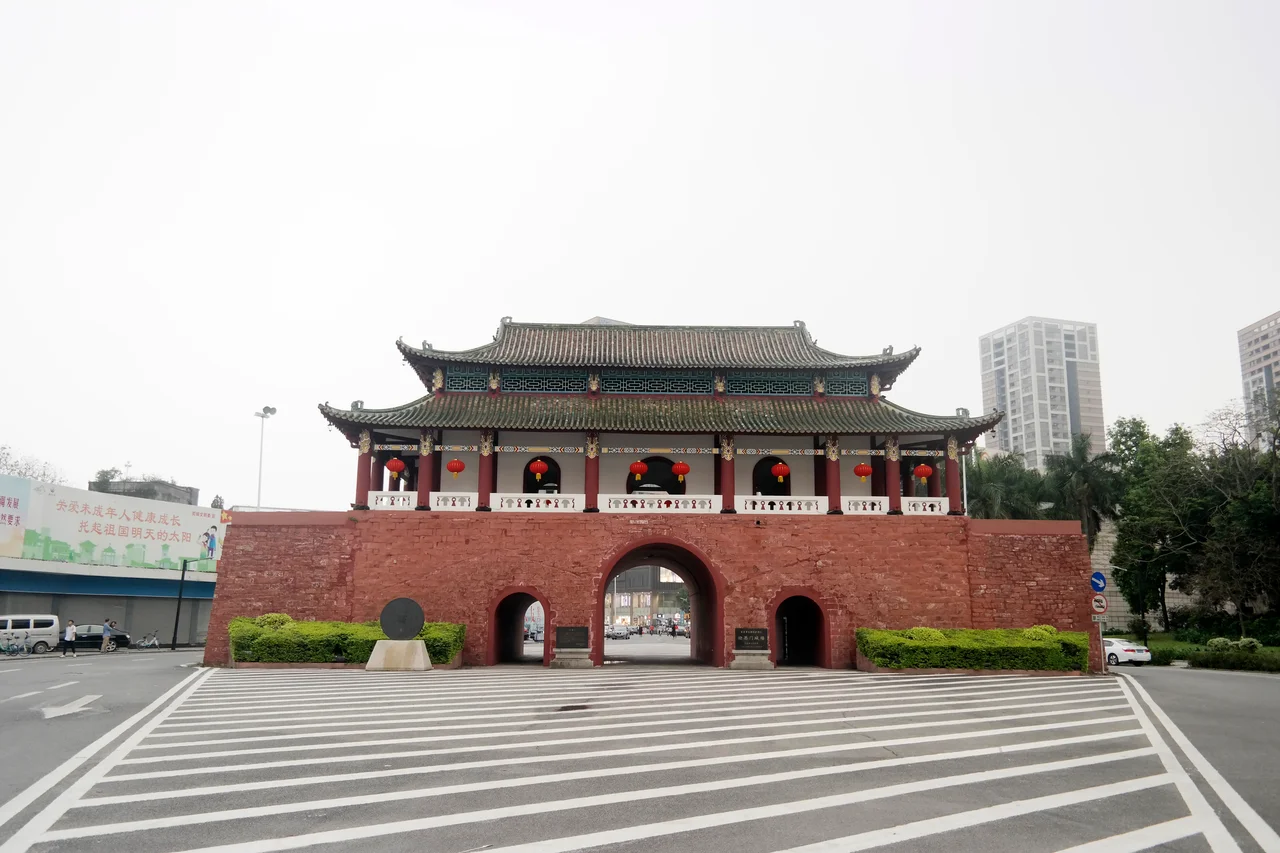

Dongguan
Somewhere in the Pearl River Delta, between the sprawl of Guangzhou to the north and the glittering towers of Shenzhen to the south, lies a city that makes things the world uses every day without knowing where they come from. Dongguan produces an estimated one fifth of the world's smartphones and one tenth of its shoes. Its factories draw a steady current of business travelers, logistics managers, and supply-chain engineers who rarely look up from their work long enough to notice the Qing dynasty fortifications, the classical Lingnan garden, or the market stalls selling Chinese sausages and lychees that define another Dongguan entirely. The city exists simultaneously as a manufacturing engine of global significance and as a place with deep roots in Cantonese culture — and the gap between those two identities is part of what makes it interesting.
Factory Floor of the World
The statistics require a moment to absorb. One fifth of the world's smartphones. One tenth of its shoes. These are not estimates from a booster's press release — they are figures regularly cited by analysts studying global supply chains, and they give some sense of what the Pearl River Delta's manufacturing concentration actually means at human scale. Dongguan sits at the center of this industrial zone, a prefecture-level city of 28 towns spread across the delta lowlands. Chang'an, in the south of the prefecture, is home to several electronics conglomerates of national significance. Houjie, southwest of the city center, holds 400,000 mostly temporary residents who arrived for factory work. The landscape of these manufacturing towns — long low sheds, container parks, workers' dormitories strung with drying laundry — is unglamorous in the way that essential things often are. The Pearl River Delta has one of the largest concentrations of international airports in the world, which tells you something about the volume of goods that needs to move through here.
Where the Opium Wars Left Their Mark
Humen Town, at the southern end of the Dongguan prefecture, carries a weight that manufacturing statistics don't capture. In the 1800s, the wars fought between China and Britain over trade policy — particularly over Britain's insistence on selling opium into China — came to a head in part at this location. It was here, in Humen, that a massive seizure of opium was publicly destroyed, an act that sparked the First Opium War. The event is remembered in China as the opening of what became known as the "century of humiliation," a period of territorial concessions and foreign interference that shaped the country's political consciousness for generations. Two museums and surviving historic fortifications now stand in Humen to commemorate this history. Walking through the remnants of the old fort walls, looking out toward the Pearl River estuary through which foreign warships once sailed, makes the geopolitics of the 19th century feel unexpectedly immediate.
Cantonese Rhythms, Migrant City
Cantonese is the traditional language of Dongguan, spoken in a local dialect that differs in small but characteristic ways from standard Cantonese. Most residents also speak Mandarin. But the real linguistic story of Dongguan is migration: the factories drew workers from across China's interior provinces, and a significant portion of the population now speaks neither Cantonese nor the local dialect, but rather the Mandarin of their home regions. This demographic churn gives the city an energy that is simultaneously rootless and purposeful. The traditional Dongguan kitchen — Chinese sausages (腊肠, known in Cantonese as laahpchéung), lychees, roasted goose — persists in the older market areas and family restaurants, a thread of local identity running through a city that changes rapidly around it. In Dongcheng, expat bars and international restaurants cluster near factory districts where workers eat at canteen tables. Both Dongguan cities are real.
Getting Around a Car-Centric City
Dongguan is, unusually for a Chinese city of its size, extremely car-centric — with car ownership rates approaching Shenzhen's. Public transit exists but is not the dominant mode: the metro system (Dongguan Rail Transit) opened in 2016 with a single line, Line 2, serving 15 stations between Dongguan Railway Station and Humen Railway Station, and a second line connecting Dongguan West Railway Station to the southeastern part of the city was completed in 2025. For most movements within the city, ride-hailing services are the practical option. The intercity railway connects Dongguan to both Guangzhou and Shenzhen, making it accessible from either direction in roughly 30 to 45 minutes by fast train. Hong Kong is reachable by bus from hotels across the city, or by ferry from Humen Town, bypassing Hong Kong border crossings entirely and connecting directly to the international departures zone.
Beyond the Factory Gates
There is a Dongguan beyond the supply chains. A half-day itinerary that begins at Jin'aozhou Pagoda (金鳌洲塔) on the East River, moves east to the classical Keyuan Garden, and continues along Dongcheng Avenue for food and shopping — this covers more of the city's character than most business visitors ever see. Huanghe Fashion Town in the Humen District, which extends over roughly one square kilometer, is one of China's largest clothing and textile wholesale markets, where retail shoppers buy at wholesale prices alongside bulk buyers from Hong Kong and overseas. Dongguan has more than 30 government-rated five-star hotels, a consequence of the business travel that the manufacturing economy generates. For those who look past the logistics and the factory gates, the city repays attention — not with the obvious glamour of Guangzhou or Shenzhen, but with the particular density of a place that has made itself indispensable to the modern world.
From the Air
Dongguan sits at approximately 23.047°N, 113.749°E in the Pearl River Delta, roughly midway between Guangzhou to the north and Shenzhen to the south. The nearest major airports are Shenzhen Bao'an International (ZGSZ), about 50 km to the south, and Guangzhou Baiyun International (ZGGG), about 65 km to the northwest. At altitude, the Pearl River estuary and the dense industrial and urban fabric of the Delta are visible below, with Dongguan's low-rise manufacturing districts contrasting with the higher towers of the central city area. The Humen Bridge over the Pearl River is a useful navigation landmark, visible from several thousand feet in clear conditions. Approach from the south on descent into ZGSZ offers a good aerial perspective of the Dongguan-Shenzhen corridor.
Nearby Stories
- Fengjian Village 6.5 km away
- Opium War Museum 8.2 km away
- Liang's Garden 13 km away
- West Lake (Huizhou) 14 km away
- Qingyuan Maglev Tourist Line 21 km away
- Horizontal Skyscraper – Vanke Center 28 km away
- Heyuan 61 km away
- Qingyuan 77 km away