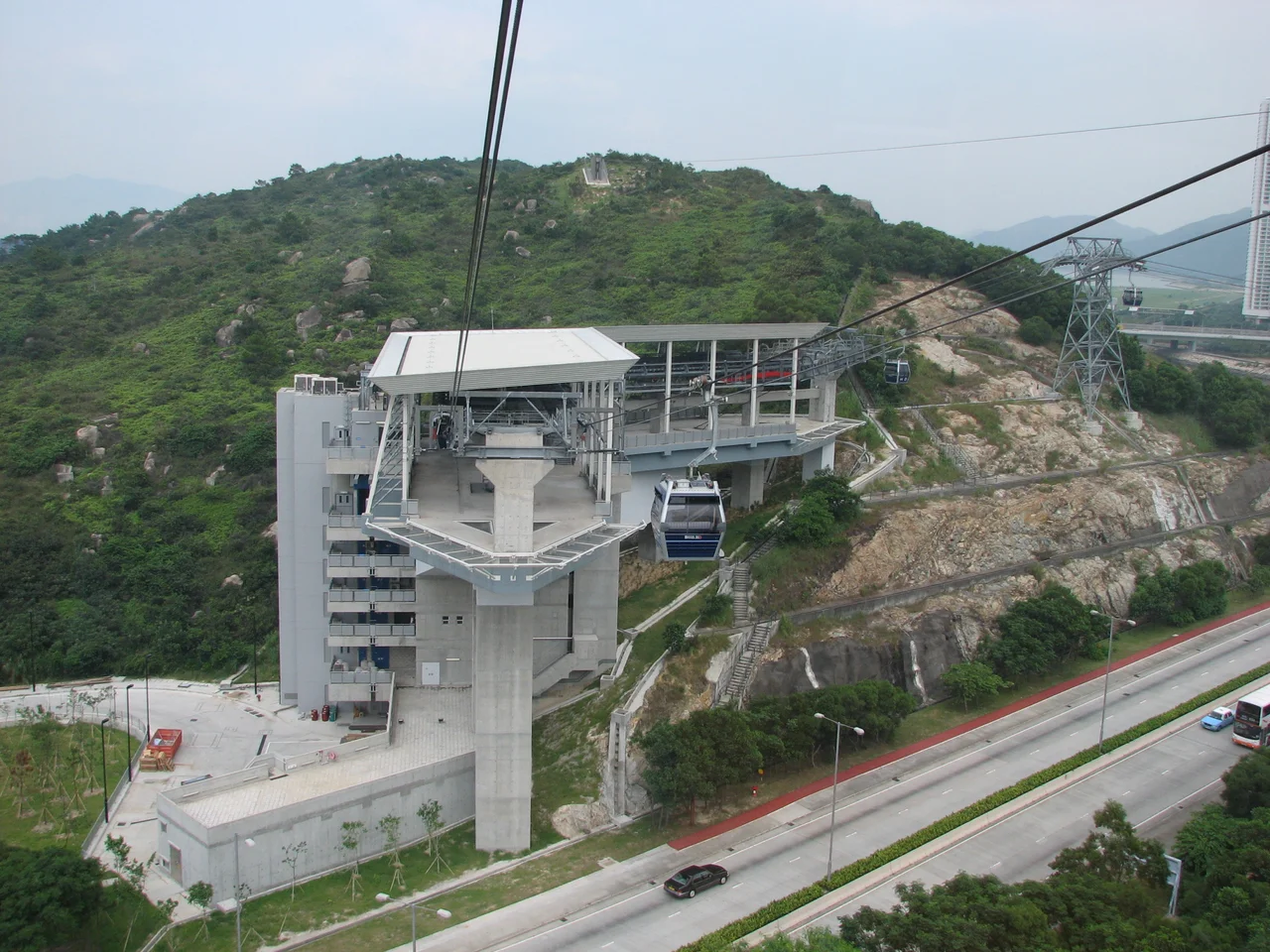

Ngong Ping 360
On 18 September 2006, the operators of Hong Kong's new Ngong Ping cable car sold precisely 1,688 tickets for the maiden run, priced at HK$88 each. The numbers were chosen for their lucky resonance in Chinese numerology. It was a careful, superstitious beginning for a project that had spent years trying to get off the ground — and would spend the next eighteen months fighting to stay on it.
Sky Rail Over the Bay
Ngong Ping 360 is a 5.7-kilometer bicable gondola lift that carries passengers from Tung Chung, on the north coast of Lantau Island, up to the Ngong Ping plateau in the hills above. The journey takes 25 minutes. Along the way, the cableway crosses Tung Chung Bay twice, passes over the southern shore of Chek Lap Kok — the artificial island that holds Hong Kong International Airport — and then climbs through the Lantau North Country Park before descending to the plateau. Eight towers support the line, five of them inside country park boundaries. The cabin design seats 10 and accommodates 7 standing, with provisions for wheelchair users; the system can move 3,500 people per hour in each direction. For an extra fare, passengers can book Crystal Cabins, which have glass floors — a choice that either thrills or terrifies depending on the rider's relationship with heights. Before this cable car existed, the only way up was a mountain road and an hour-long bus journey.
A Rocky Start, to Put It Generously
The Hong Kong government began inviting proposals for the cable car in 2000, and construction eventually started in early 2004. The system was scheduled to open in January 2006. It did not. During a June 2006 trial run with 109 gondola cabins on the cable, an arriving cabin collided with a late-departing one at Ngong Ping station. The safety system halted everything automatically, leaving 500 volunteers stranded for two hours. Typhoon Prapiroon then damaged the infrastructure in August, pushing the opening back further. The soft opening finally happened on 18 September 2006, with Henry Tang officiating at the grand opening on 9 November. Between September and late October, eight service suspensions were recorded — enough for a legislative panel to formally challenge the operator's right to continue running the system. Then, in June 2007, an empty cabin fell off the cable during a brake test and crashed into a hillside near Chek Lap Kok South Road. Nobody was hurt, but the operator and its CEO were charged with criminal negligence. The CEO's case was eventually dropped; the company was fined HK$5,000. Skyrail-ITM was removed as operator and the MTR Corporation, which owns the system, took over directly. The line stayed closed until 23 December 2007 — its one-week free trial run drew 40,000 visitors — and reopened officially on 31 December.
What Waits at the Top
The turbulent early history is easy to forget once you arrive at Ngong Ping. The plateau opens onto one of Hong Kong's most resonant landscapes: the Po Lin Monastery, where monks have practiced and chanted since 1906, and the Tian Tan Buddha, a 34-meter bronze statue completed in 1993 that sits above the monastery on Muk Yue Shan. Both were major pilgrimage and tourist destinations long before the cable car existed. The Ngong Ping Village, a retail and entertainment complex adjacent to the upper terminal, drew environmental and religious objections during planning — groups feared that 6,000 square meters of shop space would commercialize and degrade the area's contemplative character. The government argued that the design would preserve the tranquil atmosphere. The debate about what Ngong Ping is — a religious site, a tourist destination, or a commercial corridor — has never been fully resolved, which perhaps explains why it feels like all three at once.
The View That Makes the Argument
Whatever the operational history, the 25-minute ride makes a visual argument for itself. Passengers cross Tung Chung Bay looking down at container ships and fishing vessels; they float over the airport island close enough to count taxiing aircraft; they pass through green country park hillsides where feral cattle sometimes appear on the slopes below. On clear days, the South China Sea opens to the south and the urban density of Tung Chung recedes behind. By the time the plateau comes into view, with the Buddha visible from several kilometers out, the journey has done something that the bus could never manage: it has made the arrival feel like arrival at somewhere genuinely remote. The cable car is owned by the MTR Corporation and was built by Leitner Ropeways, the Austrian firm whose technology underpins similar systems in the Alps.
From the Air
Ngong Ping 360 operates at approximately 22.2565°N, 113.9020°E, with the lower Tung Chung Terminal near sea level and the upper Ngong Ping Terminal at around 500 meters elevation on Lantau Island. The cable line is visible from the air as a series of towers crossing Tung Chung Bay and climbing into green hills. Hong Kong International Airport (VHHH) is immediately adjacent to the cable car's mid-route angle station on Chek Lap Kok island — approach from the northwest at 2,000–3,000 feet for a clear view of the full cable route and the Tian Tan Buddha on the plateau above. The nearest alternate airport is Macau International Airport (VMMC), approximately 60 km to the southwest.
Nearby Stories
- Tai Tau Chau (Southern District) 0.7 km away
- Lai Chi Wo 3 km away
- Wanshan Archipelago Campaign 3.2 km away
- Pearl River Delta 3.7 km away
- Battle of Yamen 13 km away
- Jiangmen 15 km away
- Hong Kong 12 32 km away
- Battle of Nanpeng Island 114 km away