.jpg)
Basalt Island
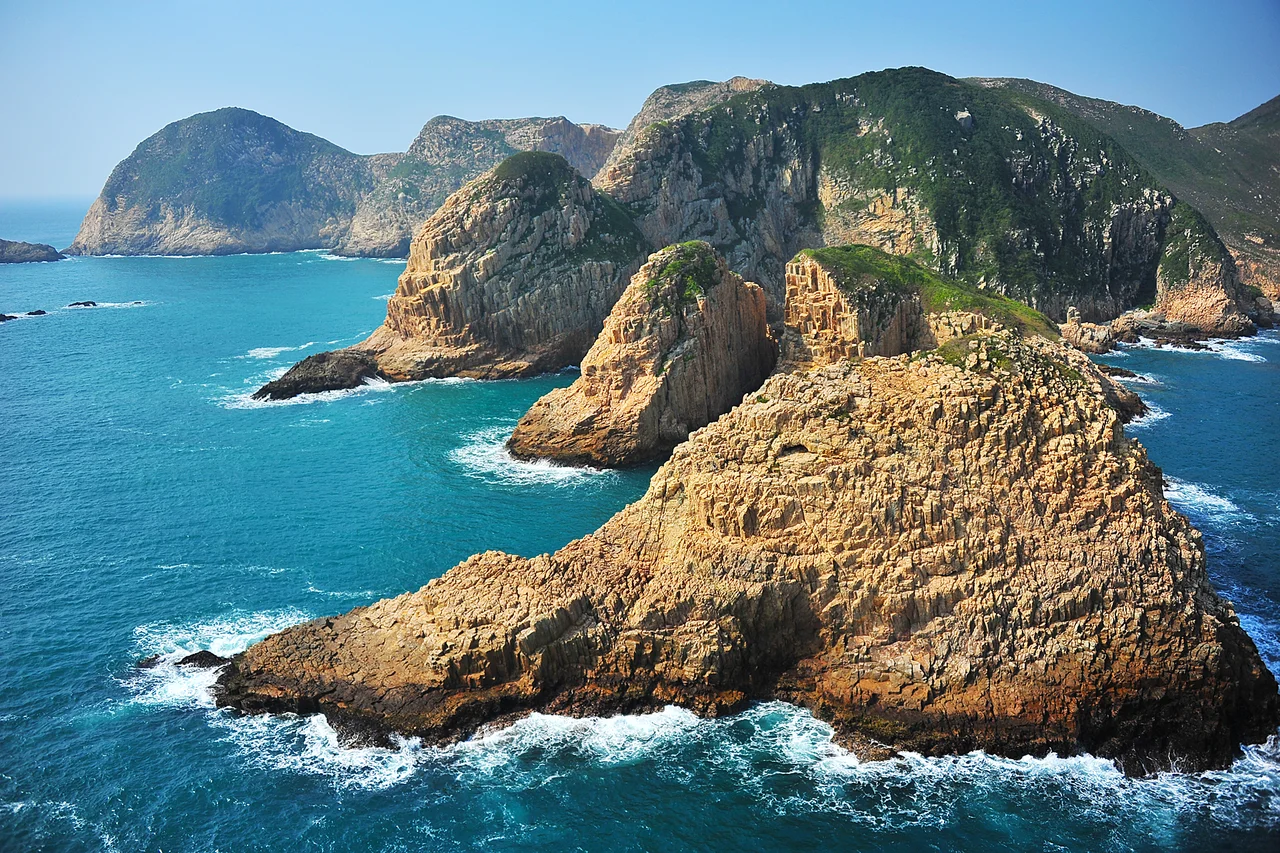
The island is called Basalt, but its rocks are not basalt. They never were. The name stuck anyway, a small geological error preserved across decades of charts and signage. What the island does hold — along its rocky shoreline and in the fog that sometimes swallows it entirely — is harder to rename: the memory of 35 people who did not survive the night of 21 December 1948, when a C-54 Skymaster inbound from Shanghai fell into the hillside and killed everyone aboard.
A Name That Doesn't Fit
Basalt Island — or Fo Shek Chau in Cantonese — sits in the eastern waters of Hong Kong, south of Town Island and Wang Chau, east of Bluff Island, and north of the Ninepin Group. Its highest point rises 174 meters above sea level. Together with Wang Chau and Bluff Island, it forms the Ung Kong Group, now part of Hong Kong's UNESCO Global Geopark.
The island was designated a Site of Special Scientific Interest in 1979, and the Ung Kong Group Special Area — covering 176.8 hectares — was formally established in 2011. The geology here is characterized by volcanic rocks of the Cretaceous period. Those rocks are rhyolitic tuff, formed from compacted volcanic ash and fragments, not the dark dense basalt the name suggests. How the discrepancy became permanent is unrecorded. The island wears the wrong name with complete indifference.
Flight XT-104
On 21 December 1948, China National Aviation Corporation flight XT-104 departed Shanghai bound for Kai Tak Airport in Hong Kong. The aircraft was a Douglas C-54 Skymaster, a four-engine transport that had served reliably across the Pacific during the war. Fog obscured the approach. The aircraft struck the hillside of Basalt Island.
All 35 people aboard died: 28 passengers including five women and one child, and seven crew members. It was the first commercial airliner crash in Hong Kong's history. The official cause was the fog.
Among those killed was Quentin Roosevelt II, grandson of American president Theodore Roosevelt and, at the time of the crash, Senior Vice President of China National Aviation Corporation. Also killed was Paul Yung, elder brother of Rong Yiren — who would later become Vice-President of the People's Republic of China. Debris from the aircraft remains near the crash site.
Lives Cut Short
The 35 people who died on Basalt Island were traveling between two cities in a country still in civil war. The People's Liberation Army was advancing through the mainland; the Nationalist government was losing ground. Passengers on that December flight had their own reasons for traveling — business, family, escape, duty. None of those reasons survived with them.
Quentin Roosevelt II carried a famous name, and his death reached the international press quickly. Paul Yung's death was quieter in the historical record, though the brother he left behind would rise to one of China's highest offices. For the other 26 — the women, the child, the crew, the unnamed passengers in contemporary accounts — the fog of that December night has largely swallowed their individual stories too.
The Geopark World
Today Basalt Island is uninhabited and protected. It belongs to the Hong Kong UNESCO Global Geopark, a network of sites that showcases the territory's remarkable geological diversity — volcanic formations, sedimentary sequences, sea caves, and columns shaped by ancient eruptions and erosion over millions of years.
The Ung Kong Group, of which Basalt Island is a part, represents the volcanic geology of the Cretaceous period — roughly 66 to 145 million years ago — when this region of what is now southern China was geologically active. The tuff that makes up the island formed from that ancient violence: ash and debris that settled, compacted, and hardened into stone. The island that took 35 lives in 1948 was built from the debris of something far older.
From the Air
Basalt Island lies at approximately 22.316°N, 114.366°E, in the eastern waters of the Sai Kung District of Hong Kong. From the air, it is visible as a compact, hilly landmass surrounded by open water, southeast of the main urban mass of Kowloon and roughly 30 km east of Hong Kong International Airport (VHHH). At altitudes of 1,500 to 3,000 feet, the island's shape and isolation become clear; its 174-meter summit is modest but distinct. The Ninepin Group (Kwo Chau Islands) is visible to the south, and Bluff Island lies to the west. The area is part of the Hong Kong UNESCO Global Geopark and sees regular vessel traffic from Clear Water Bay and Sai Kung. Approach the area from the west via Junk Bay (Tseung Kwan O Hoi) for the clearest line of sight in typical weather.
Nearby Stories
- Shek Pik 1.7 km away
- Tung Ping Chau 4.8 km away
- Hong Kong 12 14 km away
- Wanshan Archipelago Campaign 16 km away
- Pearl River Delta 18 km away
- Battle of Penghu 478 km away
- Penghu Air Raids 487 km away
- Cape Maobitou 596 km away