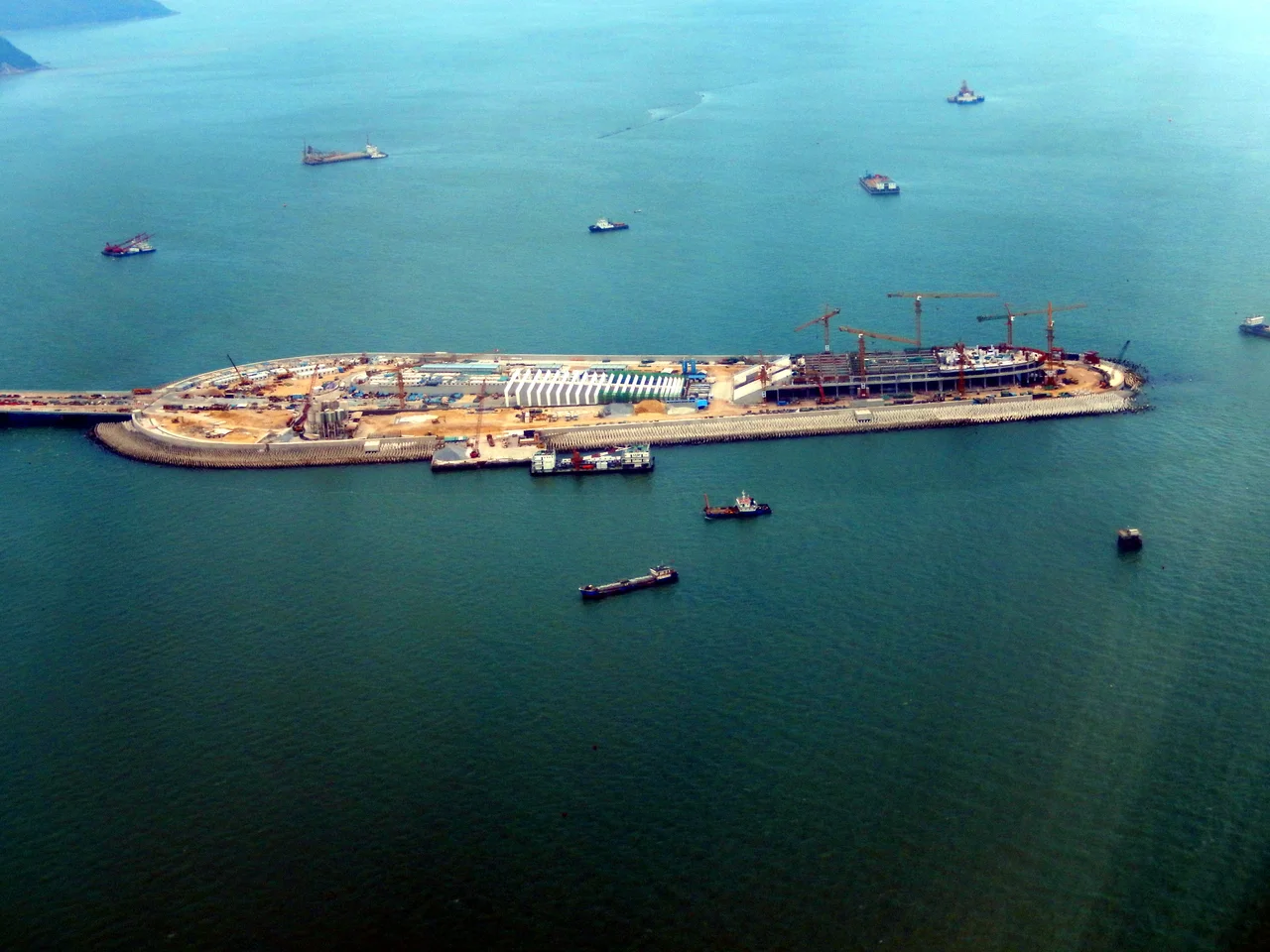

Hong Kong–Zhuhai–Macau Bridge
Gordon Wu got the idea in 1983 from the Chesapeake Bay Bridge-Tunnel. As founder of Hopewell Holdings, he was the kind of Hong Kong developer who thought in decades rather than quarters, and what he saw crossing Virginia's bay convinced him that the Pearl River estuary — separating Hong Kong from Macau and the booming mainland city of Zhuhai — was begging for the same solution. He pitched the concept in 1988. The Tiananmen Square protests of 1989 stalled it. Negotiations crawled through the 1990s and 2000s. Construction finally broke ground in December 2009, and the bridge that opened on 24 October 2018 was thirty-five years in the making.
The Scale of the Thing
At 55 kilometres, the Hong Kong–Zhuhai–Macau Bridge is both the longest sea crossing and the longest open-sea fixed link in the world. It consists of three cable-stayed bridges, a 6.7-kilometre immersed tube tunnel, four artificial islands, and link roads extending from both the Hong Kong and Zhuhai sides. The main bridge alone — the central section managed by mainland Chinese authorities — runs 29.6 kilometres across the Pearl River estuary, with three cable-stayed spans reaching between 280 metres to allow shipping traffic to pass underneath.
The tunnel section dips beneath the water between two artificial islands named Blue Dolphin Island and White Dolphin Island, built to mark where road traffic transitions between bridge and tunnel. Drivers switching from Hong Kong's left-hand traffic to mainland China's right-hand traffic use dedicated crossing viaducts at the boundaries. The bridge is technically in Zhuhai for most of its length. The total project cost ¥127 billion — approximately US$18.8 billion — and was designed to last 120 years.
Built at a Price Beyond the Budget Line
The construction record is not only one of engineering achievement. On the Hong Kong side of the project alone, more than ten workers died and between 234 and 600 were injured — the range reflecting disputed reporting. On the mainland side, at least nine additional fatalities were confirmed, though lawmakers in Hong Kong noted that the true toll there was unknown and potentially far larger. Fernando Cheung, a Hong Kong lawmaker, publicly called it 'the bridge of blood and tears.'
In December 2017, a laboratory technician pleaded guilty and was sentenced to eight months in prison for falsifying materials test results. The Hong Kong Highways Department retested the materials and found that actual results met safety standards, but the episode added to public unease about oversight across a project of this complexity. The workers who built this bridge — the ones who died and the far greater number who went home at the end of each shift — are the human foundation of what the official record calls an engineering marvel.
Opened Slow, Grown Fast
On the first day of public operation, fewer than 1,500 private cars and goods vehicles crossed the bridge. The government had projected 9,200 to 14,000 daily. Critics called it a vanity project, a massively expensive link that served politics more than people.
The picture looked different by 2024. Over 10,000 private, coach, and goods vehicles were crossing daily, and most of the bridge's traffic travelled not in private cars but on the HZMBus shuttle service — colloquially known as the 'golden buses' — which runs every five minutes around the clock and carries the crossing in about forty minutes. In a single day on 31 January 2025, the Zhuhai port recorded 156,000 passenger trips. The journey between Zhuhai and Hong Kong, which once took roughly four hours by road and ferry, now takes thirty minutes.
The Dolphins That Paid the Cost
The Pearl River estuary is home to the Chinese white dolphin, a species that ranges from pink in adults to white in juveniles and that has lived in these waters for as long as records exist. Conservationists at WWF Hong Kong documented the impact of construction directly: between April 2015 and March 2016, the population of white dolphins in the waters near Lantau Island fell by sixty percent. The construction noise, dredging, and shipping traffic associated with the project pushed the animals from habitat they had occupied for generations.
The dolphins did not have a seat at the table when the bridge was planned, and they had no recourse when the construction proceeded. They remain in the estuary in reduced numbers, sharing the water with the bridge that reshaped their world.
From the Air
The Hong Kong–Zhuhai–Macau Bridge is centred at approximately 22.282°N, 113.775°E across the Pearl River estuary. From altitude it is dramatically visible: a pale ribbon stretching 55 km across open water, connecting Lantau Island in the northeast to the Zhuhai/Macau coast in the southwest. The bridge's cable-stayed towers are visible from cruising altitude in clear conditions. Hong Kong International Airport (VHHH) is on Lantau Island just north of the bridge's eastern terminus. Macau International Airport (VMMC) lies roughly 6 km southeast of the western end. The four artificial islands appear as small white rectangles against the grey-brown estuary water. Best viewed at 3,000–8,000 feet on a clear day.
Nearby Stories
- Tai Tau Chau (Southern District) 0.7 km away
- Lai Chi Wo 3 km away
- Wanshan Archipelago Campaign 3.2 km away
- Pearl River Delta 3.7 km away
- Battle of Yamen 13 km away
- Jiangmen 15 km away
- Hong Kong 12 32 km away
- Battle of Nanpeng Island 114 km away