
Hong Kong Disneyland
A bend in the walkway near the park entrance sounds like a minor architectural detail. It wasn't. When Disney designed Hong Kong Disneyland, feng shui masters recommended the curve so that good qi energy would not flow directly into the South China Sea. The adjustment was one of dozens of deliberate choices that made this park different from its American and European counterparts — a Disneyland that had to negotiate with a city's culture, its geography, and its complicated relationship with mainland China, all before a single visitor arrived.
Built on a Bay, Launched in a Crisis
Penny's Bay on Lantau Island had spent most of the twentieth century as undeveloped coastline, with only the Cheoy Lee Shipyard operating there since the 1960s. By the late 1990s, it had been selected as the site for Hong Kong's answer to Tokyo Disneyland. Then came SARS.
The epidemic devastated Hong Kong's economy in 2003, and city chief executive Tung Chee-hwa — already instrumental in brokering the original Disneyland agreement — saw the new park as a confidence booster for the battered tourism industry. Groundbreaking took place on 12 January 2003, with more than 400 guests attending the ceremony, including Disney chairman Michael Eisner and future CEO Bob Iger. The park had one of the shortest construction periods of any Disneyland-style development, opening officially on 12 September 2005, its ribbon cut by then-Vice President of China Zeng Qinghong.
The Smallest Disneyland, Then and Now
On opening day, Hong Kong Disneyland had just four themed lands — Main Street U.S.A., Fantasyland, Tomorrowland, and Adventureland — missing the Frontierland that anchor other Disney castle parks. Its daily capacity was set at 34,000 visitors, the lowest of any Disneyland park in the world. In its first year, it attracted 5.2 million guests, just below its target of 5.6 million. The second year brought a 20% drop to 4 million, prompting criticism from local legislators.
The park expanded systematically in the years that followed. Toy Story Land opened in 2011. Grizzly Gulch — Hong Kong's version of Frontierland, themed around an abandoned mining town supposedly founded on 8 August 1888, the luckiest day of the luckiest month of the luckiest year — opened in 2012. Mystic Point, set in 1909 in a mysterious uncharted rainforest, opened in 2013. By 2024, the park was drawing 7.9 million visitors annually, ranking it 17th most visited theme park in the world.
Marvel, Frozen, and a Castle Transformed
The original centerpiece, Sleeping Beauty Castle, stood at the heart of the park until 2018, when it closed for a three-year reconstruction. In November 2020, it reopened as the Castle of Magical Dreams — double the height of its predecessor, decorated with symbols drawn from thirteen Disney princesses. The transformation coincided with the park's 15th anniversary, a milestone the park observed while closed due to the COVID-19 pandemic.
The same multi-year expansion that brought the new castle also introduced the first Marvel attraction in any Disney theme park: the Iron Man Experience, which opened on 11 January 2017. Ant-Man and The Wasp: Nano Battle! followed in 2019. In November 2023, World of Frozen opened as the world's first and largest Frozen-themed park area, featuring a dark ride and a family roller coaster called Wandering Oaken's Sliding Sleighs. The park that once had four lands now has eight, with more in development.
Between Two Systems
Hong Kong Disneyland is owned jointly by Hong Kong International Theme Parks, which holds 52%, and the Walt Disney Company with 48%. That ownership structure reflects a broader tension the park has always navigated: it is a global American entertainment brand operating in a Special Administrative Region of China, designed to appeal to mainland Chinese visitors while remaining distinctly Hong Kong.
Disney's cultural accommodation went beyond feng shui. Staff speak Cantonese, English, and Mandarin. Guide maps were printed in traditional and simplified Chinese. The opening soundtrack album featured Cantonese and Mandarin covers of Disney classics by Hong Kong pop stars including Jacky Cheung, Eason Chan, and Karen Mok. For two decades, the park has worked to be both something universal and something local — an ongoing negotiation with a city that has always had to be both things at once.
From the Air
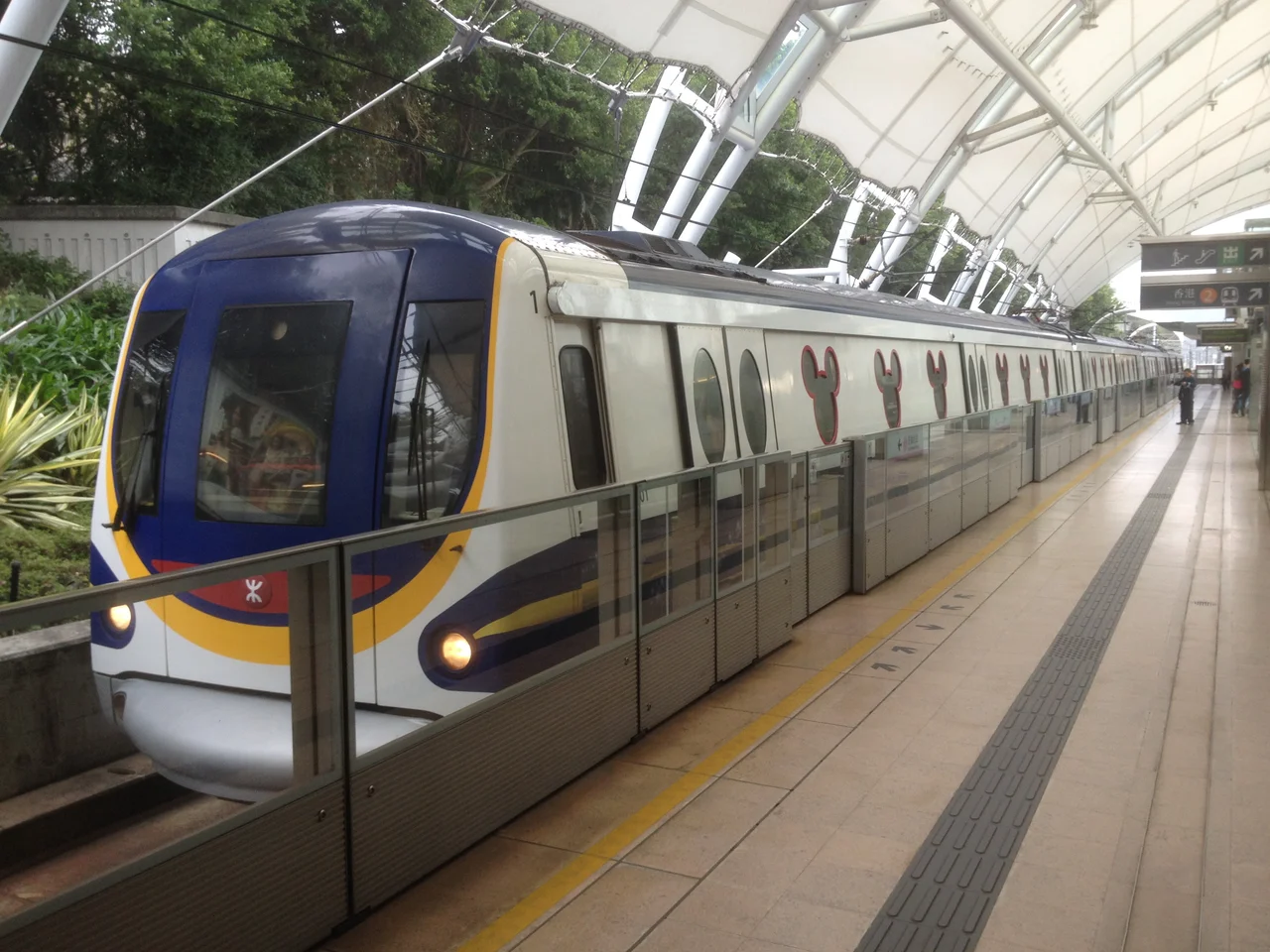
Hong Kong Disneyland sits at 22.313°N, 114.044°E on reclaimed land at Penny's Bay, Lantau Island, roughly 30 km west of central Hong Kong. From the air, the park is clearly visible just south of the North Lantau Highway, with its castle and themed lands easily distinguishable at altitudes of 2,000–5,000 feet. The nearby airport is Hong Kong International Airport (VHHH), located approximately 6 km to the northwest on the same island — approach from the west or north for a clear view of the park before reaching the runway threshold. The Disneyland Resort MTR station sits adjacent to the park's main entrance.
Nearby Stories
- Lok Ma Chau Loop 2.3 km away
- Portas do Cerco 2.3 km away
- Kweilin Incident 17 km away
- Wanshan Archipelago Campaign 34 km away
- Nanxiong Formation 115 km away
- Battle of Nanpeng Island 148 km away
- Heyuan 169 km away
- Cape Maobitou 632 km away