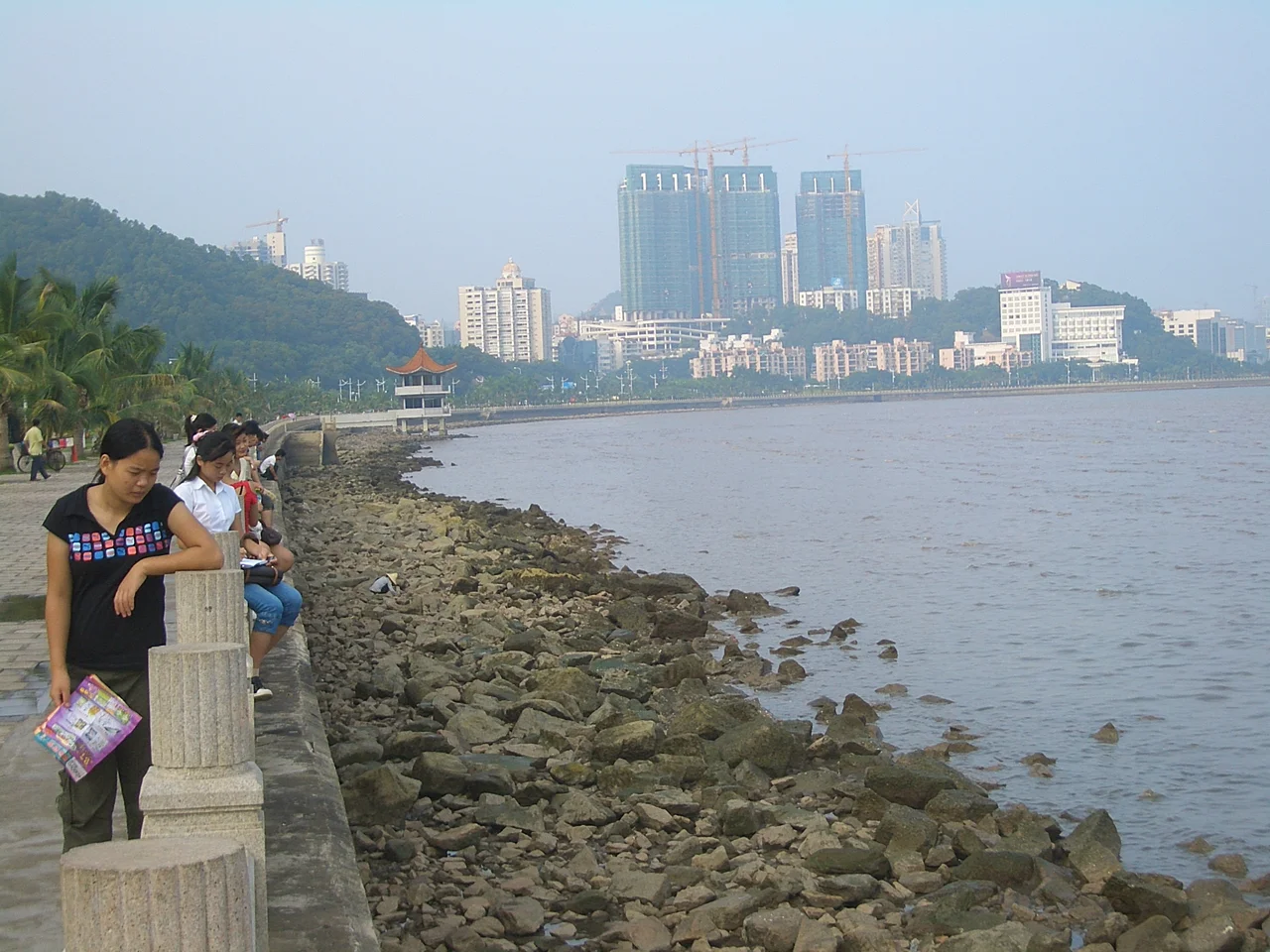

Zhuhai
The name says everything and almost nothing: Pearl Sea. Zhuhai sits at the mouth of the Pearl River where it spills into the South China Sea, and the name has always described both a geography and a promise. Until the 1970s, around 100,000 people lived here in a scattered collection of fishing villages, their lives shaped by tides and catches rather than by any grand urban ambition. Then, in 1980, the central government designated Zhuhai a Special Economic Zone, and the fishing villages began their transformation into one of China's most unusual cities — sprawling, green, coastal, and surprisingly easy to love.
Romance and a Hundred Islands
Zhuhai's nicknames tell you what residents value most. The 'city of romance' and the 'city of a hundred islands' — there are actually 146 — are not marketing slogans so much as accurate descriptions of a place that genuinely looks different from most Chinese cities. Palm trees line the extensive coastline. Parks and open spaces interrupt the urban fabric in ways that denser neighbors like Shenzhen and Guangzhou rarely permit. The population density is low by Pearl River Delta standards, which means the green survives.
In 1998, the United Nations Centre for Human Settlements awarded Zhuhai the International Award for Best Practices in Improving Living Environment — recognition that the city's ecological ambitions were serious, not decorative. The sub-tropical climate, ranging from around 10°C in winter to 35°C in the humid summer months, means the palms are always swaying and the coastline always accessible, if occasionally swept by typhoons between June and September.
Islands Without Maps
From the Xiangzhou Port, ferries depart for the Wanshan Islands — a scattered archipelago where most tourist information simply does not exist in English, and where most local residents have never been. Dong'ao Island offers diving and clear water. Outer Lingding Island, Guishan Island with its sleepy fishing-village pace, and Hebao Island for those who prefer wilderness to amenity — each has its own character, and the seafood on all of them is exceptional.
Bring cash. Some islands have no ATMs. The logistical friction that keeps most visitors away is precisely what makes these crossings feel like genuine escapes. A ferry ride to Guishan or Hebao is, as locals sometimes put it, comparable to leaving the country — the same Pearl River Delta, transformed by water into somewhere quieter, stranger, and harder to describe.
Where Three Borders Converge
Zhuhai's position in the Pearl River Delta makes it one of the world's most transit-dense small cities. To the south lies Macau, the former Portuguese colony now connected by the Lotus Bridge land crossing and by ferry from Wanzai. Across the Pearl estuary to the east are Hong Kong and Shenzhen, reachable by ferry and, since October 2018, by the 50-kilometer Hong Kong–Zhuhai–Macau Bridge, one of the largest infrastructure projects in the world.
The Gongbei district, where the main Macau border crossing sits, runs on a different rhythm from the rest of the city. Lianhua Road — the Walking Street — transforms at night into a dense spectacle of outdoor bars, food vendors, and the full spectrum of tourism's informal economy. The underground shopping complex at the border crossing draws shoppers from both sides. Gongbei is the face Zhuhai shows to the world; the quieter residential districts of Xiangzhou and New Xiangzhou are where the city actually lives.
Sun Yat-sen's Shadow
History runs close to the surface in Zhuhai. The northern district of Tangjia is home to a campus of Sun Yat-sen University, named for the revolutionary leader who was born just 37 kilometers away in Cuiheng village — the same man whose family home in Macau became a museum, whose face appears on the Taiwanese dollar, and whose legacy remains contested across the strait. The university's Zhuhai campus, with roughly 9,000 students enrolled across 14 schools, continues that complicated inheritance quietly, on a headland between the coast and the hills.
Zhuhai's western district of Doumen holds its own quieter treasures: the Jintai Buddhist Temple, built during the Song Dynasty over a thousand years ago, and the hot springs resorts that draw visitors from across the region. The city that began as fishing villages has not entirely forgotten what it was. It has simply become much more.
From the Air
Zhuhai occupies a series of coastal bays and headlands on the western shore of the Pearl River Delta, centered roughly at 22.27°N, 113.57°E. From the air, the city is immediately distinctive: coastline broken by hills and islands, with Macau's casino towers visible to the south and the vast bridge of the HZMB curving toward Hong Kong to the northeast. Zhuhai Airport (ZGSD) is located on the northwestern coast of the city, about 30 km from the Gongbei border area. Macau International Airport (VMMC) is the closest major facility, roughly 10 km south. A viewing altitude of 3,000–5,000 feet reveals the full geography of the delta — the green hills breaking up the coastal plain, the scatter of offshore islands, and the Pearl River's broad mouth. VHHH (Hong Kong International) is approximately 50 km to the northeast.
Nearby Stories
- Tai Tau Chau (Southern District) 0.7 km away
- Lai Chi Wo 3 km away
- Wanshan Archipelago Campaign 3.2 km away
- Pearl River Delta 3.7 km away
- Battle of Yamen 13 km away
- Jiangmen 15 km away
- Hong Kong 12 32 km away
- Battle of Nanpeng Island 114 km away