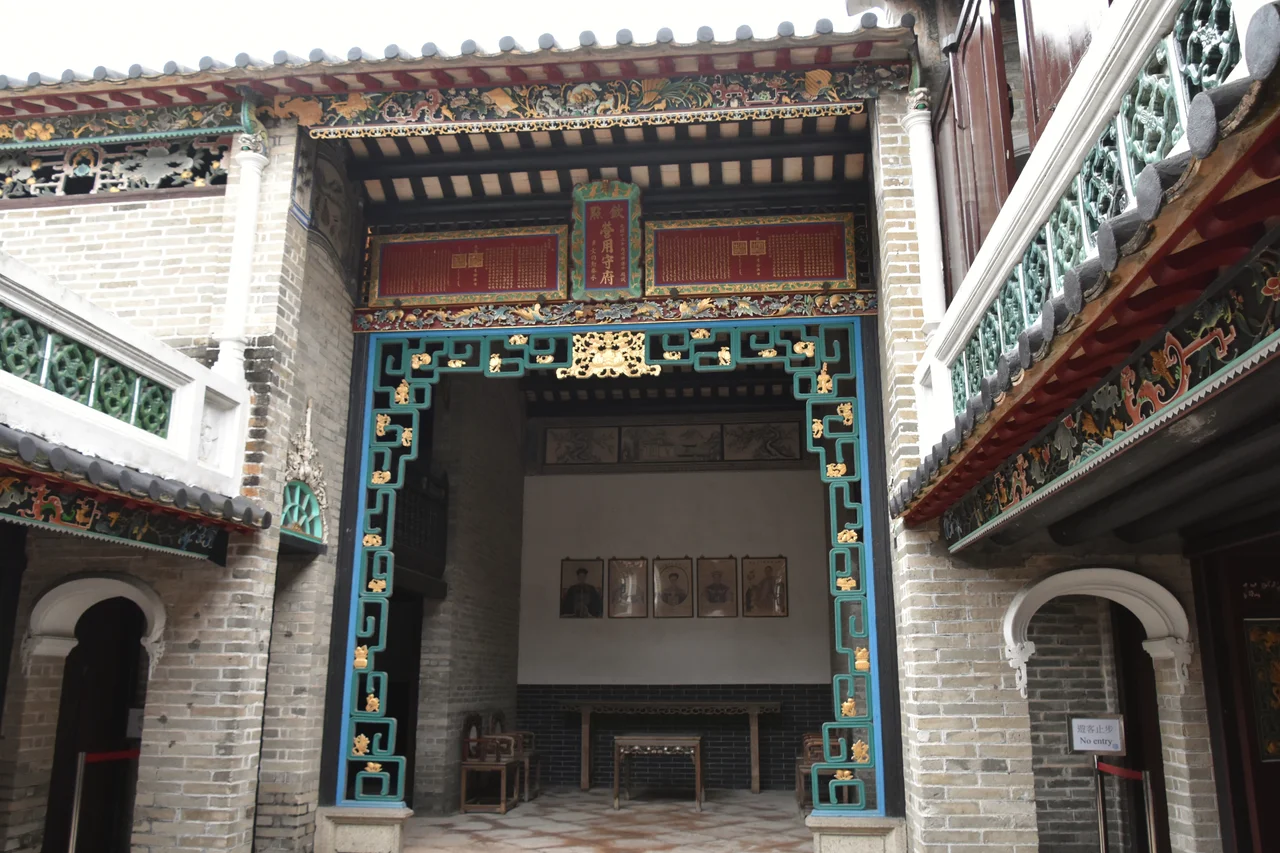

Tai Fu Tai Mansion
The Man clan has been rooted in San Tin since the 15th century. When Man Chung-luen built a residence there in 1865, he did not simply construct a house — he built an argument about status, taste, and belonging. The result, Tai Fu Tai Mansion, is one of the most ornate surviving examples of traditional Lingnan-style residential architecture in Hong Kong: a compound surrounded by green-brick walls, with a large open forecourt, richly decorated interior spaces, and a garden at the rear. It stands in Wing Ping Tsuen, near Lok Ma Chau in northern Yuen Long, as a monument to a world the Qing dynasty has long since left behind.
The Scholar-Gentry and Their Houses
In imperial China, the scholar-gentry class occupied a distinctive position: educated men who had passed the civil service examinations and earned official rank, but who remained rooted in their home villages and clans. Their residences were expressions of that dual identity — classical in their decoration and spatial organization, but local in their materials and community context. Tai Fu Tai translates roughly as 'residence of a senior official,' a title that signals the ambition embedded in the architecture.
The mansion is a fine example of the Lingnan style, the architectural tradition of the region encompassing Guangdong, Guangxi, and Hong Kong. Lingnan buildings are typically lower-pitched than northern Chinese architecture, with richly carved and painted decorative elements — friezes, ceramic figurines along rooflines, painted panels — suited to the warm, wet climate. At Tai Fu Tai, these elements are present in abundance: the building is, in the words of heritage records, 'richly embellished.'
Six Centuries in San Tin
The Man clan's connection to San Tin predates the mansion by four centuries. Their ancestors settled in the area in the 15th century, putting down roots in what was then a remote agricultural plain north of the Yuen Long lowlands. By 1865, when Man Chung-luen commissioned the mansion during the reign of the Qing emperor, the clan had developed into one of the established lineages of the New Territories — the kind of deep-rooted family that built ancestral halls, maintained clan schools, and expressed continuity through architecture.
The mansion itself reflects that longevity. The green-brick enclosing wall, the formal forecourt, and the rear garden follow a layout that treats the residence as a self-contained world — secure within its walls, ordered in its spaces, and open at the front to receive guests with appropriate dignity.
Preservation and the Digital Record
Tai Fu Tai Mansion is a declared monument of Hong Kong — the highest level of heritage protection available — and is managed by the Antiquities and Monuments Office. The designation reflects the building's architectural rarity in a city where demolition has been the default response to almost everything old.
In 2007, the mansion was the subject of a 3D laser scanning project that digitally captured detailed images of the structure's form and surface decoration. The technique creates a precise spatial record that can document deterioration over time, guide restoration work, and preserve the building's geometry even if the physical structure changes. It was an early adoption of a technology that has since become standard in heritage conservation — a recognition that documentation is itself a form of preservation.
What the Walls Still Hold
Walking through Tai Fu Tai Mansion today, the decorative detail is what holds the eye. Carved wooden screens, painted plaster friezes, ceramic figurines riding the ridgelines — each element was chosen and placed according to conventions that carried meaning for the people who commissioned and inhabited the building. The forecourt's open space was not just functional; it was symbolic, expressing the household's openness to the world outside the wall. The garden at the rear was private, a space for contemplation away from the formal reception areas.
The mansion is open to the public as a heritage site, and the Antiquities and Monuments Office has produced detailed documentation of its construction and decoration. San Tin remains a functioning village. The Man clan's connection to the area, now stretching across more than six centuries, is one of the longest continuous human habitations in Hong Kong's documented history.
From the Air
Tai Fu Tai Mansion is located at approximately 22.50°N, 114.08°E in the San Tin area of northern Yuen Long District. From the air at 1,500–3,000 feet, the walled compound is visible within the village of Wing Ping Tsuen, near Lok Ma Chau and the boundary with Shenzhen. The Deep Bay wetlands and the Mai Po Nature Reserve are visible to the west. Lok Ma Chau Loop lies to the north. The nearest major airport is Hong Kong International Airport (ICAO: VHHH), approximately 25 km to the southwest on Lantau Island.
Nearby Stories
- Chapel of St. Francis Xavier 3.5 km away
- Cuiheng 4.1 km away
- 2015 Shenzhen Landslide 16 km away
- Shunde 31 km away
- Wanshan Archipelago 37 km away
- Nanxiong Formation 96 km away
- Heyuan 149 km away
- Checheng Fu'an Temple 629 km away