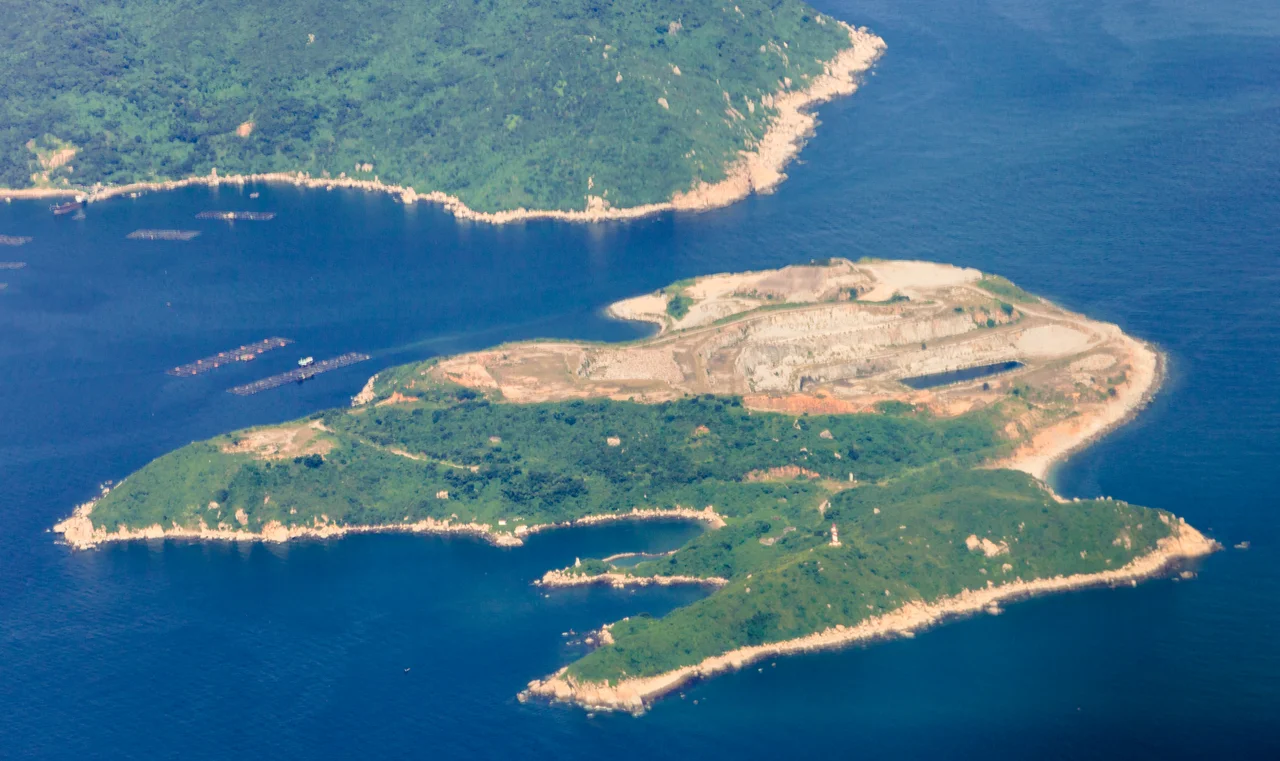

Wanshan Archipelago
Europeans who sailed these waters in the centuries before reliable charts named the islands after what they feared finding there. Ladrones — thieves — was the Spanish word that stuck, a blunt warning written onto the navigation records passed between merchant captains working the Pearl River trade. The islands earned the name: shallow channels, sudden anchorages, and the proximity of Canton's commerce made the archipelago useful to pirates who preyed on ships waiting for favorable winds. The name lasted long after the pirates faded, carried in British Admiralty charts and diplomatic cables well into the twentieth century. Today the archipelago is simply the Wanshan Islands, administered from Zhuhai, and the 350,000 tourists who visit annually are looking for beaches, not thieves.
A Hundred and Four Islands
The Wanshan Archipelago comprises 104 islands spread across the South China Sea south of the Pearl River estuary, between Macau to the west and Hong Kong to the east. They divide naturally into groups. The western cluster — historically the Ladrones proper — includes Greater Wanshan (Dawanshan Dao), Guishan, and the Zhizhou and Sanmen island groups. The eastern cluster, south of Hong Kong Island, was known as the Lema Islands and now carries the names Jiapeng Liedao and Dangan Liedao. The northern group sits between Lantau Island and Macau. Each cluster has its own character: some are mountainous enough to resemble Hong Kong's outlying islands, others are low and barely forested. The largest, Dangan Dao, covers 13.2 square kilometers and has 200 permanent residents concentrated along Zhangmu Bay and Hengkeng village. Erzhou, at 437.7 meters above sea level, is the highest point in the archipelago.
The Lighthouse at the Edge
On Beijian Dao, in the southern group, two peaks rise almost perpendicularly to 300 meters at the island's southwestern end — features that sailors coming from the south called the Asses' Ears, navigational markers they could read from miles out. At the summit, a lighthouse was built to guide ships into Hong Kong. Construction was funded partly by the Imperial Qing Government, built by a Hong Kong contractor, and came into operation in 1892 under Hong Kong control — a careful administrative arrangement on an island that remained under Chinese sovereignty. The lighthouse had separate European and Chinese living quarters, a telegraph room, and storage. Typhoons damaged its lenses and windows in 1893 and 1905. The keepers eventually abandoned the site. China's civil war left it in ruins through the 1930s and 1940s. After the Communists took control in Beijing, the lighthouse was eventually restored in 1986 with solar panels and fully automated. It still operates. The Asses' Ears still stand.
Fishing Villages and Fishermen
The archipelago's economy runs on what the sea provides. Crystal prawns and peeler crabs are the primary catches, sold in markets in Zhuhai and Hong Kong. Small fishing villages hold on across the islands, though permanent populations are thin — most of the islands have no year-round residents at all. Dangan has its village; Wai Lingding has the headquarters of Dangan Town; Dawanshan houses the seat of Wanshan Town. The people who stayed on these islands across generations developed a life organized around tides, weather, and the catch, largely insulated from the casino economy building itself on the nearby mainland coast. Guishan Dao, in the northwestern group, served as a People's Liberation Army base from the 1950s before being opened up more broadly. A monument on the island commemorates the martyrs of the Guishan warship. Wen Tianxiang Park preserves the memory of the Song Dynasty loyalist who passed through these waters in his final years.
Tourism and the Islands Today
About 350,000 tourists visit the Wanshan Islands annually, drawn by beaches, history, and the visual drama of a place that most of Hong Kong and Macau's visitors never reach. Dong'ao Dao has the most resort infrastructure: Club Med opened a holiday resort there in 2014, adding the company's particular model of all-inclusive beach tourism to an island that previously had only local fishing activity. Miaowan island offers Xiafeng Bay, a coral beach adjacent to its fishing village. On the main Wanshan island (Dawanshan Dao), the A-Ma Temple honors the sea goddess venerated across this entire coast, and Floating Cobbles Bay offers the specific geological curiosity its name describes — large rounded stones deposited in patterns by wave action. Ferry services run from Zhuhai to the main inhabited islands. Sightseeing ferryboats circuit the archipelago. The access is improving, and the islands, long defined by their strategic position between Hong Kong, Macau, and the Pearl River delta, are becoming known for something else: the quiet.
The Stage for a Naval Drama
In January 1799, the same channels and anchorages that once sheltered pirates provided the setting for one of the more peculiar encounters of the French Revolutionary Wars. A Franco-Spanish squadron of six warships arrived in the Wanshan Archipelago with orders to destroy the British China convoy assembled at Macau. The British escort under Captain William Hargood sailed out to meet them. Both sides formed lines of battle, steered toward each other — and then the Franco-Spanish squadron retreated into the island channels as darkness fell. Both admirals filed reports claiming the other had refused to fight. The China Fleet sailed safely west eleven days later, passing unimpeded into the Indian Ocean. The archipelago provided the geography of retreat and the cover of its islands to whichever side needed them most. It had done the same for pirates for a century before. The islands took no side.
From the Air
The Wanshan Archipelago lies at approximately 21.995°N, 113.765°E, south of the Pearl River estuary between Macau and Hong Kong. From the air at 5,000–8,000 feet, the full sweep of the island groups is visible — dark forested masses scattered across the blue-gray South China Sea, with the Pearl River delta opening to the north and Hong Kong's Lantau Island visible to the northeast. The Asses' Ears peaks on Beijian Dao, rising to 300 meters, are visually distinctive from altitude. Nearest ICAO airports include VMMC (Macau International Airport) to the northwest and VHHH (Hong Kong International Airport) to the northeast. Best viewed from the southeast in clear weather, when the island chains recede toward the horizon in sequence.
Nearby Stories
- Trio Beach 3.9 km away
- Po Toi 12 km away
- Nei Lingding Island 12 km away
- Battle of Yamen 27 km away
- Xinhui, Jiangmen 28 km away
- Battle of Nanpeng Island 107 km away
- Temple of the Five Lords 403 km away
- Mavulis Island 800 km away