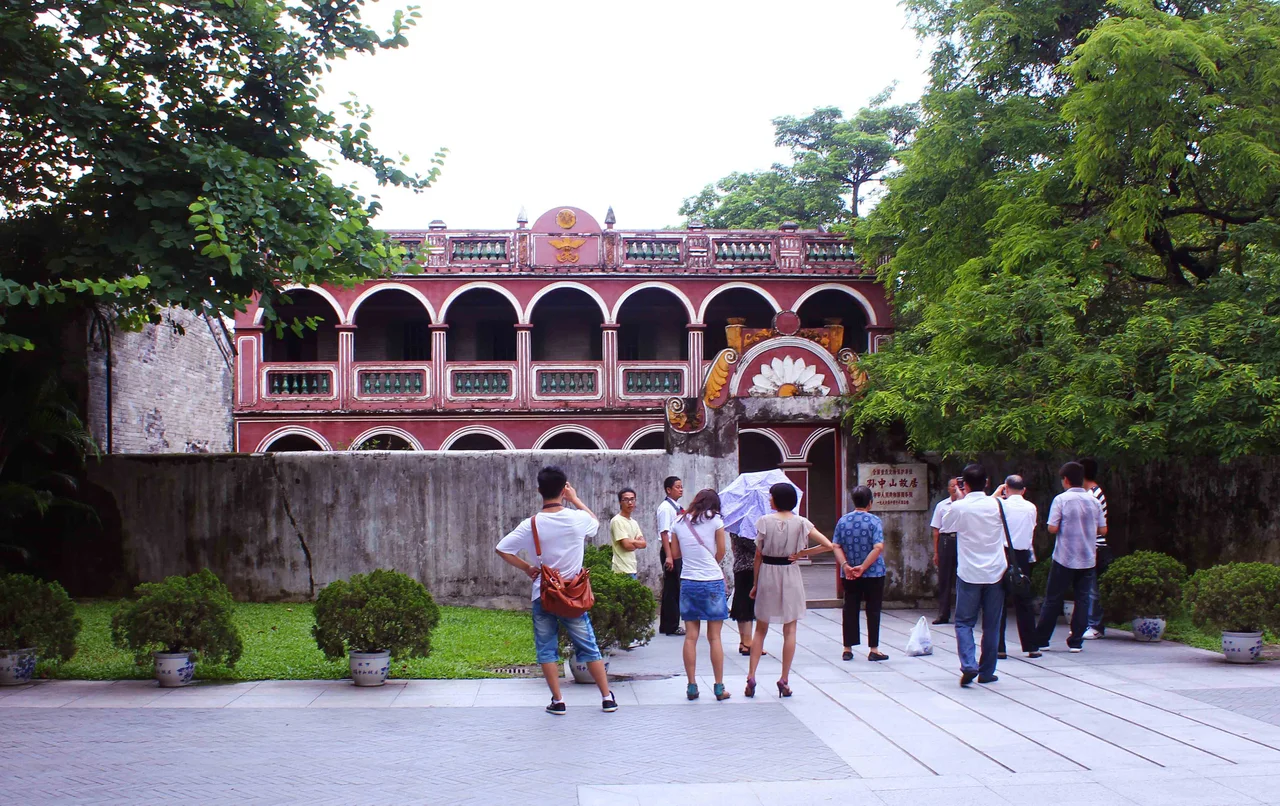

Cuiheng
Twenty-six kilometers north of Macau, in the rolling farmland of Guangdong province, there is a village that produced a man who changed the shape of the world's most populous country. Cuiheng was a modest place when Sun Yat-sen was born here in the 1860s — about sixty households, ten surnames, and the kind of quiet agricultural life that the Qing Dynasty preferred its subjects to lead without complaint. The boy born in Cuiheng would spend the rest of his life violating that preference.
The Village Where It Began
Cuiheng was founded in the latter half of the seventeenth century by the Feng and Mai families. Over generations, the Yang and Lu families joined them, and the Lu surname eventually became the most numerous. By the time of Sun Yat-sen's birth in the 1860s, the village had roughly sixty households spread across ten family names. It was not a place of any particular historical distinction — until it was.
Two other people who would shape Sun's story were also born in Cuiheng: Lu Muzhen, who would become his first wife, and Lu Haodong, born in 1868, who became one of his earliest and most important revolutionary companions. Lu Haodong is credited with designing the earliest flag used by Sun's revolutionary organization and died for the cause in 1895 at the age of twenty-seven, captured and executed by Qing authorities after an abortive uprising in Guangzhou. Three people from the same small village, bound by proximity and then by history.
The House Yat-sen Built
The ancestral home where Sun Yat-sen was actually born was dismantled by the Sun family in 1913. What stands today is the Former Residence of Dr. Sun Yat-sen — a house he designed and built himself in 1892, when he returned to Cuiheng as a trained physician. It reflects his dual formation: a Western-educated doctor from Hong Kong who retained deep roots in a Guangdong village.
Next to the residence, the Sun Yat-sen Residence Memorial Museum was built in 1956. The complex was classified in 1986 as a Major Site Protected at the National Level by China's State Council — the highest cultural heritage designation available. The museum holds artifacts, documents, and photographs tracing his life from this village outward to Honolulu, Hong Kong, Macau, Tokyo, and eventually to the presidency of the Republic of China. The journey began in the fields around this house.
Between Zhongshan and Macau
Cuiheng sits 17.6 km southeast of downtown Zhongshan — a city renamed in Sun Yat-sen's honor after his death in 1925, its original name Xiangshan. The geography is significant: Cuiheng, Zhongshan, and Macau all once lay within the same administrative county. The Portuguese occupation of Macau in the nineteenth century changed Macau's legal status, but not its cultural proximity to the villages that supplied its labor and trade.
Sun Yat-sen grew up commuting between these worlds. His father had worked as a cobbler in Macau. At thirteen, Sun traveled there with his mother. At twenty-six, he graduated from the Hong Kong College of Medicine for Chinese and set up practice in Macau. The colonial borderlands of the Pearl River Delta were not obstacles to his formation — they were its essential conditions. Cuiheng gave him roots; Macau and Hong Kong gave him the world to compare them against.
A Village Designated, a Legacy Debated
Cuiheng today is more than a village. In 2013, it was upgraded to a 'New Area' — a designation that has brought development, infrastructure, and the particular tensions that come when a heritage site becomes an economic zone. The entire village is now a special economic district, with the memorial complex at its civic heart.
Visitors arrive by bus from Zhongshan city center — a 30-to-40-minute ride on Bus 12. The Polaris Temple, dedicated to the Polaris Emperor, adds a layer of older religious practice to a site now dominated by revolutionary commemoration. Sun Yat-sen remains a figure claimed by both sides of the Taiwan Strait, his image appearing on Taiwanese currency while his birthplace sits squarely in mainland Guangdong. Cuiheng has no position on this dispute. It is simply where he started.
From the Air
Cuiheng village sits at approximately 22.4447°N, 113.5367°E, on the flat coastal plain of Zhongshan municipality in Guangdong. From the air, the area appears as a mix of low-density development and farmland between the city of Zhongshan to the north and Macau's towers visible to the south. The Guangzhou–Zhuhai Intercity Railway serves the nearby town of Nanlang, about 10 minutes to the north by bus. The closest airports are Zhuhai Jinwan (ZGSD) approximately 35 km to the southwest, and Macau International (VMMC) about 30 km to the south. A viewing altitude of 2,000–3,000 feet on approach from the south reveals the Pearl River Delta's characteristic geometry: water, reclaimed land, farmland, and the distant high-rises of Macau and Zhuhai marking the coastline.
Nearby Stories
- Lung Kwu Tan 2.4 km away
- 2015 Shenzhen Landslide 5.4 km away
- Lampacau 10 km away
- Shunde 17 km away
- Kaiping 17 km away
- Jiangmen Underground Neutrino Observatory 36 km away
- Hong Kong 12 71 km away
- Erhai Lake 1329 km away