_10.jpg)
Chapel of St. Francis Xavier
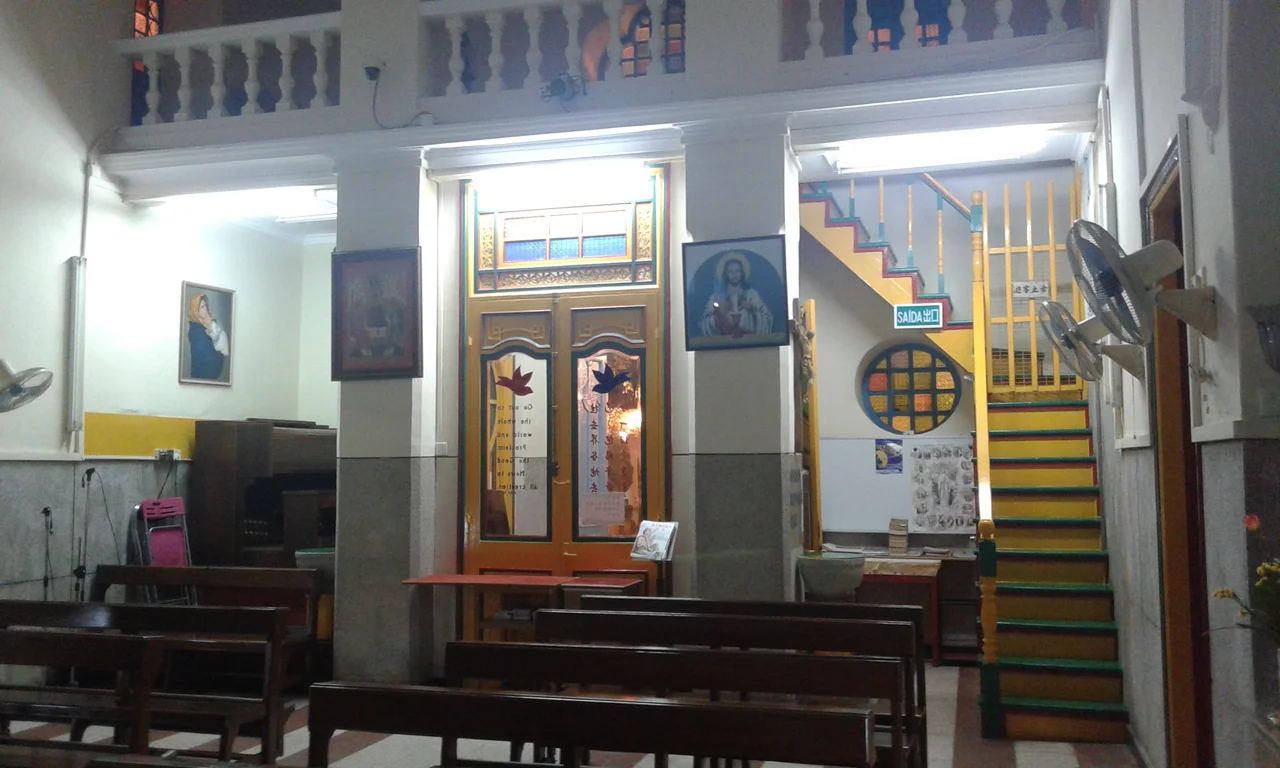
The chapel stands at the southwestern edge of Coloane, Macau's southern island, beside a small square and a monument commemorating a 1910 victory over pirates. It is not large. Its facade is white and yellow, in the Portuguese colonial style common to Macau's older religious buildings. Built in 1928, it looks like many other chapels in this part of the world — which makes it easy to miss what was kept inside. For decades, the Chapel of St. Francis Xavier held some of the most freighted Christian relics in Asia: the bones of men crucified in Japan in 1597, the remains of Christians killed in a seventeenth-century rebellion, and a fragment of bone from the arm of Francis Xavier himself, the Jesuit who brought Christianity to Asia and died within sight of China's coast. The chapel was a small room at the end of a very long road.
The Martyrs of Nagasaki
In February 1597, twenty-six Catholic men were executed on a hill outside Nagasaki under orders from the Japanese ruler Toyotomi Hideyoshi. They were crucified — left on crosses in the winter cold — and then killed with spears. Among them were six Franciscan friars from Europe, three Japanese Jesuits, and seventeen Japanese laypeople, including several who were teenagers. Their crime was practicing a religion the authorities had decided was a political threat. The executions were meant to discourage further Christian activity. Instead, they became martyrdoms — the twenty-six were venerated immediately, and formally canonized by the Catholic Church in 1862. Some of their remains eventually made their way to Macau, where the Portuguese colonial presence provided a degree of protection for Catholic practice, and came to rest in this chapel on Coloane. Alongside them came remains of some of the Japanese Christians killed in the Shimabara Rebellion of 1637, a peasant uprising with strong Catholic dimensions that was suppressed with enormous violence. These relics are now held in the Museum of Sacred Art and Crypt, opened in 1996, after being moved from the chapel.
A Bone Fifty Miles from China
Francis Xavier arrived in Goa in 1542 and spent a decade moving through India, Southeast Asia, and Japan, establishing Christian communities and arguing with local rulers. By 1552, he had fixed his ambition on China — the largest, most populous civilization he had not yet reached — and made his way to Shangchuan Island, a small island off the Guangdong coast, to wait for a passage to the mainland. The passage never came. Xavier died on Shangchuan Island in December 1552, age 46, within fifty miles of the Macau coast. His body was taken first to Malacca, then to Goa, where it remains today in the Basilica of Bom Jesus and continues to draw Catholic pilgrims from across the world. A bone from his arm — a relic distributed to honor his memory and extend his intercessory reach — eventually came to Macau. For years it was kept at this chapel in Coloane; it has since been transferred to St. Joseph's Seminary and Church in central Macau. The story of that bone — separated from its owner five hundred years ago, carried across Asia, kept in a small chapel on an island that didn't exist as a Catholic mission when Xavier died — is a story about how faith moves through geography.
Coloane and the Pirates
The chapel stands near a monument that marks a different kind of history: a battle in 1910 in which the residents of Coloane, helped by Portuguese forces, defeated a pirate raid. The pirates had kidnapped children from the village, and the subsequent fight to recover them became part of the island's founding mythology. Coloane remained the more rural and less developed of Macau's islands until the late twentieth century — a place of fishing villages, temples, and Portuguese colonial buildings, separate in feel from the urban density of the Macau peninsula. The chapel fits that character. It is not a monument to power or imperial ambition. It is a small building that held fragments of people who died badly for what they believed, in distant places, and were carried here to be remembered. The square in front of it is quiet. Pigeons land on the monument. Inside the chapel, or in the museum nearby, the weight of what was kept here is still present for those who come looking for it.
From the Air
The Chapel of St. Francis Xavier sits at 22.12°N, 113.55°E on the southwestern coast of Coloane, the southernmost island of Macau. From the air at 3,000–5,000 feet, Coloane's green hills and the Cotai Strip reclaimed land between Coloane and Taipa are clearly visible, along with the Pearl River estuary opening to the South China Sea. Macau International Airport (VMMC) is roughly 5 km northeast on Taipa island. Zhuhai Jinwan Airport (ZGSD) is about 30 km northwest on the mainland. Visibility in Macau is often reduced by Pearl River Delta haze; clearest conditions in autumn and winter.
Nearby Stories
- The Brothers Islands, Hong Kong 6.3 km away
- Tai A Chau 11 km away
- Kaiping 18 km away
- Cuiheng 21 km away
- Taishan City 22 km away
- Battle of Nanpeng Island 73 km away
- Temple of the Five Lords 372 km away
- Mavulis Island 836 km away