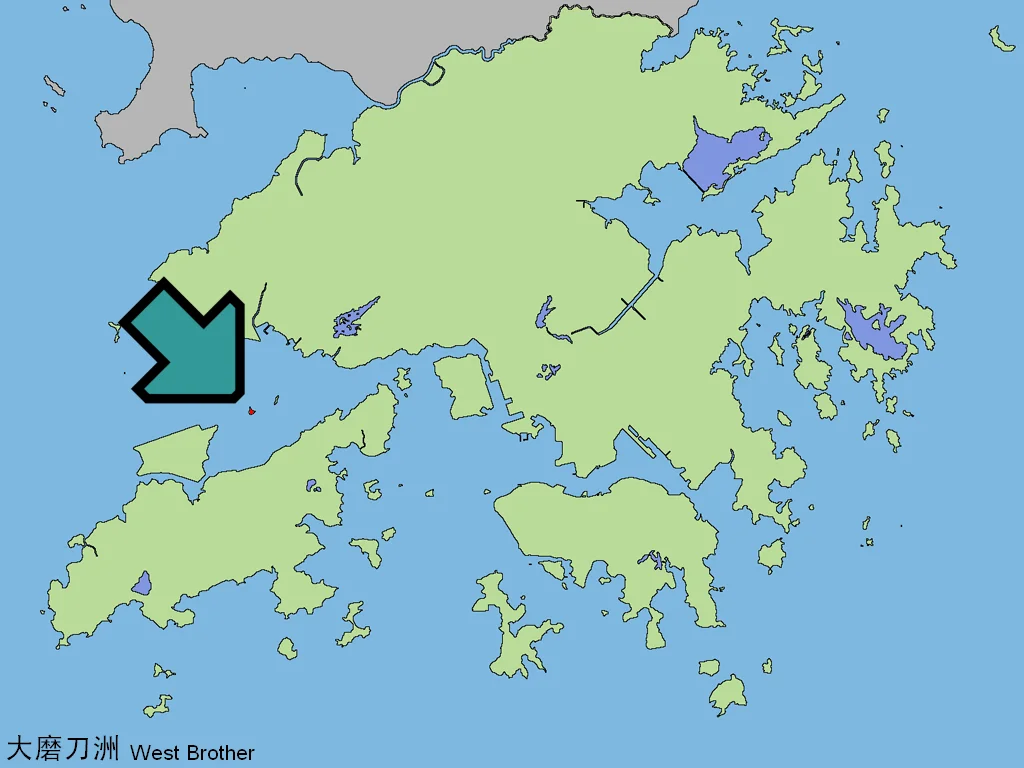

The Brothers Islands, Hong Kong
Two islands were sacrificed to build one airport. The Brothers — Tai Mo To and Siu Mo To, West Brother and East Brother — once rose from the waters north of Lantau Island, modest humps of rock reaching 68 and 63 metres above the Pearl River estuary. They don't anymore. Hong Kong needed flat ground for a new international airport, and these islands stood in the way — literally, in the approach path. So they were leveled, and the stone that made them was used to create the platform on which Hong Kong International Airport now stands. The islands gave themselves to the project, or rather, the project took them.
Islands That Gave Way to the Sky
The Brothers lie midway between Chek Lap Kok — the artificial island on which HKIA was built — and the town of Tuen Mun to the north. West Brother measured 550 by 430 metres; East Brother, narrower and longer, ran 800 by 180 metres. Together they occupied a patch of water that, on paper, sat directly under the paths aircraft would need to follow approaching the new airport from the east.
The decision to level them was not taken lightly, but it was taken. Between 1952 and 1971 the islands had already been partially mined — by 1964, workings on West Brother's graphite mine had reached 90 metres below sea level. When the airport project accelerated in the 1990s, that extracted material went directly into the land reclamation effort that created Chek Lap Kok. The islands were unmade so an airport could be made. It is one of the more dramatic instances of Hong Kong rewriting its own geography.
What the Leveling Left Behind
Flattening two islands and filling a bay does not erase an ecosystem. It displaces one. The waters around the former islands remained, and in the years after the airport opened they became important habitat for Chinese white dolphins — the pale pink Indo-Pacific humpback dolphins that frequent Pearl River Delta waters and are rarely found elsewhere in such numbers.
In December 2016, the Brothers Marine Park was formally designated, wrapping the island remnants and surrounding waters in a protected area. The park's stated aim is to conserve the Chinese white dolphins, their habitat, and the marine and fisheries resources of the area. The brothers that once broke the surface are gone, but the waters they sat in now have official protection. What was leveled above water has become, in some sense, a sanctuary below it.
Navigation Markers in an Unusual Form
From the air, the Brothers' location is still meaningful — marked now not by rock but by infrastructure. East Brother (Siu Mo To) carries a VHF omnidirectional range and distance measuring equipment (VOR/DME) station, a navigational beacon that guides aircraft toward HKIA. The island that was lowered to protect flight paths now hosts the equipment that defines them. Pilots arriving from the northeast use the beacon as a waypoint, tracking the signal down toward one of the world's busiest airports.
Administratively, both islands fall under Tuen Mun District, though they are uninhabited and have been since the mining operations ceased. The surrounding waters, under the jurisdiction of the Marine Park authority, see dolphins more often than people. The Brothers have become, in their flattened form, a threshold — the last landmarks before the runway, the first marine protected area past the airport's shadow.
From the Air
The Brothers islands sit at approximately 22.3311°N, 113.9669°E, midway between Chek Lap Kok and Tuen Mun in the waters north of Lantau Island. Flying into Hong Kong International Airport (VHHH) from the northeast or east, pilots use the VOR/DME station on East Brother (Siu Mo To) as a primary navigational reference. From the cockpit at 3,000–5,000 feet, the flat-topped remnants of the leveled islands are visible in the channel between Lantau and the mainland shore. The airport threshold at VHHH is approximately 8 km to the southwest. The Tuen Mun urban towers are visible to the north.
Nearby Stories
- Chapel of St. Francis Xavier 3.5 km away
- Cuiheng 4.1 km away
- 2015 Shenzhen Landslide 16 km away
- Shunde 31 km away
- Wanshan Archipelago 37 km away
- Nanxiong Formation 96 km away
- Heyuan 149 km away
- Checheng Fu'an Temple 629 km away