
Liuqiu Island
The boat from the mainland takes twenty-five minutes, sometimes fifteen if the sea cooperates. When Liuqiu Island finally appears — a low green shape rising from blue water — it looks almost too small to carry what it does: Taiwan's only inhabited coral island, a seafloor that rivals anything in the country for marine biodiversity, temples to gods of the sea, and a graveyard that covers most of the southern shore. Also known as Xiaoliuqiu, the island covers just 6.8 square kilometers and houses roughly 12,200 people, all of them within easy reach of the water that made this place possible.
Coral Underfoot, Ocean All Around
What distinguishes Liuqiu from every other island off Taiwan's coast is geology. While most of Taiwan's outlying islands are volcanic or sedimentary, Liuqiu is built from accumulated coral reef — limestone shaped by the sea over millennia into caves, arches, and honeycombed tidal shelves. The result above the waterline is a ring of dramatic coastline: Beauty Cave cuts back into the cliffs on the island's northeast, Black Dwarf Cave opens to the west, and Wild Boar Ditch — a steep gully the locals call Shanzhū Gōu — slices down through the rock near the island's northwest corner. Beneath the surface, green sea turtles move through water that local conservation efforts have protected with growing seriousness. The island is 8 nautical miles from the Taiwan mainland. Ferries arrive at Baisha Port on the northern end or Dafu Port on the east coast.
The God-Thick Shore
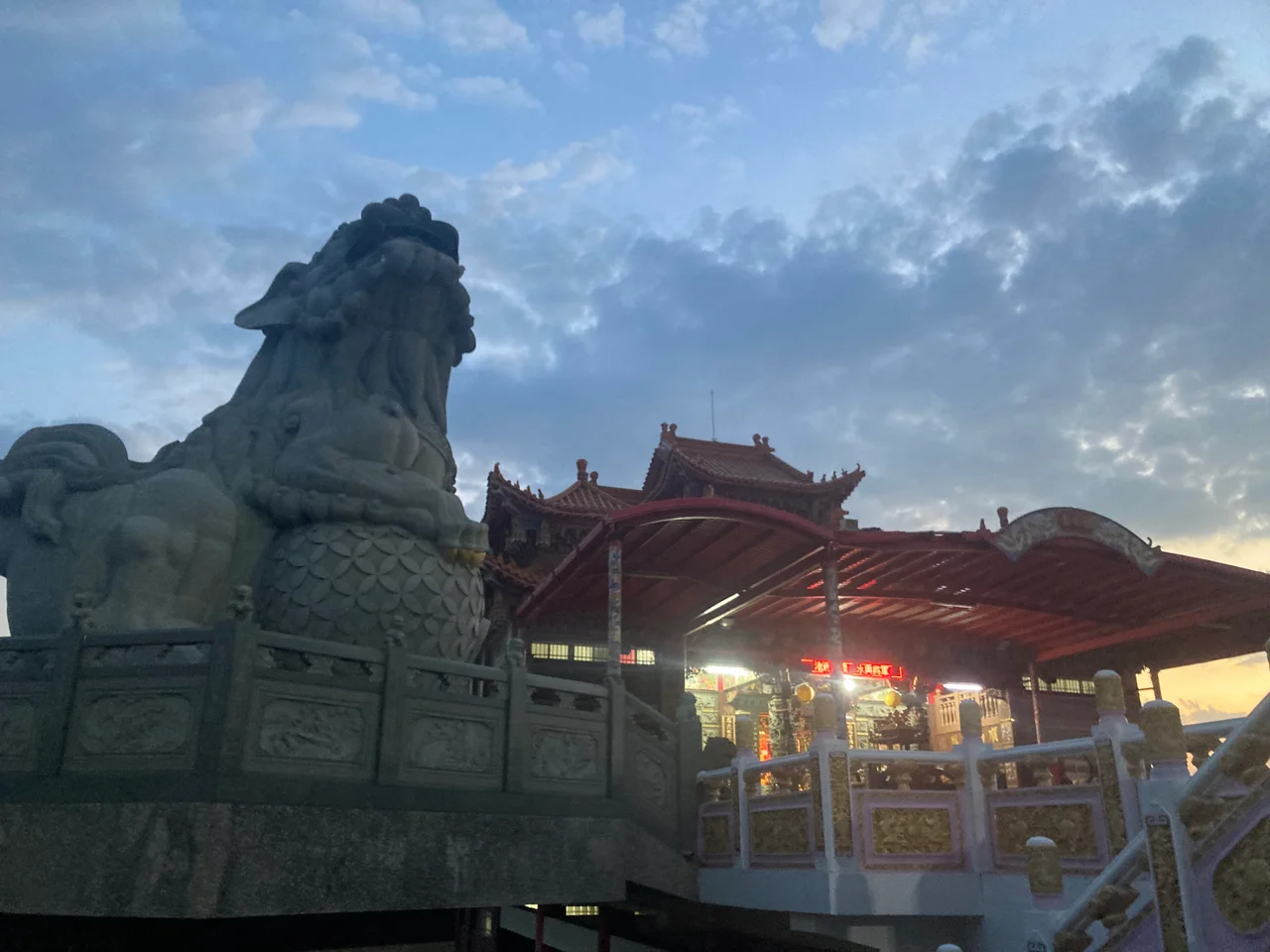
Religion on Liuqiu is not a Sunday affair but a daily one. The island holds as many as 70 temples in a space that could fit inside many city parks — a density of worship that reflects the risks of a fishing community entirely surrounded by water. People pray for new ships before they are launched, for safe passage, for recovery from illness. The Palace of the Three Prosperous Ones, the Sanlong Temple south of Benfu Village, is dedicated to Lord Zhu, Lord Chi, and Lord Wu — figures from the Wang Ye tradition, spirit kings who govern the sea and its moods. During Taiwan's Ghost Festival, the island's ancestral observances expand outward: most undeveloped land on the southern half of the island, outside the tourist areas, is covered with graves. The dead and the living share the small territory in close, deliberate proximity. Christianity arrived with the Dutch centuries ago, and a Presbyterian church still stands on the island today.
Two Problems and One Answer
A 2004 report on the island captured a predicament in two directions: "'Liuchiu has two problems," said one resident, pointing toward Kaohsiung on the horizon, '— all the young people go over there.' Then, pointing south toward the island's graves: 'And all the old people go over there.'" Brain drain was real. The island's five schools — Liuqiu, Baisha, Quande, and Tiannan primary schools, plus Liuqiu Junior High School — provided education only through ninth grade. High school students left for Taiwan Island, and many did not return. That dynamic shifted as tourism grew. The coral coastline, the sea turtles, the temples and the ring road that circles the entire island — these drew visitors from the mainland who once saw no reason to make the boat trip. Tourism brought some of the young people back.
Island Time and the Ring Road
The ring road is both infrastructure and ritual. Travelers follow it counterclockwise or clockwise — it makes no difference — stopping at the Sea View Pavilion beside Beauty Cave, climbing to the Restoration Pavilion on the island's reclaimed eastern landfill, pausing at the Sunset Pavilion on the southwest corner where the Taiwan Strait opens up and the light turns orange over the water. Sanfu Fishing Port on the north side shows the working face of the island: boats that still go out for fish, nets spread to dry, the economic layer beneath the tourist one. Erlong Temple in Haizikou is a regular waypoint along the ring, used by visitors who have learned that walking past a temple without acknowledging it is considered bad form on an island with this many gods.
The Name Behind the Name
The island carries a quiet weight of history in its nomenclature. The tourism department long described the island's former name — Golden Lion Island — as a reference to Vase Rock's supposed resemblance to a lion's head. The actual origin is more sobering: the name honored the crew of the Dutch ship Gouden Leeuw, killed here in the seventeenth century, and the punitive expeditions that followed — particularly the Liuqiu Island Massacre of the 1630s and 1640s — reduced the island's indigenous Malay population to near nothing. The Taiwan Strait has not always been kind to the people who crossed it or lived beside it. Liuqiu Island holds that history in its geology, its graves, and its too-many temples.
From the Air
Liuqiu Island (Xiaoliuqiu) lies at approximately 22.34°N, 120.37°E, about 14 km southwest of the Pingtung coast and 25 km southwest of Donggang. From altitude, it appears as a small oval of green in blue water with no adjacent landmass — unmistakable. Nearest major airport: RCKH (Kaohsiung International), approximately 40 km to the northeast. Recommended viewing altitude: 4,000–6,000 feet to appreciate the island's full outline and the surrounding coral shelf visible in shallow water. The Hengchun Peninsula is visible to the south on clear days.
Nearby Stories
- Zhiben Hot Spring 8.7 km away
- Fo Guang Shan 8.8 km away
- Duoliang Station 11 km away
- Checheng Fu'an Temple 32 km away
- Orchid Island 62 km away
- Dongji Island 68 km away
- South Penghu Marine National Park 96 km away
- Hong Kong 12 548 km away