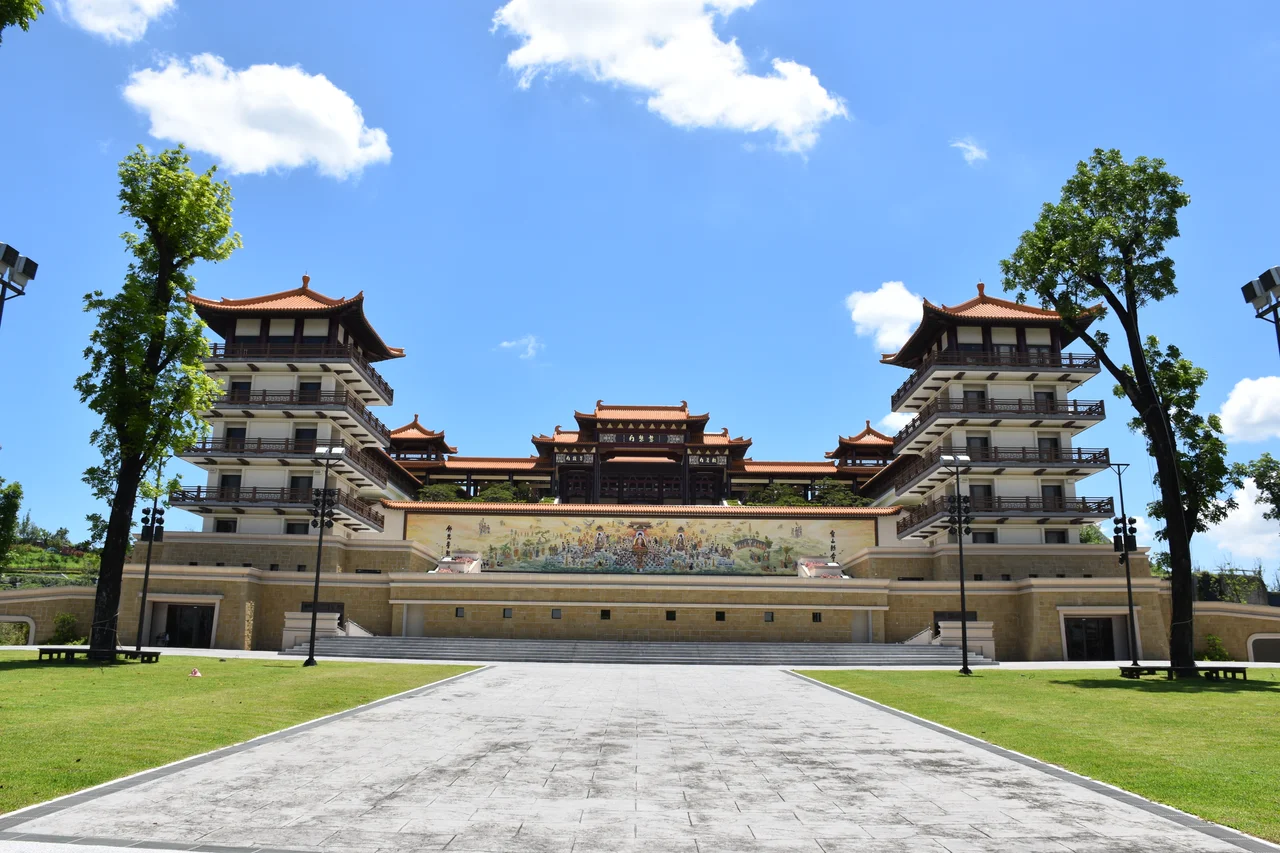

Fo Guang Shan
The temples have Wi-Fi. This might seem like a trivial detail, but it captures something fundamental about Fo Guang Shan, the international Buddhist organization headquartered on a hillside in Kaohsiung, Taiwan. Founded in 1967 by Hsing Yun, a monk who fled mainland China during the civil war, Fo Guang Shan practices what it calls Humanistic Buddhism -- a philosophy rooted in the Linji school of Chan Buddhism that insists the faith must engage with the modern world rather than retreat from it. The order is famous for equipping its temples with the latest technology. It operates universities, television stations, publishing houses, and mobile medical clinics. It has branches in 173 countries and more than 3,500 monastics. When its founder died in February 2023 at age 95, Taiwan's President Tsai Ing-wen and Premier Chen Chien-jen attended the funeral.
A Monk Builds a Mountain
Hsing Yun purchased more than 30 hectares in Dashu Township, then part of rural Kaohsiung County, in 1967. The groundbreaking ceremony was held on May 16 of that year. What followed was decades of relentless construction: shrines, university buildings, retirement homes, rectories, a cemetery. In 1975, the order's iconic 36-meter statue of Amitabha Buddha was consecrated. The Great Hero Hall was completed in 1981. Meanwhile, temples were being established beyond the mother monastery at an accelerating pace, forming a network that would eventually make Fo Guang Shan one of Taiwan's most influential organizations. Over 300 branches now operate throughout Taiwan alone, and the headquarters monastery in Dashu remains the largest Buddhist monastery on the island. When Hsing Yun closed the mountain gate in 1997 to give monastics more contemplative space, the public outcry was so strong that President Chen Shui-bian himself came to request it be reopened.
Humanistic Buddhism in Practice
The organization's reach extends far beyond chanting halls. Fo Guang Shan runs orphanages, homes for the elderly, and drug rehabilitation programs in prisons. Mobile medical clinics serve remote villages. An annual winter relief program distributes warm clothing and food to the needy. Wildlife conservation areas protect living creatures -- a direct expression of Buddhist reverence for all sentient life. The order operates Pu-Men High School in Taipei and several other schools offering secular curricula alongside Buddhist education. Along with Tzu Chi, Fo Guang Shan is one of only two major Buddhist organizations in Taiwan that provides strictly secular education. Dharma programs extend into prisons and factories, onto television and radio, and into large-scale public lectures both in Taiwan and overseas. In mainland China, where religious proselytizing is illegal, the order focuses on cultural exchange to introduce Buddhist ideas without crossing legal boundaries.
A Museum That Plans in Centuries
The Fo Guang Shan Buddha Museum, opened in December 2011 adjacent to the main monastery, is the organization's most visually dramatic achievement. The complex covers more than 100 hectares and is built along a central axial line facing east. Eight Chinese-styled pagodas flank the main avenue leading to the Bodhi Square, where statues of the Buddha's principal disciples and the founders of China's major Buddhist schools line the approach to the Memorial Hall. The Jade Buddha Shrine houses a tooth relic of the Buddha, entrusted to Hsing Yun during a 1998 visit to Bodh Gaya. Behind the Memorial Hall, four stupas symbolize the Four Noble Truths. And behind them rises the Fo Guang Big Buddha: a seated metal Shakyamuni Buddha 108 meters tall, completed in 2011 using 1,800 tons of metal. Beneath the museum lie 48 sealed underground palaces, designed as time capsules to be opened one per century -- an expression of Buddhist faith measured in millennia.
A Global Network Seen from Above
From Hsi Lai Temple in California to Nan Hua Temple in South Africa, from Zu Lai Temple in Brazil to branches in Auckland, Toronto, London, and Manila, Fo Guang Shan has built a physical presence on every inhabited continent. But the spiritual center remains the hillside in Dashu District where it all began. From the air, the monastery and museum complex is one of the largest religious sites visible anywhere in East Asia. The great seated Buddha is distinguishable from miles away. The eight pagodas stand in precise formation along the ceremonial avenue. The monastery buildings cascade down the hillside in terraces, their traditional rooflines softened by the tropical forest that has regrown around them. Below, the Gaoping River winds through the agricultural plains northeast of Kaohsiung. It is a landscape that Hsing Yun saw something in when others saw only remote hillside -- and that millions of visitors now travel to see each year.
From the Air
Located at 22.747N, 120.446E in the Dashu District hills, northeast of Kaohsiung. The 108-meter seated Big Buddha at the adjacent museum is the primary aerial landmark, visible from considerable distance. The monastery complex and museum together cover a vast hillside area. Nearby airports: RCKH (Kaohsiung International Airport, 25 km southwest). Best viewed at 4,000-8,000 ft AGL. The Gaoping River valley and agricultural plains surround the hillside complex.
Nearby Stories
- Huang Family Historical Residence 3.1 km away
- Taivoan Language 9 km away
- Zhiben Hot Spring 12 km away
- Bunun Cultural Museum 26 km away
- Dongji Island 33 km away
- South Penghu Marine National Park 58 km away
- Orchid Island 79 km away
- Hong Kong 12 550 km away