.jpg)
Anping Small Fort
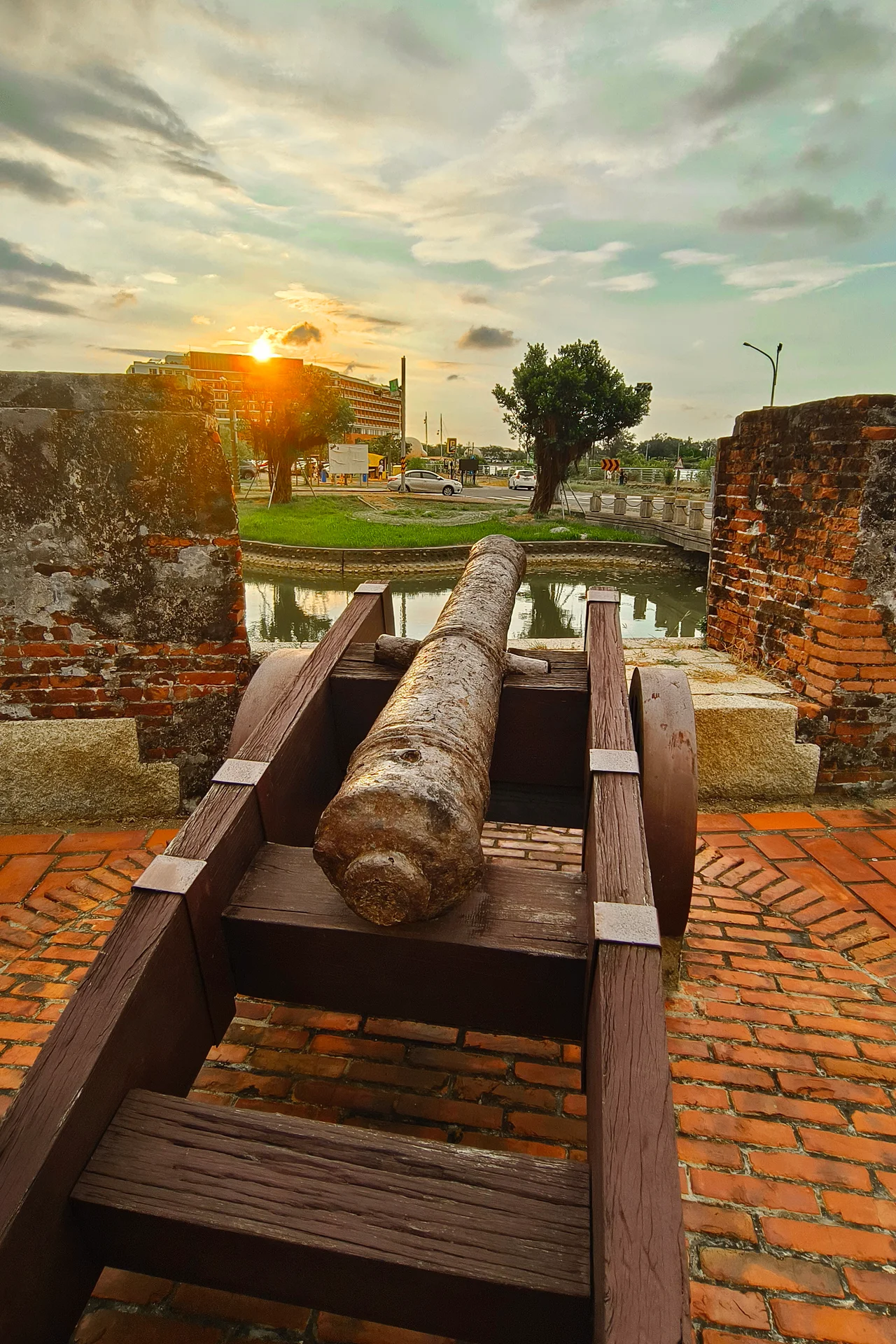
The British had already seized Hong Kong and forced open Chinese ports when Yao Ying, the imperial official responsible for defending Taiwan's southern coast, decided to build something. In 1844, three years after the First Opium War reshuffled power across maritime Asia, Yao ordered the construction of a small fortified battery at Anping — the port district of Tainan, seat of the oldest continuous Chinese settlement on the island. The result was the Anping Small Fort: modest in scale, precise in purpose, and carrying in its walls a compressed history of Taiwan's complicated relationship with foreign power.
A Battery Against Empire
Anping in the 1840s was already an old place by Taiwan's standards. Dutch traders had built Fort Zeelandia here in the seventeenth century; Koxinga had expelled them in 1662 and made Tainan his base for challenging Qing authority. By the time Yao Ying raised the Anping Small Fort, the district had been Chinese-administered for nearly two centuries, but the Opium War had made the limits of that security painfully clear. The British Royal Navy had demonstrated what modern gunboats could do to coastal defenses across the Taiwan Strait. Yao's fort was a direct response: a battery positioned to command the harbor approach, built in what the historical record describes as the latest period of traditional Chinese military architecture. It was not built to stop a determined assault by a major fleet — nothing that small could — but it was a statement of intent, and in the uneasy years after the Nanjing Treaty, that mattered.
Layers Added, Layer by Layer
The fort's story did not end with the Qing. Taiwan changed hands dramatically in 1895, when the Qing ceded the island to Japan following the First Sino-Japanese War, and for the next half-century the Japanese colonial administration reorganized the island's institutions. Then in 1949, another wave of change arrived: the Republic of China Armed Forces, retreating from the mainland after the Chinese Civil War, occupied the fort and added a reinforced concrete bunker to its fabric. This was pragmatic wartime construction, not heritage preservation — Taiwan in 1949 was preparing for a potential invasion, and every defensible position had potential value. The bunker remains, an incongruous layer of mid-twentieth-century military architecture set against the older masonry, making the fort an accidental palimpsest of the island's modern crises.
Renovation and Memory
By 1990, the Anping Small Fort had been designated for preservation and underwent renovation. Tainan, Taiwan's oldest city, has developed a strong awareness of its historical fabric over the decades since — the district around Anping is rich in sites from multiple colonial eras, and the small fort takes its place alongside Fort Zeelandia and the broader network of heritage buildings that make the neighborhood one of the most historically layered in Taiwan. The 1990 renovation stabilized the structure and opened it to visitors, transforming what had been a piece of decommissioned military infrastructure into a publicly accessible monument. The fort is compact enough to take in quickly, but its layered history rewards attention. Standing at the old battery, looking toward the harbor, it is possible to imagine Yao Ying's calculation: what this position could and could not defend against, and why he built here anyway.
Anping Today
The Anping District surrounding the fort is one of Tainan's most visited quarters. Seafood restaurants, shrimp paste vendors, and shops selling the district's famous tofu pudding cluster along streets that still follow their older alignments. Nearby Fort Zeelandia — far larger and more elaborate — draws bigger crowds, but the Small Fort offers something the grander site cannot quite match: the sense of a single moment of historical anxiety frozen in brick and mortar. Yao Ying built it in a hurry, in response to a specific threat, and that urgency is still readable in its compact, functional form. In a district that has been continuously inhabited for nearly four centuries, the Anping Small Fort is just one layer among many — but it is a particularly legible one.
From the Air
The Anping Small Fort sits at approximately 22.9995°N, 120.159°E in Tainan's Anping District, on Taiwan's southwestern coast. The district occupies a low-lying peninsula between the Taiwan Strait and the Taijiang National Park lagoon system, clearly identifiable from the air by the contrast between the open water to the west and the dense urban fabric of central Tainan to the east. The nearest major airport is RCKH (Kaohsiung International Airport), approximately 40 km to the south; RCNN (Tainan Airport) lies approximately 8 km to the northeast. Approaching from the west at 3,000–5,000 feet, the coastline of Anping is visible as a narrow strip of urban development bracketed by water, with the harbor entrance the fort once guarded still discernible in the bay geometry.
Nearby Stories
- Chung Li-ho Museum 0.7 km away
- Jingzaijiao Tile-paved Salt Fields 8 km away
- Wanchin Basilica of the Immaculate Conception 9.3 km away
- Namasia District 16 km away
- Battle of Penghu 21 km away
- Shoushan (Kaohsiung) 21 km away
- Penghu Air Raids 62 km away
- Daya Bay 512 km away