.jpg)
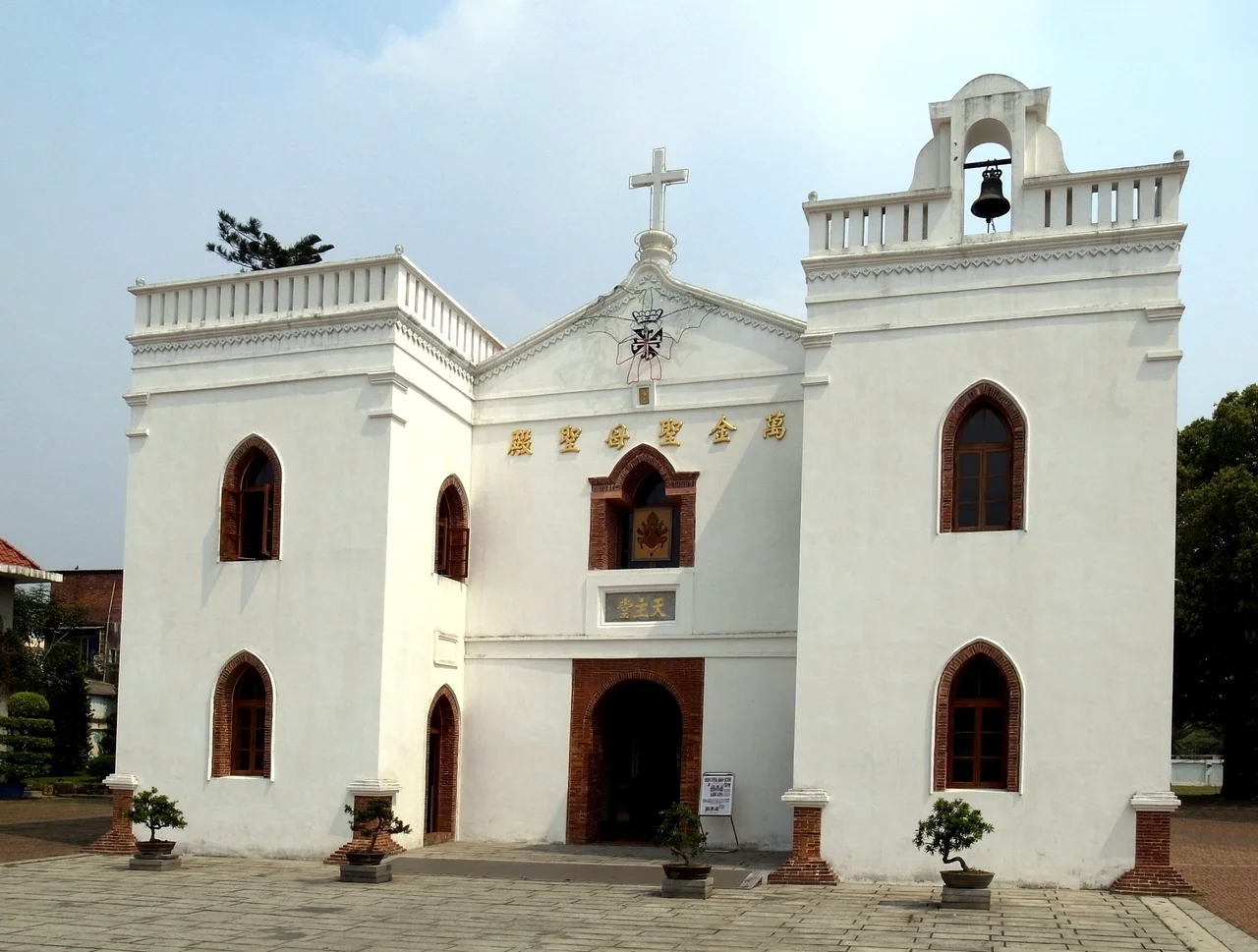
Wanchin Basilica of the Immaculate Conception
The village of Wanchin sits quietly in rural Pingtung County, southeast of Kaohsiung, surrounded by the flat farmland of the Pingtung Plain. Nothing about the landscape announces what stands here — but turn down the right lane and you encounter a church whose story begins in 1863, survives an earthquake two years later, and runs forward through more than 160 years of Taiwanese history to a formal recognition from Rome in 1984. The Basilica of the Immaculate Conception at Wanchin is the oldest Catholic church in continuous use in Taiwan, and in 1984 it became the island's first minor basilica. Its walls hold a story that is at once specifically Dominican, specifically Taiwanese, and specifically about what faith looks like when it is planted in a place far from home and refuses to leave.
A Mud Church in Qing Dynasty Taiwan
Father Fernando Sainz arrived in Taiwan as a Dominican missionary with the straightforward intention of establishing a parish. In May 1863, during the final decades of Qing Dynasty rule, he built the first church at Wanchin — a simple structure made of mud, the most available material on the Pingtung Plain. It was a modest beginning. Two years later, on 13 October 1865, an earthquake struck with enough force to heavily destroy the building. Sainz and the community did not abandon the site. They rebuilt — larger this time — and the new church was completed and inaugurated on 8 December 1870, the feast day of the Immaculate Conception. That date was not coincidental: the dedication of the rebuilt church to the Immaculate Conception on the very day that marks the doctrine would bind the identity of this community to that theological commitment for generations.
Spanish Fortress in Subtropical Taiwan
The church building that visitors see today was constructed with Spanish fortress architecture — a style that reflects the Dominican Order's Iberian roots and the practical concerns of building in a region subject to tropical typhoons, earthquakes, and the various pressures of an island where Catholic missionaries were not always welcomed by every authority. Thick walls, a compact footprint, and structural solidity characterize this approach. Inside and outside, the building carries a distinctly European formal vocabulary that sits in striking contrast to the subtropical landscape of the Pingtung Plain. The grounds extend to include the Dominican Priory of the Immaculate Conception and a visitor center, while nearby convents house Dominican cloistered nuns and missionary sisters. The church and its surrounding community form a small but coherent religious complex — a piece of European Catholic institutional life transplanted into southern Taiwan and maintained continuously for over a century and a half.
The First Basilica in Taiwan
On 20 July 1984, Pope John Paul II issued the Pontifical decree *Qui Sanctos Caelites*, raising the shrine at Wanchin to the status of a Minor Basilica. The decree was signed and notarized by Cardinal Agostino Casaroli, then Vatican Secretary of State. This made Wanchin the first church in Taiwan to receive the title of basilica — a formal recognition from Rome that designates certain churches of particular historical, artistic, or spiritual significance. The following year, in 1985, the Holy Office designated it a national shrine. These formal recognitions carried weight for the Catholic community in Taiwan, a small minority in a society where Buddhism, Taoism, and folk religion are the dominant traditions. In 1991, the Immaculate Conception Dominican Residence was built on the grounds; an activity center followed in 1994, extending the complex's capacity to serve visitors and pilgrims.
A Community That Endures
The church has not been without incident across its long history. In August 2016, a man set fire to a wooden statue of the Blessed Virgin Mary inside the building, an act of vandalism that damaged an object of deep devotion to the community. The statue was part of the church's interior heritage — irreplaceable not because of its monetary value but because of what it had meant to the people who had prayed before it for generations. The community's response was in keeping with the long pattern of this place: repair, continue, endure. The renovations and adaptations that have accumulated over more than 160 years — through the Qing Dynasty, Japanese colonial rule, and the Republic of China era — have each left their mark on the building and the grounds. What remains is a church that has been remade multiple times and is still, recognizably, the place Father Sainz began.
Pilgrimage to the Plain
Wanchin draws Catholic pilgrims from across Taiwan, particularly on major Marian feast days. The village itself is small — a rural community in Pingtung County's agricultural heartland — and the scale of the basilica stands in thought-provoking proportion to its surroundings. This is not a grand cathedral in a capital city. It is a fortress-walled church in a farming village, elevated to the highest formal distinction the Catholic Church bestows on individual churches below the level of cathedral. That contrast is part of what makes Wanchin memorable. The faith that built this place was not urban, institutional, or convenient. It was planted in the soil of the Pingtung Plain by a Dominican friar in 1863, tested almost immediately by an earthquake, rebuilt, maintained through a century and a half of change, and recognized by Rome a hundred and twenty-one years later.
From the Air
The Wanchin Basilica sits at approximately 22.595°N, 120.611°E in rural Pingtung County, about 30 kilometers southeast of RCKH (Kaohsiung International Airport). From the air, the Pingtung Plain spreads south and east of Kaohsiung as a broad agricultural flat bounded by the Central Mountain Range to the east. The basilica's modest scale makes it difficult to distinguish from altitude, but its village setting and the cluster of religious buildings on the grounds are identifiable at lower altitudes. Recommended viewing altitude: 1,500–2,500 feet MSL. The mountain ridgeline of the Central Mountain Range rises dramatically to the east, with peaks exceeding 3,000 meters creating a striking backdrop to the farmland below.
Nearby Stories
- Ten Drum Rende Creative Park 9.9 km away
- Shouka Mountain Pass 12 km away
- Donghe, Taitung 14 km away
- Chung Li-ho Museum 20 km away
- Lüdao Lighthouse 21 km away
- Orchid Island 40 km away
- Barclay Memorial Park 43 km away
- Hong Kong 12 585 km away