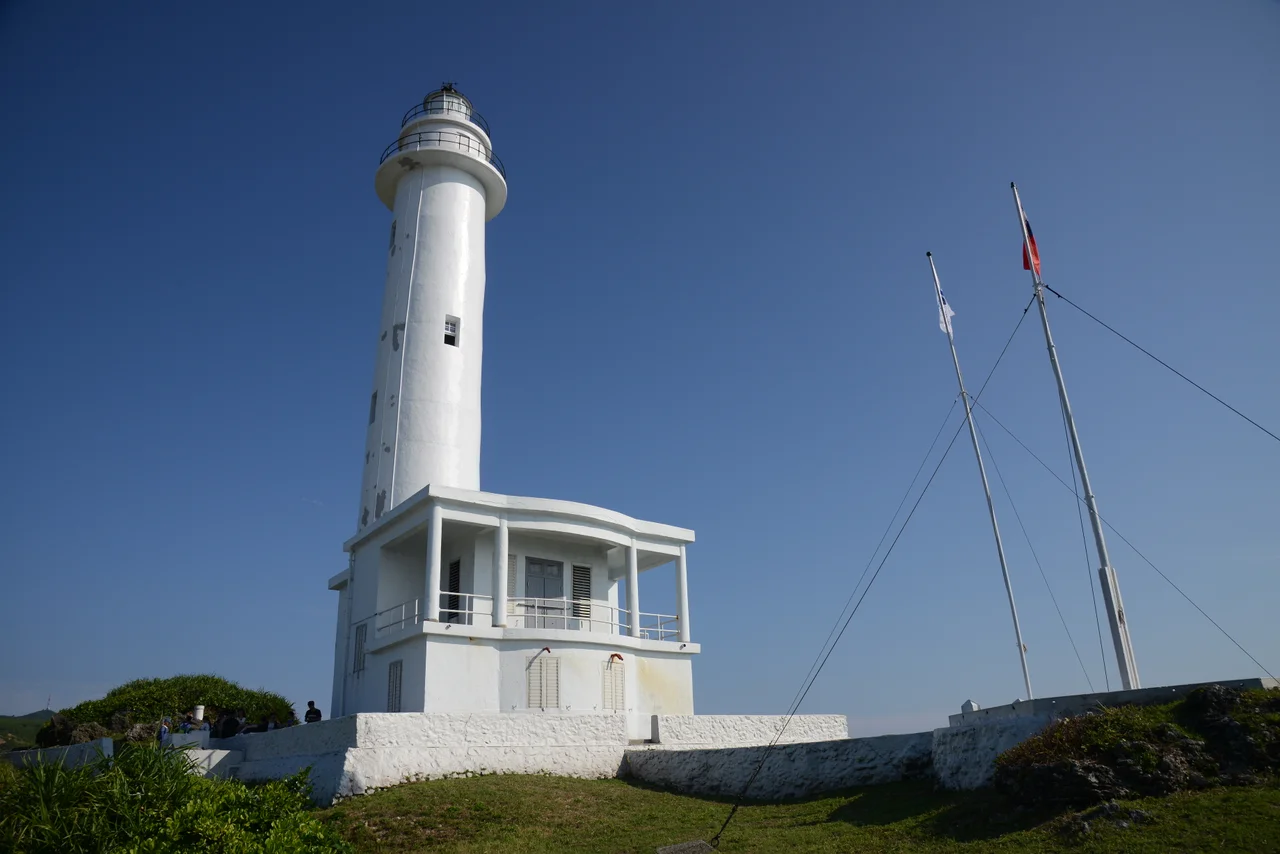

Lüdao Lighthouse
On December 11, 1937, the Dollar Steamship Company luxury liner SS President Hoover was en route from Japan to the Philippines when it struck a reef at Zhongliao Bay on the coast of what was then called Kashotoken — Green Island, Taiwan. All 503 passengers and 330 crew survived. The island's residents pulled them ashore, sheltered them, and kept them safe until other ships arrived to carry them home. As a gesture of gratitude, the American Red Cross funded a lighthouse to mark the island's position and warn future mariners. Designed by a Japanese engineer and built by the islanders themselves, it went into service in 1939. The Lüdao Lighthouse — Green Island Lighthouse — stands today on Cape Bitoujiao as a white 33-meter tower with 150 steps to its top, and with a history that encodes a remarkable sequence: a wreck, a rescue, an act of gratitude, a war, a rebuilding.
The Wreck That Built a Lighthouse
The SS President Hoover was one of the prestige liners of the Dollar Steamship Line, a name that has since faded from memory but was prominent in Pacific Ocean passenger travel during the 1930s. When the ship struck Green Island's reef in December 1937, the situation could easily have become catastrophic — more than 800 people aboard, far from any major port, on an island with limited infrastructure. It did not become catastrophic because of the people who lived there. The islanders mounted a rescue operation that brought every passenger and crew member safely to land.
Two years later, the lighthouse the Red Cross funded in their honor began guiding ships away from the same reef. Designed by a Japanese architect — Green Island was under Japanese colonial administration at the time — and built with local labor, the white tower was a collaboration of sorts across national lines: American money, Japanese design, Taiwanese hands.
War and Rebuilding
The lighthouse survived the late 1930s but not the 1940s. American air strikes during World War II destroyed it — a grim irony, given that American generosity had paid for its construction. After the war, with the Republic of China government now administering Taiwan, the lighthouse was rebuilt in 1948. The rebuilt tower preserved the essential form: white, cylindrical, 33 meters tall with 150 interior steps spiraling to the lamp room above.
For decades after its rebuilding, the lighthouse remained a working navigational aid but was not accessible to visitors. That changed in September 2013, when it opened to the public. It has since been designated a historical building in Taitung County, recognition that its origins and its survival make it something more than functional infrastructure.
Cape Bitoujiao: Watching the Pacific
Cape Bitoujiao — the headland where the lighthouse stands — juts from the northwestern portion of Green Island into open Pacific water. The position is strategically logical: a light here is visible to ships approaching from multiple directions, and the cape's prominence means it reads clearly against the island's silhouette from the sea.
From the lighthouse platform, the view takes in a sweep of Pacific horizon, the island's volcanic ridges, and on clear days the Taiwanese coast to the west and the vast empty ocean to the east. The 150-step climb is worth the effort. Green Island has a layered character — volcanic island, fishing community, and also the location of a political prison used during the White Terror period after 1949, where thousands of political prisoners were held by the Republic of China government. That history marks the island with gravity alongside its natural beauty. The lighthouse predates that period, funded by a rescue and standing as a marker of something simpler: one community's willingness to help strangers, and the gratitude that followed.
From the Air
The Lüdao Lighthouse stands at approximately 22.677°N, 121.466°E on Cape Bitoujiao, at the southern end of Green Island (Lyudao). Access by air is via Lyudao Airport (RCGI), a short runway on the island's northern tip, served by small aircraft from Taitung Airport (RCFN) approximately 33 km to the west. On the approach to RCGI, the lighthouse is visible at the island's southern headland — a white spire against the green volcanic slopes and blue Pacific. The island's compact size makes a full circuit by scooter feasible in under an hour; the lighthouse is typically the southernmost point on that route. Recommended viewing altitude for the island: 2,000–3,500 feet on a clockwise coastal circuit.
Nearby Stories
- Sanxiantai 12 km away
- Kucapungane 20 km away
- Baolai Spring Park 26 km away
- Shouka Mountain Pass 30 km away
- Orchid Island 51 km away
- Twin Forts of Romblon 1104 km away
- Sibuyan Island 1152 km away
- Sinking of MV Sewol 1303 km away