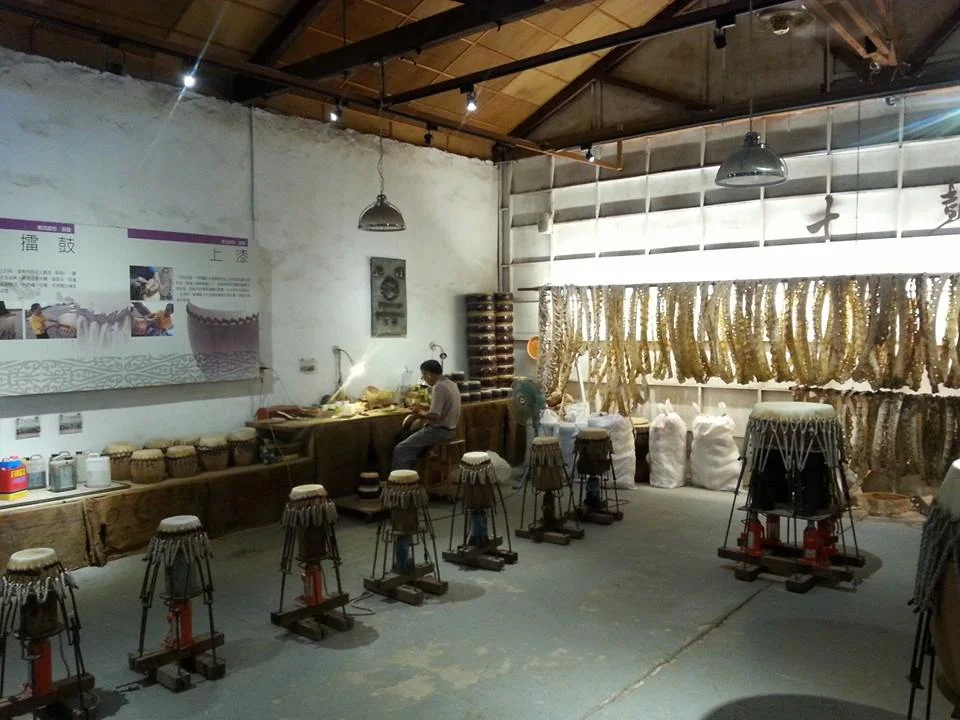

Ten Drum Rende Creative Park
The Rende Sugar Factory ran for nearly a century on sugarcane and steam. Built in 1909 during the Japanese colonial era and operated by the Taiwan Sugar Corporation through most of the twentieth century, it shut down on July 1, 2003, when production consolidated elsewhere. The machinery stopped. The molasses storage tanks went cold. The industrial buildings that had defined this corner of the Rende District fell silent — and sat that way until a percussion troupe came looking for a place to practice without neighbors to disturb.
A Century of Sugar
The refinery that became Ten Drum Rende Creative Park was established in 1909, part of the Japanese colonial administration's systematic development of Taiwan's agricultural economy. Sugar was one of the island's most important export crops during this period, and factories like this one processed it at scale: cane in, refined sugar out, the cycle repeating season after season across decades.
After World War II, ownership transferred to the Taiwan Sugar Corporation, a state enterprise that managed the many mills the Japanese had left behind. For a time the industry continued, but rising land prices, changing economies, and shifting agricultural priorities worked against the smaller and older facilities. Some mills were demolished so the land could be sold and redeveloped. Others, like the Rende factory, outlasted that pressure — or were simply too far from the urban core to attract immediate interest. The factory ran until the day it didn't, then went still.
Ruins with Good Acoustics
Ten Drum Art Percussion Group is a Tainan-based troupe known for performances that combine traditional Taiwanese and Japanese drumming with theatrical staging. By the mid-2000s, they needed space — not ordinary space, but room enough for rehearsals that generate the kind of sound that clears out nearby buildings. The abandoned sugar factory offered exactly that. It sat in the middle of nowhere, well away from any neighborhood that would object, with industrial structures large enough to hold a full ensemble.
The group signed a lease and moved in during December 2005. They did not tear down what they found. Rusty machinery stayed in place. The molasses storage tanks remained. Pipelines ran where they always had. Instead of erasing the factory's history, the troupe worked around it and eventually through it — turning the industrial ruins into the backdrop and structure of their new home.
The Park Opens
Ten Drum Rende Creative Park opened to the public on January 1, 2007. What visitors found was unlike most cultural parks: not a restored building presenting a cleaned-up version of the past, but a working performance venue embedded in authentic industrial ruins. The drumming happens against the same corroded metal and worn concrete that the factory workers once moved through. The juxtaposition is the point.
A Drum Museum on the grounds showcases percussion instruments from across East Asia, tracing the cultural spread and variation of drum traditions through the region. Performances run regularly, ranging from the troupe's full theatrical shows to smaller demonstrations. The factory buildings frame each performance differently — a space designed for sugar processing turns out to have its own kind of drama.
What Saved It
The story of the Rende factory is the story of a close call. After World War II, many of Taiwan's colonial-era sugar mills were demolished outright. The land was valuable; the buildings were old; the industry had moved on. The Rende factory survived partly by accident — its location in the Rende District, away from Tainan's denser urban center, made it less immediately attractive to developers. That marginal geography, which might have doomed it to slow decay, instead gave it time.
What ultimately preserved it was not a government designation but a percussion group willing to bet that an old sugar factory could become a stage. The bet paid off. Today the molasses tanks and rusted machinery that outlasted the industry serve as the scenery for performances that have nothing to do with sugar — except that without the sugar, none of it would exist. The drums fill rooms that once roared with a different kind of production. Both sounds belong to the same place.
From the Air
Ten Drum Rende Creative Park is located at approximately 22.940°N, 120.230°E in the Rende District of Tainan, southeast of the city center. From the air at 2,000–3,000 feet, the complex is identifiable as a cluster of industrial-era factory buildings in an otherwise low-density agricultural and suburban area. The nearest major airport is RCKH (Kaohsiung International), approximately 20 km to the southwest — the closest of the five Tainan-area articles. RCNN (Tainan Airport) is approximately 10 km to the northwest.
Nearby Stories
- Chung Li-ho Museum 0.7 km away
- Jingzaijiao Tile-paved Salt Fields 8 km away
- Wanchin Basilica of the Immaculate Conception 9.3 km away
- Namasia District 16 km away
- Battle of Penghu 21 km away
- Shoushan (Kaohsiung) 21 km away
- Penghu Air Raids 62 km away
- Daya Bay 512 km away