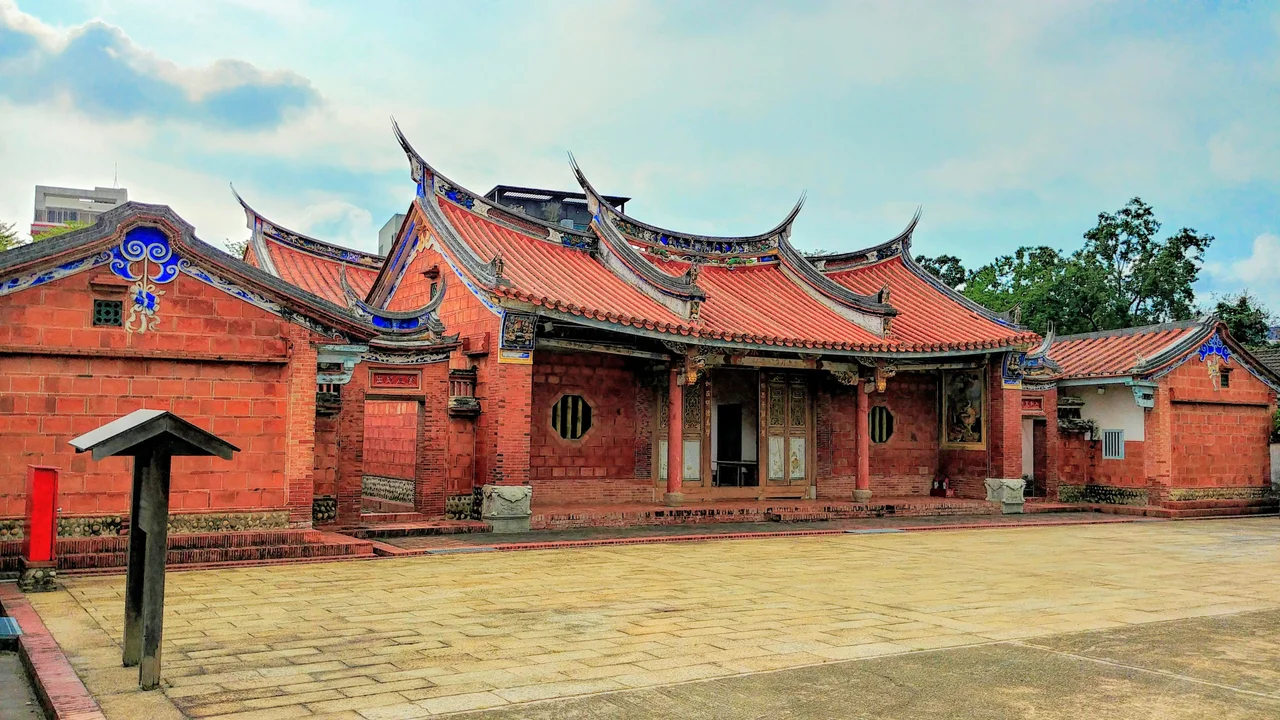

Daodong Tutorial Academy
In 1857, when the Qing dynasty still administered Taiwan as a remote frontier prefecture, a group of local scholars and community leaders in what is now Hemei Township decided to build a place for serious study. They named it the Daodong Tutorial Academy — "Daodong" evoking the eastern transmission of Confucian learning — and they built it to last. More than 165 years later, it still stands. The pillars have been replaced, the façade restored, but the arrangement of halls and courtyards survives largely as the founders intended: a quiet argument, made in timber and tile, for the enduring value of education.
An Academy on the Frontier
The Daodong Tutorial Academy belongs to a tradition of shu yuan — classical academies — that spread across the Chinese-speaking world as regional elites sought to cultivate talent for the imperial examination system. In nineteenth-century Taiwan, still lightly settled by mainland migrants and governed loosely from Fujian, such academies carried outsized importance. They were the primary institutions through which local society connected itself to the broader Confucian intellectual world. Founding an academy was an act of community ambition as much as educational necessity — a signal that a settlement had matured enough to support scholarship. Hemei's elite, in establishing the Daodong Academy in 1857, were staking that claim. The timing was notable: Taiwan would not become a separate province of the Qing empire for another three decades, yet communities like this were already investing in the infrastructure of civilized life.
What the Walls Enshrine
The academy's spatial organization is intentional in every detail. The central hall — the building's heart — enshrines Zhu Xi, the great Song-dynasty Neo-Confucian philosopher known reverentially as Chu Wen-kung, whose commentaries on the classical texts shaped the examination curriculum across East Asia for centuries. Alongside Zhu Xi, the hall also honors Kuei Hsing, the deity of scholarly success, whose image was invoked by candidates seeking success in the imperial examinations. The east wing holds the memorial tablets of those who contributed to the academy's renovations — a permanent record of communal generosity written in stone and wood. The west wing is dedicated to the God of the Land, Tu Di Gong, grounding the scholarly enterprise in local spiritual protection. Outside, the garden preserves original wooden logs used in the academy's construction: raw material made monument.
Timber, Tile, and Restoration
The architecture of the Daodong Academy follows the courtyard-and-hall arrangement typical of southern Fujianese building traditions — the same traditions that Taiwanese settlers carried across the strait and adapted to local materials and conditions. The layout creates interlocking spaces: formal halls for ceremony and worship, subsidiary wings for auxiliary functions, a garden that provides relief from the enclosing walls. Restoration work in recent years replaced deteriorated pillars and columns and returned the façade to its historical appearance. These interventions required careful documentation and craftsmanship, since traditional joinery and tile-work of the kind used in Qing-period Taiwanese construction involve techniques that have largely passed out of everyday use. The academy is now recognized as a national monument — an acknowledgment that what survives here is not merely old, but irreplaceable.
Inheritance of Thought
The Confucian academy as an institution largely disappeared from everyday life after Taiwan's Japanese-era reforms replaced the traditional curriculum with a modern school system. The Daodong Academy was no longer training candidates for imperial examinations well before the last such examination was held. But the building outlasted its original purpose, as significant architecture often does. It became a cultural landmark, then a protected monument, and now a destination for those interested in the religious, educational, and civic life of nineteenth-century Taiwan. Walking through its courtyards today, you encounter all three of those dimensions at once: the scholarly aspiration encoded in the central hall, the communal memory preserved in the east wing's tablets, and the spiritual rootedness expressed in the west wing's altar. The Daodong Tutorial Academy is a small building by any measure. What it contains is not.
From the Air
The Daodong Tutorial Academy sits at approximately 24.11°N, 120.49°E in Hemei Township, in the northern reaches of Changhua County. From the air, Hemei is a modest township on the flat coastal plain west of central Taiwan's mountain foothills. Taichung International Airport (RCMQ) lies roughly 20 km to the southeast. A low-altitude pass of 1,500–2,500 feet over the township affords views of the agricultural landscape characteristic of northern Changhua, with the Taiwan Strait coastline visible to the west on clear days. The Taiwan High Speed Rail corridor and the older Western Line railway both run north-south through this part of the county.
Nearby Stories
- Formosan Aboriginal Culture Village 4.4 km away
- Xiluo Bridge 12 km away
- 1916–1917 Nantou Earthquakes 20 km away
- Former Residence of Chang Hsueh-liang (Hsinchu County) 23 km away
- Tongxiao Shrine 28 km away
- China Airlines Flight 611 29 km away
- Mudouyu Lighthouse 32 km away
- Battle of Xiapi 1117 km away